thiRD EDITION JULY 2025
MICHAEL VENN
digitised by Henry Venn
Contents
- Forward
- PART ONE: Getting Established (1838 – 1850)
- PART TWO: Later Arrivals – The Wigzells And Richardsons
- PART THREE: The Colonial Born Children And Grandchildren Of Robert And Ann Venn
- Synopsis
- Andrew and Sarah Venn
- The Children Of Andrew And Sarah Venn
- Bob And Gert’s Story
- Migration To Melbourne
- Appendix 1
- Appendix 2
- Appendix 3
- Appendix 4
- Footnotes
FORWARD
During the writing of my parents’ biography,[1] I became aware of a mass of information about my father’s forebears, who arrived in South Australia in 1838, when the colony was not yet two years old. These were Robert (Bob) Venn, and a few weeks later Andrew and Margaret Harriott with their two little children and manservant. These pioneers were brave, colourful and sometimes desperate characters, living during a time very different to our own. Yet their story is so interwoven with the early history of Australia, and so close to home, its telling has been a labour of love. I have focused on Bob and Andrew as there is enough evidence about their lives to build a story. But newspapers and other references about their colonial born children are scarce.This is not a genealogy. Researchers have discovered Venn ancestors as far back as the Eighteenth Century, but to know only dates and places for births, marriages and deaths does not tell us much. Furthermore, to explore just one surname is a bit meaningless. Andrew Harriott is my great-great-great grandfather, but he is only one of my 32 ancestors of that generation. My grandchildren can add another 96 to that total!
I have endeavoured to keep true to the known facts while suggesting reasons for some of the decisions and circumstances that shaped their lives. I alert the reader to these ponderings with words like ‘possibly’ or ‘probably’ or ‘likely’. I have drawn on earlier research by Walter Venn and Dal Burton. They were researching before the National Library of Australia digitised Australian newspapers, which can now be freely accessed on the Internet site ‘Trove’. I have been able to correct and expand some of their work, but I am indebted to them. In addition, some genealogical facts and photographs have been found on MyHeritage and Ancestry. Others may dig deeper into official sources, notably probate records, the archives of Holy Trinity, North Terrace (the Venn’s church), and West Terrace Cemetery documents.
The facts of this story are sensational enough, yet the thirst for romance has led some people to speculate that one of our forebears was a smuggler! My family certainly held mysterious secrets and experienced a very public bankruptcy, along with triumphs, hilarity and tragedy aplenty, but great care needs be taken when writing about those who are unable to speak for themselves. As a historian I am simultaneously the prosecutor, defence lawyer, jury, judge and executioner of my subjects, so they are entitled to the same grace that would be extended them in a court, but more so they are entitled to mercy. What would I have done in their shoes?
As I write this, it is fashionable in some circles to criticise the colonists who built Australia. Disparaged as ‘settlers’, their achievements are overlooked, their courage ignored, their kindness to the poor and the aboriginees mocked. But Australia is a nation of immigrants. If it were not the British, this continent would have been colonised by the French, whose ships were present when the First Fleet arrived in 1788. The Industrial Revolution triggered unstoppable population movements which continue to this day, with people arriving from many nations.
The past is like a foreign country, with different customs and use of language. To travel there one must try to jettison much of our current values, and endeavour to empathise with their values. Remember too, that our forebears would be horrified at some of the attitudes and practices our society accepts! So you descendants of this pioneering family, as you enter this time machine you have every reason to celebrate your heritage.
Nevertheless, no matter how much we learn of another’s life story, we can only know a part; a very small part in the case of our ancestors. But to paraphrase St. Paul, now we see through a glass, darkly; now we know in part; but then shall we shall know even as we are known.[2] In another place the full book of our lives is already written.[3] With this in mind I offer this story with the hope that the readers will enjoy their heritage and be very thankful to those who brought us to this Great South Land.
© Michael Venn
Surrey Hills
March 2025
PART ONE
GETTING ESTABLISHED 1838 – 1850
SYNOPSIS
Bob Venn’s childhood in London and coming to Sydney as a sailor. His move to Port Adelaide in 1838 and establishment as a butcher and Ships Chandler. His extensive family, loss of his first wife Kate at 29 and marriage to 20 year old Ann, the daughter of Andrew Harriott, who also landed at Port Adelaide in 1838. Andrew’s establishment as a very wealthy farmer, squatter and hotelier. He and his wife Margaret’s secret. Their migration from Edinburgh, and initial settlement in Sydney where they managed a hotel. The birth of two children in Sydney who died as infants. Disease and the increasing number of convicts prompt their move South Australia. Andrew’s purchase of a hotel in Currie Street, Adelaide and naming it the Edinburgh Castle.
Bob’s butchering business prospers, supplemented by coastal trading. His fleet of small sailing vessels. His fortune and disastrous purchase of a ship its Captain had no right to sell. The subsequent sailing of this ship to London where it was impounded. The Admiralty Court’s ruling it was stolen and Bob’s bankruptcy. His short jail term as an insolvent and desperate attempts to recover as a restauranteur. His hilarious but failed run for Parliament. His licence of his father-in-law Andrew’s Edinburgh Castle hotel, the Venn’s home for many years. Bob’s eventual re-establishment as a butcher and death at 53 years.
THE OLD COUNTRY
Venn is an old English surname, chiefly from Devon and Cornwall. It occurs in the names of approximately 33 places in Devon, and is the southern form of ‘fen’ or ‘fenn’, meaning fen or marsh.[4] The most famous Venn’s were a family of churchmen, of whom Henry and John were leaders in the great Evangelical revival of the 18th Century. John’s grandson (also John) was a mathematician (Venn diagrams), but we are not connected with this family. Our story starts in the chaotic days of the early Industrial Revolution, when our forebears had already been drawn into the crowded metropolis of London. Walter Venn, author of a book about Robert Charles Venn titled ‘Of Many Things’, has discovered seven other Venn clans in Australia. This is the story of the family sired by our pioneering forebears, Robert (Bob) Venn, his wife Ann, and in-laws Andrew and Margaret Harriott.
Birth and Migration
Bob was the third child of John Venn, who was born on 28th October 1786 in Exeter, Devon. Bob’s grandfather, also named John, his great-grandfather John and great-great-grandfather Henry were all from Devon.[5] But by the time Bob’s father married in 1809, he had moved to Bermondsey on the south side of the Thames, about 500 yards from the river in the heart of London’s docklands. He was just one of thousands seeking work and opportunity in the big cities during the Industrial Revolution. This was just two years after the abolition of the slave trade in Great Britain. John’s unrelated namesake Rev. John Venn, the Minister at nearby Clapham, was a leading evangelical and had campaigned with William Wilberforce to outlaw slavery.
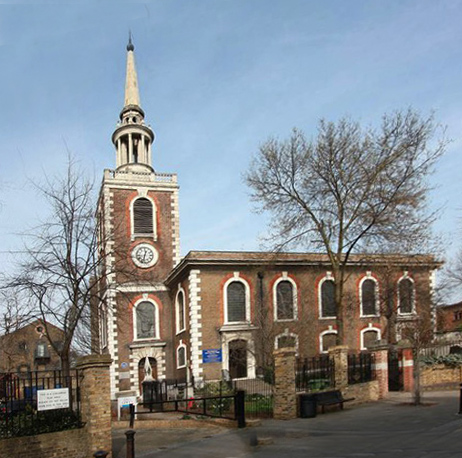
On 9th December 1809 John married sixteen-year-old Elizabeth Winter.[6] She had been born in the Gloucestershire village of Dymock, about 100 miles west of London, and had moved to the city with her family.[7] John and Elizabeth lived in nearby Rotherhithe, beside the Thames. They had six children over 24 years, Robert Charles (Bob) being their third, born on 2th June 1816.[8] He was their second boy, and there were four daughters. Bob was 19 years old when the last was born. By then the family had moved further downstream to Deptford, but most had been baptised at St. Mary’s Rotherhithe. [9]
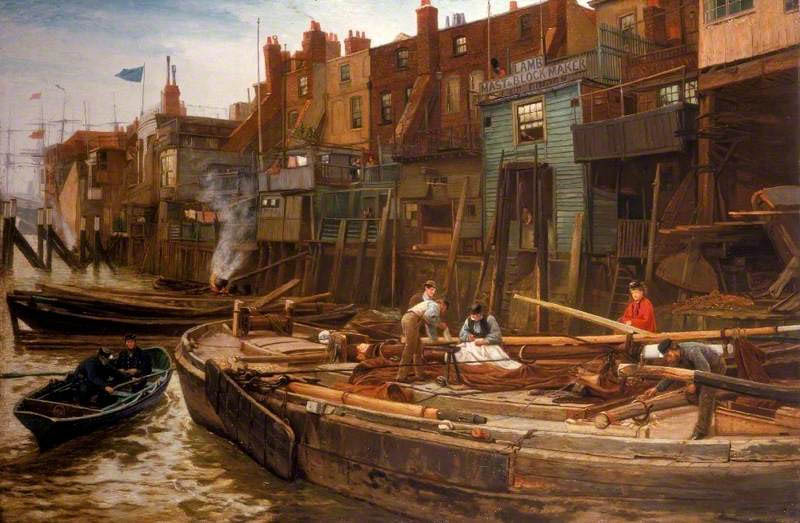
Rotherhithe at the time it was on the edge of London, then one of the largest ports in the world. It was very industrial, overcrowded, working class and unhealthy: by 1820 London’s population had exploded to 1,226,000. This was an increase of over 30 percent in twenty years! By the time Bob left in the early 1830’s London’s population was about 1,500,000 and still growing fast.[10] This growth was enabled by the new boat canals, which efficiently carried goods all the way from the industrialised Midlands by waterway. The first was opened to London in 1790, then several others were opened over the next few decades. They brough much needed foodstuffs, coal and coke, sand, road-building materials, bricks and slates, iron, lime, timber, stone, chalk, salt, ice, etc.[11] The railway did not enter the city until 1838.[12]
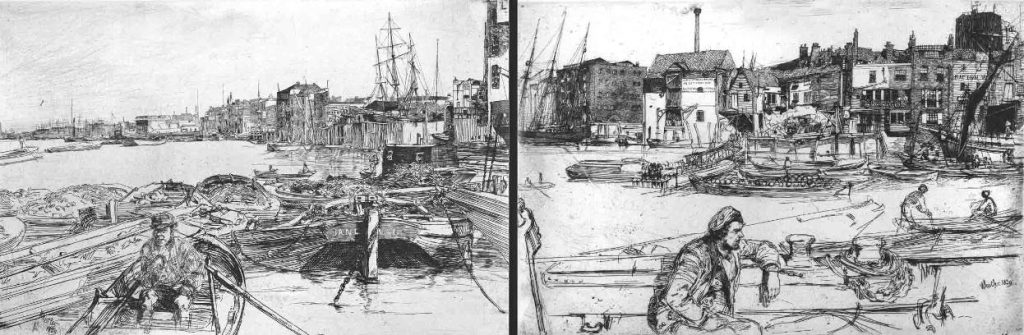
But London was a very compact and overcrowded city. There was no public transport until a horse drawn omnibus service was introduced in 1829: people just walked everywhere. Much of the work on the docks and in associated industries was casual and poverty was widespread. Bob would have been familiar with ships from boyhood, probably hearing stories from sailors who had braved the Roaring Forties taking convicts and settlers out to Botany Bay, and who had survived mountainous seas and icebergs off Cape Horn on their way home with cargoes of fine merino wool.
It was from the Angel Hotel on the banks of the Thames at Rotherhithe that Captain Cook planned his voyage to the South Seas in 1768.
When Robert was five years old, his first cousin Tom Winter won the heavyweight boxing championship of England. He had changed his name from Winter to Spring, and held the title for the next three years. Boxing was bare-knuckle, and hugely popular, with some fights attracting crowds of over 30,000 spectators; all before public transport had been developed.[15]
Young Robert was delighted to have such a famous cousin and no doubt boasted about him to his school mates and continued to do so all his life. He must have been educated, as later in life he wrote to newspapers and ran a successful business. St. Mary’s church ran a ‘Free School’ in an adjoining property, and it is likely he was one of their students. If so, his father probably had a trade.
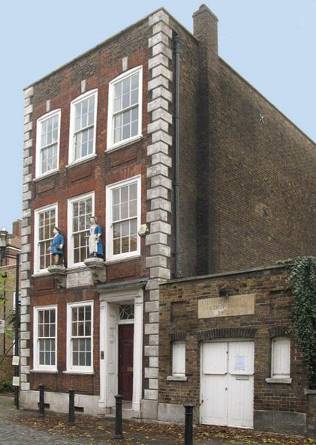
His uncle was a successful butcher in the West Country, and so was his cousin Tom before he became a professional boxer. It seems likely young Robert knew about butchering before he left home, as it later became his business. But the sea cast its spell over him, and offered an escape from the limited opportunity of his industrial neighbourhood.
What prompted Bob to leave? Perhaps it was the cholera epidemic which swept the world in the early 1830’s. It struck London in 1831, claiming over 6,500 lives.[16] Its cause was unknown and there was no known cure. But the ships that brought the disease to Britain also offered a way of escape, and the sparsely settled new colony of New South Wales on the other side of the world offered safety and also opportunity.
In those days it was normal for boys to start work in their early Teens, and Bob went to sea and learned to be a seaman. We can only imagine the wrench this must have been for his parents. Sailors led a dangerous life in the days of sail, so Bob’s family must have wondered if they would ever see him again. He may well have sailed for Australia as early as 1832 or 1833, some years before Queen Victoria ascended the throne.[17] He said he ‘sailed some years out of Sydney, New South Wales, and round this continent before it was colonised’,[18] and to have ‘sailed round the colony [South Australia] before it was settled upon’.[19] The colony of South Australia was proclaimed on 28th December 1836, so Bob must have seen it somewhat earlier.
Young Bob left his parents, both his paternal and maternal grandparents, a brother and two sisters in England. A third sister was born about the time he left, and another sister was born after he reached Australia. Of these, he was never to see his grandparents again, or his father, his brother and three of his four sisters. This was typical of migrants in the nineteenth and the early part of the twentieth centuries. Their only connection was an occasional letter, but the mail was very slow.
Voyages from England to Australia of 115 days, more or less, were normal in the days of sail.[20] Bob was friends with Captain Alexander Jamieson, who made numerous voyages to Australia, and may may well have arrived on these shores as a sixteen year old in 1932 and then ‘sailed some years out of Sydney’.[21] It was not unusual for boys as young as 13 years to be apprenticed on ships.
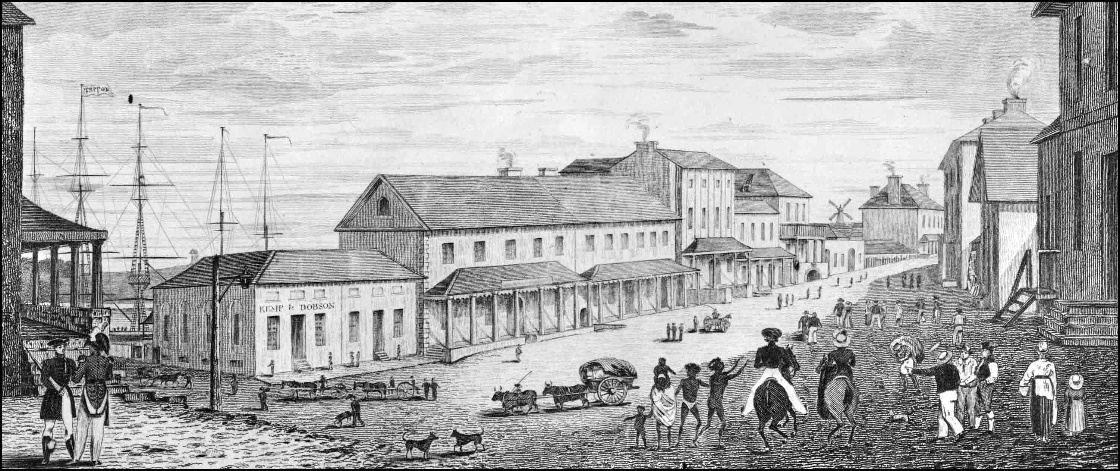
Sydney was just a small town of about 17-18,000 people in 1833-34,[23] when Bob Venn and Andrew Harriott first stepped ashore. That’s about the size of Horsham or Murray Bridge in 2021.[24] Despite its small size, it too, like London, was overcrowded and unhygienic, and convicts were arriving in large numbers. But as a young seaman, Bob likely met Andrew Harriott, who managed an Inn at the port and was later to become his father-in-law. It is interesting that Bob, Andrew Harriott and Captain Jamieson all decided to settle in Adelaide in late 1838. But we can only speculate on a possible connection.
What prompted Bob and Andrew to leave Sydney for Adelaide? Perhaps they were getting fed up with the huge numbers of convicts being dumped in Sydney during the 1830’s: 7,000 in 1833 alone.[25] Every ship brought disease which spread in the unhygienic city environment, and we will see the devastating impact this had on Andrew and Margaret Harriott. Melbourne had been illegally settled in 1835, but was still part of New South Wales which was a convict colony. Adelaide on the other hand was established by the South Australian Land Company under the leadership of George Fife Angas. He went to extraordinary lengths to ensure the new colony would not only be convict free, but would foster economic prosperity, and guarantee both religious and civil liberty.[26]
Bob said that he ‘arrived in South Australia Aug. 16, 1838’.[27] This is a strong clue that he was aboardthe Brig Lady Wellington. This small 142-ton Brig plied regularly between Sydney, Hobart, Launceston and Adelaide: she was one of the new colony’s supply ships. She could make the Sydney to Port Adelaide run in 17 days in good weather[28] but not this time!
Captain Devlin rode out bad weather in Sydney Harbor for two days before leaving the Heads, but then had to shelter a day at Jervis Bay. Conditions improved a little so he sailed on, but soon sheltered in the lee of Perseverance Island, where he anchored for ten days! Braving Bass Strait, he made it to Stanley on the northeast tip of Tasmania. Conversant with the dangers of Bass Strait which had already claimed ships, he took no chances. A few years later the Barque Cataraqui was wrecked on the west coast of King Island, with only nine of its 423 complement saved.[29] So Devlin spent a few days at Stanley before completing the voyage at Port Adelaide on 11th August.[30] A horror trip of 48 days!
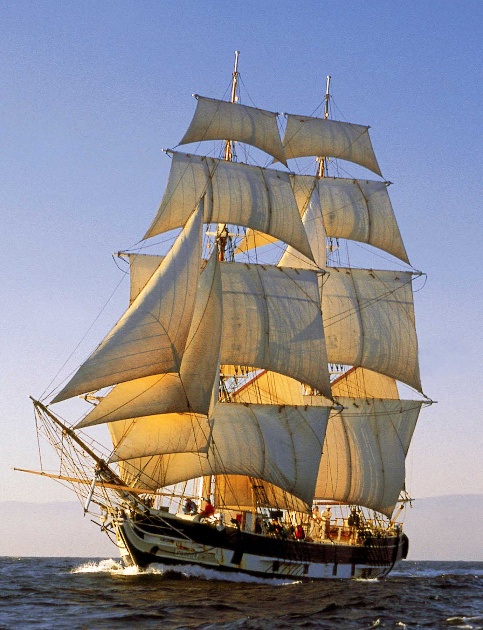
All the ships that sailed to and around Australasia in the first half of the Nineteenth Century were very small by modern standards. They were almost exclusively built of wood. Of 29 ships noted in Australian ports in early January 1850, the approximate average size was 200 tons. All were ocean going vessels, the smallest being 26-35 ton cutters and schooners, and the largest a Barque of 650 tons.[31] There were larger ships, the 802 ton Cataraqui for one, but it was approaching the limit of wooden construction. For comparison, the modern-day Australian tall ships One and All in Adelaide, Alma Doepel in Melbourne and Leewin II in Perth are 206, 256 and 339 tons respectively. Ships of that size carried 200 or more people, and on the voyage out to the Antipodes were at sea for three to four months!
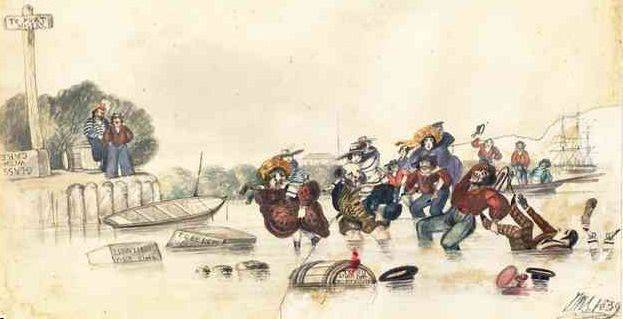
There was still no proper wharf at Port Adelaide, and the place was nick-named Port Misery: a shallow, mosquito infested place and with very few facilities. Sailors and passengers had to wade ashore.[32] Bob is not listed as a passenger, but may well have been one of the crew, which may explain why he says he landed five days later: he may have been required to help unload the cargo.
When Bob arrived, Adelaide had been settled just over 19 months. [33] But all the Australasian colonies were in their infancy. Victoria was settled in 1834-35, Western Australia 1829, Queensland 1824, New Zealand 1814, Van Diemen’s Land (Tasmania) 1804 and New South Wales in 1788.
BOB SETS UP BUSINESS AND STARTS A FAMILY
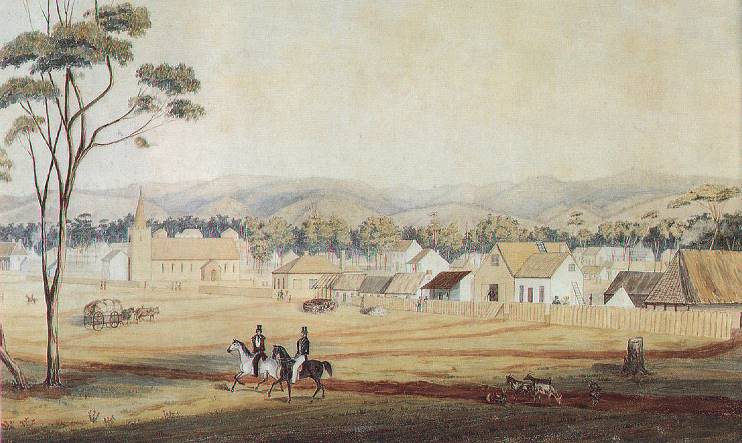
Bob was only 22 years old when he set foot on South Australian soil, and ‘being a seafaring man decided to set up business’. [34] He opened a ship’s chandler store at Port Adelaide.[35] With many ships moored nearby there was money to be made by stocking them with supplies for their outbound voyages and providing their crews and disembarking passengers with the necessities. Aboard one of these ships, the Thomas Harrison, was a girl who caught his eye. Kate Evans disembarked on 25th February 1839 with her parents, six months after Bob set foot in the Port.[36] He lost no time in meeting and wooing her, for they were married just five months later. Kate (Elizabeth Victoria Katherine Evans) was also a West Country girl from Cirencester in Gloucestershire. She was eighteen years old when she and Robert were married on 24th July 1839 at the still incomplete Holy Trinity church, in North Terrace,[37] and would have had her parents’ permission and blessing. The year after their marriage Bob must have received news that both his grandfathers had died.
Bob and Kate soon started a family, Kate giving birth to a son a month before their first wedding anniversary. They named him Robert Evans.[39] Later that year Bob was doing well enough for the Bank of Adelaide to provide the capital for him to purchase his first boat, a 15 ton cutter which he renamed Kate after his wife. He used the cutter in and around Spencer Gulf in the oyster trade, [40] and began to explore the coastline, as only the few hundred miles around Adelaide was then known. Who knew what business opportunities lay beyond?

Port Adelaide in 1840 would not have been an easy place to nurture a baby. Its population was very small, and facilities basic. But Bob and Kate would have known nearly all the residents, and we can imagine the local women stepping up to help a young mother. Bob would have been busy running his store, which by the early Forties had developed into a full-scale Ships Chandler, the supply of meat to ships being the main part of his business.
A Ships Chandler combined Bob’s love of the sea with a family trade. Among his first suppliers were the explorers E.J. Eyre and Charles Sturt[41], who together had driven mobs of livestock overland from Sydney to Adelaide. As a butcher, Bob was one of their customers, but in turn his store helped equip each of them for their inland expeditions.[42] Being located at Port Adelaide Bob was well positioned to view and purchase goods from incoming vessels, and developed good relations with ships captains and crews.

After droving his second lot of livestock from Sydney to Adelaide, Eyre set out in May 1839 on an expedition north. He discovered Lake Torrens and explored the Eyre Peninsula, but reported that in 600 miles “… we never crossed a single creek, river, or chain of ponds, nor did we meet with permanent water anywhere, with the exception of three solitary springs on the coast”. The following year (1840) he set out on an attempt to find a stock route to Western Australia. Crossing the southern rim of the Nullarbor in the height of summer he endured great privations. His companion Baxter was murdered by two natives in the party, and Albany was finally reached on 7th July 1841. The expedition had taken over a year and found only more waterless desert.
Charles Sturt had discovered the Murray and Darling Rivers before Adelaide was colonised, and in 1844 made an expedition inland, exploring and naming the Grey Range and Sturt’s Stony Desert in North West NSW and the Simpson Desert, where he was forced to turn back, nearly dying of scurvy. The vision of finding verdant pastureland in the inland was proving nothing more than a shimmering mirage.
The colony had initially prospered under the big spending Governor Gawler, who had arrived only two months after Bob, but in 1841 the British Government recalled him and refused further credit. South Australia was thrown into its first economic depression. By late 1841 some 2,0000 destitute people were on Government support.[43] There were many bankruptcies of business and individuals, and Bob soon found himself in trouble with his creditors.[44] His business was placed in the hands of Trustees, under whom his cutter Kate was offered for sale after only two years in Bob’s possession.[45] However, the setback was temporary, and he appears to have kept the Kate, which was needed in his new business ventures.
On one of its voyages the Kate sailed to Thistle Island, at the entrance to Spencer Gulf near Port Lincoln. After unloading some of her cargo, the crew spent the night ashore. But a gale blew up and Kate drifted away! Next morning a worried crew began to search for the cutter, as there was still cargo aboard, together with a bag of 40 sovereigns (over $10,000 in 2023). Travelling to Port Lincoln they noticed some aborigines dressed in sailors’ clothes, which aroused suspicions. But soon afterwards the Kate was found about 30 miles up Spencer Gulf, high and dry on the shore. It was clear the vessel had been torn from its moorings and not stolen. When found by the natives they had helped themselves to some clothing and a few supplies, but Bob’s sovereigns were untouched. The losses were trifling and the aborigines were absolved. The cutter was refloated.[46]
By 1843 Bob had begun a company that burnt the mangroves that grew around Port Adelaide to make barilla (sodium carbonate), which he began exporting to other colonies.[47] Barilla was used in soap making, but the market was soon saturated and one consignment to Hobart was returned.[48] But as Ships Chandler, Bob had to salt his meat, as in the days before refrigeration this was the favoured method of food preservation. The Kangaroo Island salt lakes had been known before Adelaide was settled, so after the failure of the barilla trade Bob turned his attention to salt harvesting.[49] To do this he had purchased the small 13 ton cutter Resource [50] and later the 37 ton Thompson. This gave him a fleet of three vessels, with which he claimed to have done ‘most of the Coasting trade.’ [51] The Resource was trading as far east of Portland, Victoria by 1849.[52]
In 1844 he would have received a letter with the sad news that his little sister Sarah had died at Greenwich. She was only 12 years old, and was a baby when Bob left for Australia. That year he became the first to export salt, and in April 1844 he dispatched 279 bags, with frequent shipments thereafter.[53] His cutter Resource brought charcoal from Kangaroo Island for the new copper smelter at Yatala, which was not far from Port Adelaide.[54] Bob supplied the smelter for about 18 months from 1849.[55]
Bob loved racing. He proudly claimed to have ridden the racehorse Jupiter – most likely in England, and was not averse to a wager. At an impromptu race on the road beside the Half Way Hotel in October 1844:-
Oscar Lines’s verandah was the Judge’s stand and the betting room, and though no serious sums were at issue, the bettings were vigorous and spirited… Mr. Stuckey’s horse was matched to trot against one of Mr. Venn’s for £2. The ground selected was that between Mr. Chandler and Mr Lines’s Half-way House; and Mr. Venn’s horse was the winner. This match was the forerunner of another, and Mr. Wilkinson’s chesnut mare Matilda, was backed to trot against a horse belonging to Mr. Venn for £3, the chesnut mare was the winner.
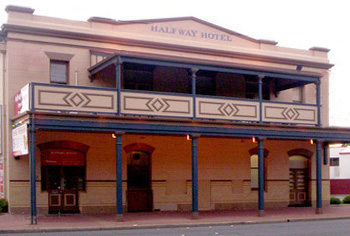
So Bob was £1 down, but not deterred wagered his horse against Matilda again: this time he lost £3. Trying yet again he lost another £3, bringing his losses to £7.[56] That was several weeks’ wages for a working man. But Bob’s interest in racing was not limited to horses. He entered one of his cutters in the Port Adelaide regatta on 29th December 1845. The paper called it ‘Venn’s little clipper’.[57]
Bob employed crews to sail his cutters, but he also sailed in them to Port Lincoln and other ports in connection with his business interests. In 1844 South Australia became self-sufficient in wheat, the surplus being shipped to the eastern colonies.[58] This might have been a factor influencing Bob to add a larger vessel to his fleet. With growing confidence, he decided to have a ship built by W. B. Sullock at Encounter Bay (Victor Harbor). In August 1847 it was sailed round to Port Adelaide for fitting out. A 50 foot schooner, it was registered as the Venus, of 40 tons,[59] and was the largest vessel yet built in South Australia.[60]
Possibly its first voyage of his schooner was to Beachport and Robe (Rivoli and Guichen Bays), returning with a cargo of 266 bags of wheat, 2 casks of tallow and 10 bales of hides for Bob, plus smaller amounts for other customers.[61] This gives an idea of his thriving ship’s chandler business. The Venus, was the first vessel to sail into Venus Bay, on the Eyre Peninsula. Matthew Flinders had sailed past in 1802, and in 1839 the bay was explored by the South Australian Company, but it remained unnamed. Bob’s schooner called to load wool in 1850, and the bay was named after his boat.[62] The same year it was recorded landing 570 bags of copper ore from Port Lincoln at Port Adelaide.[63]

In the meantime, his family rapidly grew. Kate was 19 when her first child was born, but it was three years before the next arrived in June 1843[64], a girl they named Elizabeth Catherine Ann, after her mother. (It is possible there could have been a miscarriage or two during the interval). Then just sixteen months later another boy, Henry Whittal was born,[65] but just as he was beginning to toddle around the little family suffered its first tragedy. In December 1845 two-years-old Elizabeth died. Her eldest brother was only five and must have felt his sisters parting deeply. Henry was to too young to understand, but in an age before home entertainment, children proved a special delight to their parents and the loss of Elizabeth must have been a grief indeed for Bob and Kate. But life carried on and soon Kate was pregnant again.
Bob’s business was prospering, and he purchased the old Customs House, the last building at the Old Port for £11.[66] He also arranged to bring his parents out to South Australia. His father John, mother Elizabeth and a sister embarked as cabin passengers on the Hooghly, a 466 ton Barque which had earlier brought convicts to Australia.[67] There were only eleven passengers in the ship’s cabins; the other 184 passengers were crowded in steerage below decks.
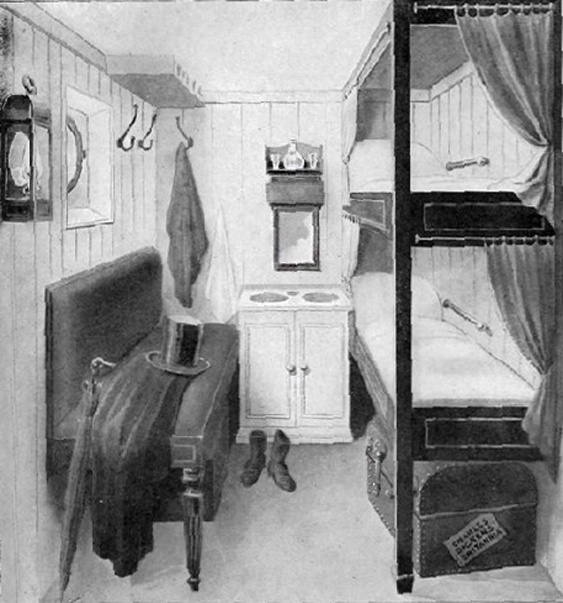
But despite their privileged accommodation, a few weeks into the voyage John fell ill and died. He was buried at sea off the coast of South America, on 15th August, 1846.[68] Deaths at sea were the norm in the days of sail, where the exceedingly cramped conditions and dubious hygiene promoted the spread of infections, all the more probable on the long and arduous voyage to the antipodes. So Elizabeth was a 53-year-old widow when she arrived on 24th October that year, with her eleven year old daughter Rosetta Matilda – or was it 25- years-old Mary Ann, or both? [69] Soon afterwards the family got news that Bob’s sister Elizabeth had died at Islington, in London. She was only 34 years old.[70] Letters from ‘Home’ must have been received with a mixture of anticipation and trepidation.
Elizabeth was therefore on hand to help her daughter-in-law during another birth soon afterwards. This was Francis, her third boy, and no doubt Kate was glad to have her mother-in-law handy to help manage the house. Little Francis was walking when Kate became pregnant again, giving birth to her fourth boy in December 1847. They named him Frank John in memory of his grandfather. He was still on the breast when she became pregnant yet again, so with four little boys running around and getting into mischief their grandmother and young aunt Rosetta must have had their hands full too. Baby John James arrived in March 1849 and was named after Robert’s older brother, who had remained in England. As was normal in those days, Kate’s children were born at home, and we can only wonder what Bob and his older boys did with themselves during the labour and birth; no doubt they were packed off to friends and neighbours! Were the drinks and cigars on Bob when news arrived at the Local?and cigars on Bob when news arrived at the Local?
THE HARRIOTT MYSTERY
Bob had been in the Colony about five years when he began to do business with a farmer and storekeeper who had arrived just weeks after him. This was Andrew Harriott, a Scot who had farming land at nearby Noarlunga and further afield at Langhorne Creek. [72] He was twelve years Bob’s senior, and by 1843 he had raised enough animals to exhibit in the colony’s first livestock show at Noarlunga. Andrew exhibited his horse Sailor Boy, but only two years later he showed a ‘prodigiously large sow’ with six piglets, and his sheep were the best in the market, surpassing all in weight. Many changed hands, with local butchers engaged in the spirited bidding.[73] We can be sure one of these butchers was Bob Venn, and his friendship with the Harriotts was to inextricably join the two families.
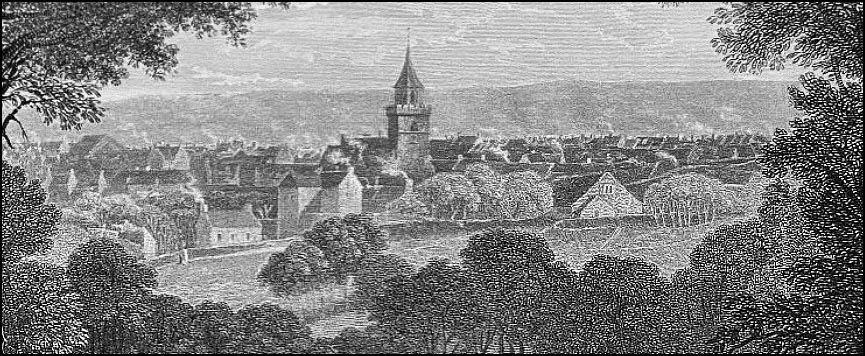
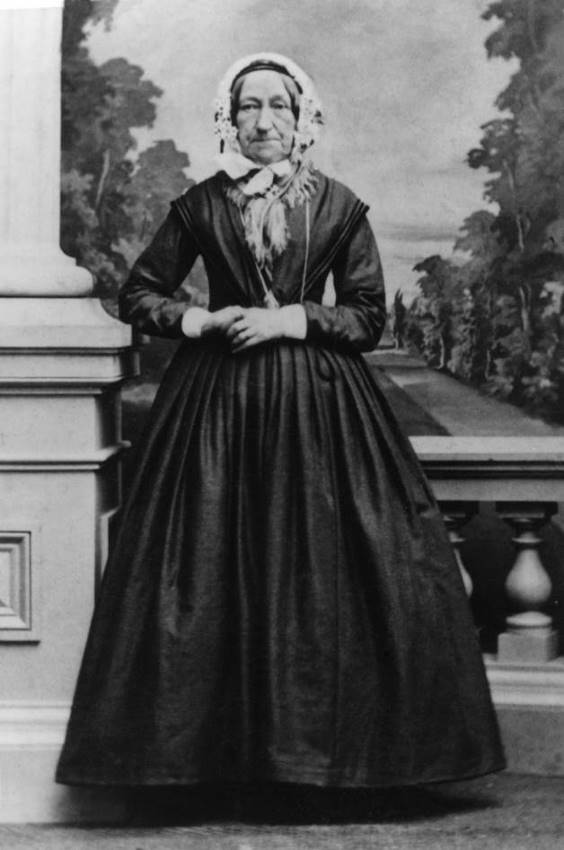
Andrew and Margaret Harriott[74] had left Scotland with baby Ann about the time Bob Venn left England. Like Bob, Andrew had taken up the trade of flesher (butcher). He was born in the village of Dalkeith, seven miles from Edinburgh in 1804. [75] Details of his father and mother are very sketchy. It seems his father was also named Andrew, and was born in Dalkeith in 1777. His mother was Euphemia Newlands, born in Bolton, a nearby village.[76] It is likely their forebears had been in the same region for generations, but the commercialisation of agriculture led to the Lowland Clearances, forcing people off the land into towns and cities. Many even migrated overseas. Our Dalkeith forebears were part of this great social dislocation.
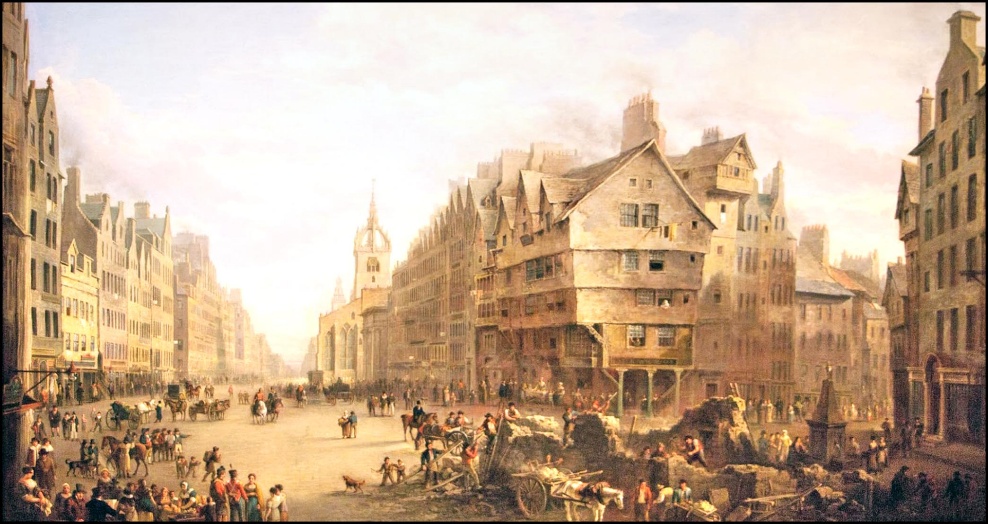
Andrew was only 18 years old when he married Janet Halliday in Edinburgh on 11th September 1822. She was four years older, and also from Dalkeith. [77] Edinburgh at the time was an overcrowded and growing city of about 140,000, only one-tenth the size of London but even more crowded. It was a centre of finance and academia; its main industries being printing and brewing. The rich had moved to New Town, but the Old Town where the Harriot’s lived was home to the poor, with unsanitary living conditions. Disease was rife.
Glasgow had overtaken Edinburgh as Scotland’s largest and most industrialised city, but living conditions were bad there too. It seems that Andrew and Janet moved to Lanark, a town of over 2,000 people, about 20 miles south-east of Glasgow, and 30 miles south-west of Edinburgh.[78] The world’s largest cotton mill had been established at New Lanark, beside the waterfall on the River Clyde which powered the machinery. The old town of Lanark was just a mile and a half away, so together they would have provided customers for Andrew’s trade.

He and Janet grew up at the beginning of the Industrial Revolution in Scotland, with the new factories drawing folk by the thousands from villages and towns like Dalkeith. The Mill at New Lanark was a big employer, their workforce including about 500 children aged six to eight, who laboured very long hours. Andrew’s daughter Ann was born there on 6th July, 1932, but Janet was in declining health and died a few months later, at only 32 years of age.[79]
How long Andrew kept at his trade is unknown, but he had moved back to Edinburgh by the time of Janet’s death.[80] Baby Ann would have been cared for by a wet nurse, or possibly spoon-fed cow’s milk. Caring for infants whose mothers had died or who were incapable was difficult and could be hazardous. This was especially so that year, as Edinburgh suffered an outbreak of cholera. Maybe this prompted Andrew’s decision to emigrate to Australia with Janet’s younger sister Margaret and baby Ann, but exactly when is unknown. [81] Once in Australia Margaret was always referred to as Andrew’s wife, and she gave birth to a boy they named Francis, probably in 1835. He was named after Margaret’s father, but where he was born is unknown. Andrew Harriott is first recorded as living in Sydney during 1836.[82] In February that year Elizabeth Maloney, their ‘Ticket of Leave’ convict maid, absconded and was listed along with many others in a government notice.[83] So it is reasonable to assume that they were in Sydney by 1835. Yet there is no record of Andrew’s marriage to Margaret until a decade later. She gave birth to two more children in Sydney, both of whom died as infants.
What then became of Andrew’s wife Janet? Was she the mother of Ann? It remains a mystery, but tragedy was never far from the door in those days. Infant mortality was high, as was the death or disability of mothers during or after childbirth or miscarriages. As we shall see, our family was touched several times by such things. When the worst happened there was no social welfare to help, so people fell back on family. Perhaps Janet was damaged by miscarriages and was physically and perhaps mentally ill. Her younger sister Margaret seems to have stepped in as housekeeper, nurse or maybe as nanny. We know she and Andrew came to Australia as husband and wife but they were not formally married. Indeed, under British law at the time marrying your sister-in-law was illegal and remained so until 1907. However, it was permitted under Mosaic law, especially if the first wife had died leaving children. [84]
In 1836 Andrew was granted the licence for the Burns’ Head Hotel in George Street, close by King’s Wharf (now Circular Quay).[85] It was there Margaret gave birth to their daughter Janet, significantly named after Andrew’s first wife and Margaret’s sister. Little Janet did not thrive in the unhealthy dockside environment, and died the year following her birth. By then Margaret was pregnant again, so the grief of loss was followed by the joy of a son’s arrival. They named him Andrew, after his father, but this little one also took sick, and he too died the year after his birth.[86] One can only imagine the strain on Margaret, alone in one of the world’s most remote cities, with no family support and a hotel to help run.

Andrew was fined £2 for serving drinks on Sunday. (As late as 1969 public houses were not permitted to trade on Sundays).[87] Not deterred, Andrew made the most of his business, hosting a juggler[88] and a man selling a dozen of bee hives he had imported from Hobart.[89] He was also importing produce from Hobart.[90] But the King’s Wharf was a rough area and they were burgled one night, Andrew foiling the robber by climbing out a window and fetching a police constable.[91] A few months later a sailor died at the Burn’s Head, probably from a heart attack – but the doctors being unable to diagnose the cause, the Coroner pronounced it a ‘Visitation of God’.[92] Andrew is listed as donating 2/6d towards the erection of a statue of Sir Richard Bourke, the popular Governor of NSW.[93] For some reason his licence was not renewed in mid-1838[94]. Perhaps the death of their son Andrew was the last straw, and they were preparing to migrate to South Australia.
Margaret was most likely pregnant again when they embarked with their two children, Ann and Francis, and their man-servant on the 217 ton Barque Pero, which was smaller than a modern tug boat and took twenty days to reach Adelaide, arriving there on 19th September. [95] It was a slow and unpleasant trip indeed on this little ship as it battled prevailing westerlies in Bass Strait and the Southern Ocean. Furthermore, two of the apprentice sailors had deserted in Sydney before she sailed, which makes one wonder about the temper of the captain.[96]
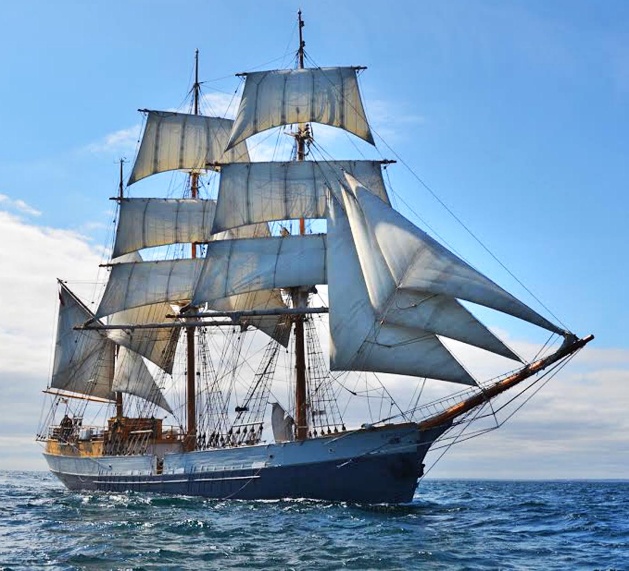
Just before the Pero left Sydney, a ship had arrived from Adelaide which made the voyage in only six days, hurried along by the prevailing westerly winds. It was carrying Sir John Hindmarsh, the first Governor of South Australia, who had been recalled after two years due to the fractious state of affairs in the infant colony.[97] The Harriotts arrival at Port Adelaide was only weeks after Bob Venn. There were still no proper port facilities, hence its nickname Port Misery. Perhaps Andrew waded ashore carrying Margaret and the children. Ann was already six years old and must have remembered the adventure for the rest of her life. By then her father was 34 years old and Margaret was 30 years old. They hardly had time to settle before their daughter Mary arrived.[98]
It is likely Andrew had other interests in New South Wales other than the licence for the Burn’s Head hotel, as he clearly had some assets on arrival in South Australia with his family and servant, for he soon became a property owner. [99] This qualified him as one of 113 men eligible to serve on Petit Juries.[100] (Women were not yet afforded that privilege). In March 1839 he secured a General Publican’s licence of Guthrie’s Hotel, at the residential west end of Currie Street. He renamed it the Edinburgh Castle, and it became his family’s main abode.[101]
The following year Andrew was advertising his Clydesdale stallion Sailor Boy for breeding at £5 for each mare. He had brought this horse from Sydney sometime after he moved to Adelaide, and kept him at the Edinburgh Castle.[102] In 1841 he entered Sailor Boy in the No-Orlunga livestock show; the first agricultural show in South Australia’s history. Only three draft horses were shown, and Andrew’s was not the winner,[103] but he went on to become a successful farmer and landowner.
In addition to the hotel, he bought into Adam Young & Company, a wholesale and retail Grocery, Wine, and Spirit Warehouse, which by 1840 was trading in premises on the corner of Hindley and Rosina Streets, just a few blocks away from the Edinburgh Castle.[104] But farming was Andrew’s passion and he was one of the first to purchase land at No-Orlunga in 1841 (as Noarlunga was initially named).[105] The township had only just been surveyed on a horseshoe bend in the Onkaparinga River. Andrew had a homestead built about two miles south-west of the township which had just been established by the South Australian Company. Margaret gave birth to their daughter Young Catherine that year.[106]
The town of was about 20 miles south of Adelaide in ‘a delightful valley’ with some of the richest alluvial soil in that part of the colony. It was surrounded by hills, about six miles upstream from the mouth of the Onkaparinga. By 1843 a flour mill had been established and a wharf for small boats to take goods to Adelaide. [107] Andrew and Margaret named their homestead ‘Dalkeith’ after the town where they were born, but just when it was finished is unknown.[108] Fresh water came from Harriott Creek, about 100 metres away, and in the evening they would see the sun set over St Vincents Gulf: Moana beach was just a kilometre away. (The homestead is long gone, but Dalkeith Road now runs past its location).
Andrew the Squatter
The following year Andrew obtained a licence to run livestock with Adam Young in the Bremer River district, on the eastern side of the Mount Lofty Range.[109] In 1843, after three years or so they decided to dissolve the partnership; or rather Andrew bought out Young’s share, as the store kept functioning as Mr. Harriotts.[110] The same year Andrew also purchased Rose Hill Farm at Langhorne Creek.[111] It comprised 84 acres of wheat, 21 acres of barley, seven acres of oats and an acre of potatoes. There were seven horses, 33 pigs and 117 cattle on the farm, which he owned freehold, but he also had a squatter’s licence for public lands in the Bremer area, where he continued to run 5,673 ewes and 1,497 withers.[112]
Although less than 50 miles from Adelaide, the Bremer River district was still partly unsettled and raids by aborigines of the Murray tribe were frequent, especially on the unfenced public lands where licenced squatters like Andrew had their sheep and cattle stations. About twenty-five aborigines ambushed one of Andrew’s hut-keepers on his station and bound him hand and foot so he could not alert the other shepherds. Then they stripped the hut of guns, pistols, gunpowder, blankets, and six months’ provisions.
Leaving only a chest of tea they disappeared into ‘almost impenetrable scrubs’ where the police lost their trail.[113]
After another petty robbery at one of Andrew’s stations, two police hunted the offenders down but Corporal Rose was speared, an aborigine was shot and the offender apprehended.[114] Later an aborigine of the Tatiara tribe was murdered by another of his kin on Andrew’s station, probably over a woman.[115] It was the frontier of settlement, but was excellent country with plenty of grass. By early 1845 Andrew was offering to agist other farmers stock.[116]
Andrew could be hard on his employees. Some shearers came to his overseer’s hut on his Bremer property, and helped themselves to some wine from a cask. They were charged with larceny and held on remand, but the judge agreed that it was a trivial matter, bailed two of the three and doubted that even if a jury found the other guilty, their time on remand would probably be punishment enough.[117] By no means were all of Australia’s early colonists hard working and honest. In May 1848 the overseer on Andrew’s Bremer station took delivery of 992 sheep, but without fences they had to be watched by a shepherd. But this man was negligent and lost them twice, with only 846 accounted when he was dismissed a few months later! He later unsuccessfully sued Andrew for £15 12s unpaid wages.[118]
On the frontiers of settlement civil order was patchy, so if employers were not firm, they might be easy prey for the unscrupulous. Still, South Australia was better off than its eastern neighbours, being the only colony not to receive convicts. It avoided the scourge of bushrangers which troubled the eastern colonies into the 1860’s: they were practically unknown in South Australia.[119]
But it was the first colony to establish a centralised police force, and one of the first in the world.[120]
With properties inadequately fenced, stock would wander and mix with the sheep and cattle of other owners. In 1848 Andrew’s men at his Bremer station isolated eighteen cattle with the brands of other owners, and took them to the pound.[121] Andrew may have been agisting these animals and had not given his overseer permission to have them impounded, as he was away at a new property called Leith Farm, probably in the Rivoli Bay district. It was some weeks before he saw and responded to the newspaper report of the impounding, so that would fit him being a long way from Adelaide.[122]
Andrew’s Business Interests
In colonial Australia horse racing was immensely popular, both as a sport and a social occasion. Horses were everywhere, the means of power on farms and transport in city and country. Much loved animals, their owners were always striving to prove they had the best, and the racetrack was the proving ground. After six years in the colony, Andrew had built up a nice little stud and entered his horse ‘Blacklock’ in the Noarlunga races, but it was easily beaten.[123] He tried again a few months later with ‘The Thistle’ in the Maiden Stakes but was again unsuccessful.[124] He managed a third and second place the following year with ‘Gulliver’ and ‘Tommy the Nipper’, but his primary interest was farming and breeding, not racing.[125] Horses were quite valuable, and as with cars in modern times, they were sometimes stolen. Or they could wander and become lost. At a time when many properties were unfenced, or inadequately fenced, straying animals were common. In 1849 Andrew advertised a £2 reward for a horse that had been lost for twelve months.[126] This was a huge reward – worth approximately $350 at 2023 values![127]
Andrew was becoming a respected[128] and propertied citizen[129], with trading contacts in other colonies[130] and in England,[131] as well as his farming and squatting interests, but he continued to live in Adelaide at the Edinburgh Castle.[132] Unlike his partner Adam Young, who was recommended for the Adelaide Council by ‘a large body of respectable citizens’,[133] Andrew seems to have focused on his private interests. Although he was a Scot, he did not contribute to the building of the first Presbyterian Church in Adelaide, unlike his partner Adam Young.[134] The Harriotts had their children baptized at Holy Trinity, North Terrace.[135] Andrew and Adam seem to have other business interests together, and in April 1844 they sailed to Sydney on the Brig Dorset, with some hundreds of bags of wheat and flour. South Australia had an ideal climate for wheat growing, with grasslands north and south of Adelaide being easily farmed. Located close to the seaboard, the harvests could economically be carted to waiting ships. Until the 1870’s South Australia was the bread basket of the eastern colonies. Quite likely Andrew shipped his wheat from the No-Orlunga wharf. Also aboard the Dorset was over a hundred bags of salt being exported by Bob Venn. Andrew and Bob’s business interests were coinciding.[136]
Andrew had developed an importing business. In January 1844 a vessel from the Port Philip district landed 24 kegs and one hogshead of butter (about ¾ ton), together with six 6 cases of pickles for him.[137] Later that year Andrew was advertising improved pasture seed from London for sale from his store in Hindley Street.[138] A few months later he sent three bales of wool to London. Aboard the same ship was the now famous explorer John Eyre, who was taking two aborigines back to England.[139] The colony was not yet ten years old, and wealthy men were expected to assist with public works. Andrew was one of many who subscribed to a fund for the repair of Adelaide’s streets, contributing ten shillings in 1844: about $100 in 2024 values.[140] But in late 1844 Andrew decided to give up his business at his Hindley Street store: thereafter there are no references to him being in the retail trade.[141] He was 40 years old and his farming and hotel interests were enough.
Andrew and Margaret Marry
Perhaps the Harriott’s success in farming and business prompted them to regularise their relationship. In those days Scottish couples could undergo a simple form of marriage, sometimes called handfasting, and this may have been the case with Andrew and Margaret. But maybe not. We have noted the mystery surrounding Andrew’s wife Janet, who was also Margaret’s sister. We also know Margaret was sensitive about their relationship. In March 1842 Margaret was a witness in the trial of a man accused of passing a fraudulent cheque. Six months pregnant with her sixth child, she was sworn as the ‘wife of Mr. Andrew Harriot, who keeps the Edinburgh Castle’. During the proceedings the accused tried to discredit her by intimating that she was Andrew’s relative, and that Andrew had paid £200 to put away his wife. She replied indignantly ‘I am no relation to Mr. Harriott, I am his wife; Mr. Harriott did not marry my sister; he did not give her £200 to go away; I have no sister’.[142] She may or may not have had a sister in Australia, but she had several in Scotland! Clearly there was some gossip abroad and the Harriott’s had something to hide. They may have been tight lipped, but remember they had arrived in the Colony with a manservant, who may have let something slip.
Andrew may indeed have been paying for the care of Janet if she was invalided, depressed or insane. No record of Janet’s death can be found, but after at least a decade together in Australia, perhaps Andrew and Margaret got word, and at last felt free to formally marry. The ceremony took place in the Church of England on 14th January 1846, but not in their parish church.[143] Holy Trinity, North Terrace was the main Church of England in the city, and was the church where their children were baptised. Instead, they married in St. John’s in the Wilderness, on Halifax Street, a small congregation which at the time was not even holding regular services, and was some distance from their home in Currie Street.[144]
It was done quietly, and no wedding notice appeared in the Adelaide newspapers; after all, Andrew’s daughter Ann was already 13 and Francis eleven. The other surviving children were seven-year-old Mary, five-year-old Young Catherine, three-year-old Andrew and eleven-month-old Margaret. Two of their eight children had died as infants in Sydney, and later that year their boy Andrew died, not long after his fourth birthday. They must have been devastated, but kept trying for another boy. The following year their hopes were realised when Andrew Thomas was born, but he too was to die as a child, the third boy to carry his father’s name.
Even after World War II, people with disabilities were often ‘put away’. My uncle and aunt’s third child was born with autism, but Australian doctors could neither diagnose or treat it. They were told to put her in an institution and forget about her. They didn’t. But in my book Engineers and Politicians, Richard Speight, the famous Chief Commissioner of the Victorian Railways from 1884 to 1892, emigrated with his mother and teenage children, but left is wife in an asylum at Nottingham.[145] Janet’s fate was heartbreakingly common, as effective medical diagnosis and treatment was in the distant future.
Prosperity
Within a decade of their landing in South Australia, the Venn and Harriot families were prospering, and their wealth and families continued to grow, albeit mixed with reverses and disappointments which were inevitable in a pioneering colonial society. After formalising his marriage to Margaret, Andrew gave up his license of the Edinburgh Castle, which had been the family home in Adelaide for the past seven years. As a new venture he took out the licence (and probably purchased) the ‘London Tavern’ several blocks further up at 114 Currie Street on the corner of Rosina Street.[146] He set about expanding the hotel and by the spring of that year had a two-storey building, 53 x 34 feet, which included a club room 30 feet long.[147]
It was a smart move by Andrew to foster business by providing a venue for social occasions, and no doubt Margaret maintained a decorous establishment. Women and girls were widely employed in hotels,[148] and not only Margaret but her young teenage daughter Ann would have been kept busy managing the establishment. Working at the Tavern was good training for Ann and would serve her well, as she was destined to manage a hotel for twenty years. In Adelaide’s early colonial days, the ‘local’ was a centre of social life,[149] and most were often more like boarding houses.[150]
A little over a year later Andrew changed the hotel’s name to the ‘Golden Fleece’ and had his licence transferred to that title,[151] with no objections from publicans of the three nearby hotels in Currie Street.[152] But tragedy soon struck. Four-years-old Andrew, the second boy to bear his father’s name, the first having died as an infant, was playing on an unfinished stairway in the hotel. His sister, either 14 year old Ann or five year old Young Catharina, had noticed him on the landing but had not thought to take him somewhere safer. Soon afterwards he fell, suffering head injuries that within three days proved fatal.[153] This was now the fourth infant child Andrew and Margaret had lost, and one can only imagine the grief and recriminations the parents and older children experienced. Did Ann blame herself? She was still a young teenager and added to her responsibilities about the hotel she was helping Margaret who was about four months pregnant with her ninth child.[154]
Not long after work on the London tavern was finished, Andrew’s former business partner Adam Young died of ‘brain fever’. He was just 40 years old.[155] Andrew had purchased Adam’s share of their partnership of Adam Young & Co. a few years earlier, and Adam had opened a Drapery business nearby.[156] Adam had been one of the movers and shakers in establishing a Presbyterian church in Adelaide, but Andrew had given his allegiance to the Church of England. But both of them opposed State aid to religion, which was viewed as an attempt to set up an Established Church.[157] South Australia was a free colony, peopled by a mix of English, Scot, Welsh, Cornish, Irish and German immigrants, many of them dissenting protestants. Many Presbyterians, Lutherans and Catholics feared discrimination that might follow the establishment of the Church of England as the official church of the State.

After earlier disappointments, Andrew finally achieved success when his horse ‘Eclipse’ won the Adelaide Maiden Stakes in January 1848.[158] But later that year another of his thoroughbreds called ‘Liberty’ broke down and died during training.[159] This shook Andrew’s commitment, and he quit racing altogether; thereafter he occasionally entered a horse team in a ploughing competition as ever since he brought ‘Sailor Boy’ from Sydney he loved draft horses.[160] He was in his late forties and had achieved real success as a farmer. He owned 560 acres at Noarlunga, the second largest landholder in the district.[161] By 1846 he was expanding still further, re-applying for an occupation licence for his squatters run along the nearby Bremer River,[162] which was near his farm at Langhorne Creek. But that was not enough, and simultaneously he applied for another occupation licence at Rivoli Bay, over 230 miles by dirt track from Adelaide.[163]
These occupation licenses enabled him to legally graze livestock on Crown land for only £5 as a squatter, but a few months later he paid £80/1s for freehold land at Rivoli Bay, near where the town of Beachport was later established. [164] His farm at Langhorne Creek was described as the best in the country,[165] but a few years after securing land at Rivoli Bay he put Langhorne Creek up for sale. It was quite a property, including 4,867 Ewes, 1,336 Lambs, 1,134 Wedders[166] and 194 Rams. Also 400 head of ‘superior Cattle’ including 75 ‘broken in Milch Cows’.[167]
Andrew still owned the Edinburgh Castle but had leased it to a client. During ensuing three years the hotel deteriorated, so in 1849 Andrew was forced to seek the licensees eviction and pledge to the Magistrate’s Court that he would put it in good order again.[168] By then he was a wealthy man but his success was tinged with sadness. Of his four sons, only Francis survived childhood.[169] It is doubtful if Andrew spent much time at his distant properties, but he may have used Bob Venn’s new 50 ton schooner Venus to sail down and inspect his purchase. It set sail on what was its maiden voyage to Robe, Rivoli Bay and Port Philip on 4th September 1847.[170]
SHIPWRECKS AND SMUGGLING NEAR DALKEITH FARM
The coast near the mouth of the Onkaparinga River was treacherous. Ships tacking up the Gulf of St. Vincent to Port Adelaide had to beware of shoals, reefs and sandbars, but some unwary sailors ran aground. It was easy enough to do in the days of rudimentary navigational aids. There were no lighthouses in the area, charts were not strictly accurate, and at night during cloudy weather a ship’s position could not be determined by sextant (there being no stars visible). During the Harriott’s time at Dalkeith Farm several ships were wrecked not far from their homestead. On Tuesday night 26th September 1848 the Tigress, a small two masted Brig, was making its way up St. Vincent’s Gulf after the long voyage from Leith in Scotland. Captain Guthrie was ‘hugging’ the eastern shore, as many ships did as they neared Adelaide, but as night fell a gale came up and the combination of inexperience, poor visibility and uncertain position brought disaster. The ship stuck fast on a reef about a quarter mile off-shore, with seas washing over her deck. The crew and two passengers spent an anxious night, but all attempts at rescue failed until the sea calmed two days later. In the meantime, Guthrie and a passenger had tried to swim to shore and were drowned. [171]
Only a month before the loss of the Tigress the ketch Albatross foundered near the same spot, and the Brig David Whitton had come to grief there nine years earlier. It was said the Tigress mistook a light on the shore for the Light-ship at the entrance to Port Adelaide, and given Andrew Harriott’s farm was nearby, the inference was that the light came from his homestead. He was not there at the time[172] and two of his employees helped in the rescue, but decades after his death stories were put around that he had lured ships to their destruction to plunder their cargo. Not a hint of any such behavior is associated with the Harriotts in the many newspaper references and official inquiries of the time, when shipwrecks were all too frequent. The Tigress was the nineteenth shipwreck in South Australian waters since the beginning of the colony ten years previously, and as we shall see, all three of Bob Venn’s cutters were wrecked. (Bob’s cutters Resource and Thompsons were both involved in salvaging the cargo of the Tigress before she broke up, and his schooner Venus helped salvage the wreck of the Marion in 1850, which is discussed later).
Some years later another ship came to grief near Dalkeith Farm. This was the 762 ton Barque Nashwauk, carrying over 300 immigrants from Liverpool. Before dawn on Sunday 13th May 1855 she struck the notorious shoal adjacent to Harriott’s Creek, just off shore from Dalkeith Farm. The ship was stuck fast in twelve feet of water and was slowly breaking up. Most of its cargo was iron work for the Adelaide to Port railway, but was beyond saving. Throughout Sunday afternoon and evening all the passengers were taken off and lodged in the mill cottages and other empty houses in Noarlunga. The locals baked bread and killed eight sheep to feed the survivors, and ‘tea was prepared by the bucketsful’. Next day about ninety were persuaded to get into boats and be rowed out to the steamer Melbourne and the schooner Yatala, and be taken to Port Adelaide. But most had had enough of the sea and either walked or rode in drays the 20 miles to Adelaide. They arrived destitute, their salvaged luggage arriving some days later.[173]
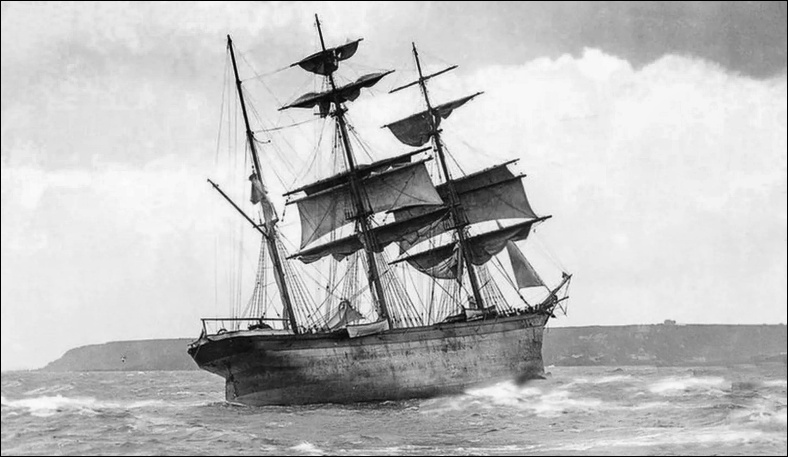
The Nashwauk’s crew had seen land all during the Middle Watch (midnight to 4am) on that fateful Sunday morning, and had noticed a light, but after 4am the coast was obscured by cloud for an hour or so before the terrifying sound of breakers was heard, too late to turn the ship about. There was no hint that the crew thought they were nearing Port Adelaide, and the Inquiry found that the captain had neglected to plot the ship’s position during the night and held him responsible for its grounding.
By the time the Inquiry decision was brought down, Captain McIntyre was dead, the only casualty of the wreck. He had exhausted himself for several weeks searching for whatever could be recovered after the grounding of his ship, and suffered from exposure. Most likely he was staying at Dalkeith Farm during this time (the only residence near the wreck), but with his worsening health he was taken to Adelaide and ministered to by Dr. Gosse at Andrew’s Golden Fleece Hotel. He died there three weeks to the day after his ship was wrecked. He was aged only 37, and left a wife and four children in Scotland.[174]
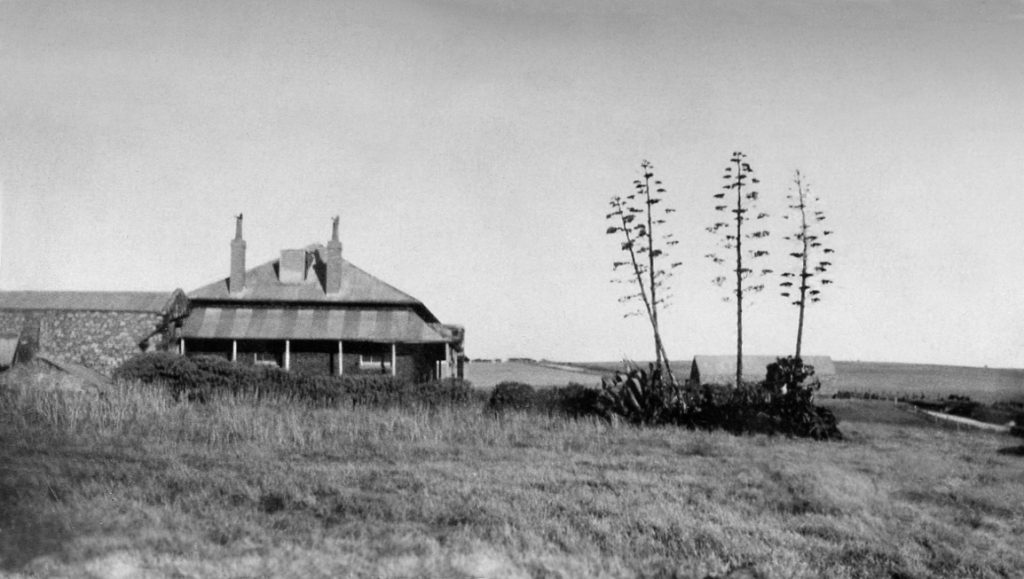
Seventy years later the remoteness of the Harriott homestead and its location near the shore fed rumours that signal lights were shown in the attic to guide smugglers! There is no contemporary evidence that Andrew was involved in smuggling, but the story grew and now the road in the housing sub-division near the site of the old homestead is named ‘Smugglers Drive’! How a yarn developed into a myth is discussed in Appendix Three.
BOB’S CHANGE OF FORTUNE
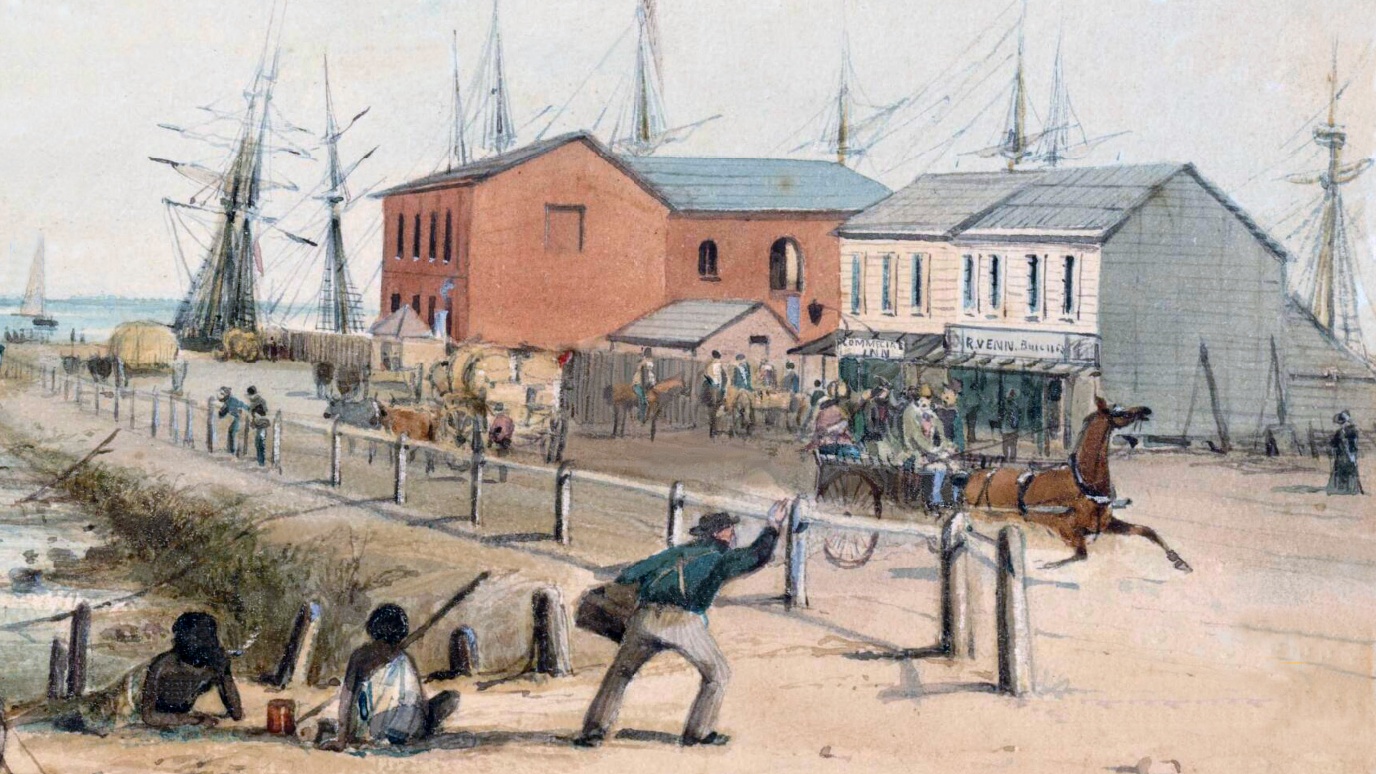
By the late 1840’s after a decade in the infant colony, Bob Venn was doing very well. He was developing a flair for self-publicity, and it is probably not a co-incidence that the artist S.T. Gill’s painting of Port Adelaide featured his shop![176]
A newspaper article gushed,
Mr. Robert Venn, Butcher, of Port Adelaide, this week killed a heifer purchased from the South Australian Company’s herd, which produced 620 lbs. of as fine fat beef as Leadenhall market ever exhibited from a beast of the same inches. [177] Each of the Captains in Port were supplied with a joint or two, and all have extolled its excellence and flavour. Mr. Venn takes a commendable pride in furnishing his shop and providing his customers (particularly his seafaring friends) with some of the best meat in the Province.[178]
But then the tide of fortune began to turn. In March 1849 he sustained a serious injury to his head when a ‘scoundrel… driving a port cart at full gallop’ collided with the gig Bob was driving in Hindley Street. It left Bob concussed, but he recovered. The newspaper added
‘The ruffian…cannot be traced: and even if he were, in the absence of Municipal Institutions, or a well-conceived Police Act, he could laugh to scorn the very serious injury he has inflicted.’ [179]
In September 1849 Bob’s cutter Thompson was wrecked at Guichen Bay, near Robe with the loss of 12 lives.[180] Then a year later his cutter Resource went aground at Rivoli Bay, near Beachport. Bob sold the wreck, and seven months later the new owner found it buried in sand, about 30 yards from high water mark. With hard labour it was dug out and re-launched.[181]

Dealing with ship owners and sailors could also be troublesome. A few months after the loss of the Thompson, the Brig Broadaxe arrived at Port Adelaide from Guernsey (Channel Islands) via the Cape of Good Hope. This little ship of 136 tons had taken 154 days to sail half way round the world – five months! [182] Bob agreed to provision Captain Bayles while the Broadaxe was in port. Soon afterwards the ship was sold to Adelaide businessman John Lamb, but Bayles stayed aboard until the sale was registered weeks later. Bob continued to supply provisions, unaware of the change of ownership. The Broadaxe remained in port until 6th April before sailing for California, racking up the considerable debt of £30 17s 8d (about $5,600 in 2023 values). In the meantime, Bob went to Port Lincoln, and his clerk, Edward Delaroche, went on board the Broadaxe to ‘bounce the money out of Jack Lamb’. The unscrupulous Lamb refused to pay, and Bob had to sue him to recover the debt.[183]
This helps us understand why businessmen like Bob and Andrew had to be pretty tough. South Australia was still a frontier colony with a small population. Employers often had to employ who they could get. One such was Bob’s bookkeeper. He had employed a man named Hall for twelve months in 1848, with a house as part of the remuneration. But Hall objected that the two roomed brick cottage with a lean-to at rear was too small for his family and left after one month. He was also absent from work on occasions. Hall sued Bob for one month’s wages and added items for house rent and rations. He was awarded the wages but nothing else and had had to pay costs.[184]
As a butcher and ships chandler Bob would have had little if any time for bookwork. Two years after selling the wreck of the Resource, Bob was charged by the Collector of Customs with neglecting to officially report the sale and also the loss of the Thompson. The bill of sale for the Resource had been prepared, but it was yet to be signed by the purchaser, who was away at the Victorian gold diggings. That case was dismissed, but Bob was fined £5 neglecting to report the loss of the Thompson, despite his ignorance about the law.[185] He needed a bookkeeper!
Much worse than these business setbacks was the loss of his wife Kate. She had suffered from heart trouble, probably made worse with every new pregnancy. At 4 o’clock on Tuesday morning, 17th December, 1850, she was suddenly seized by heart palpitations and had died before a doctor could be fetched. She had been experiencing heart trouble for some time but her death at 29 years came as a great shock. All the ships and vessels in the Port lowered their flags to half-mast.[186] Bob had only been married eleven years, and was now a 34-year-old widower with five boys under 11, and his 57-year-old mother to support.
There was no social security in colonial days, but his friend Andrew Harriott came to his aid, sending his 18-year-old daughter Ann to help run the house. Andrew also lightened the load on the Venn household by unofficially adopting four-year-old Francis Venn.[187] Ann had her work cut out, nannying four of the five young boys. One of them was hurt in a shooting accident. His gun burst and some fragments flew into his face, inflicted some very severe injuries.[188] It was a difficult time for Bob, and his health suffered. He seems to have given up on coastal trading, and sold his beached cutter Resource in March 1851, leaving it to someone else to salvage.[189] Early the following year Bob sold his remaining ship, the schooner Venus.[190]
The wreck of the Marion
One of the last tasks of Bob’s schooner Venus was a rescue mission to the grounded Barque Marion. This 919 ton Barque had set out from Plymouth on its maiden voyage with about 350 emigrants on board. As was then typical on sailing ships, most were accommodated in wooden berths in extremely crowed conditions. For most of the 126 day voyage they lived in boxes between decks. Then, on 29th July 1851 the Marion founded on the Troubridge Shoals, near the tip of the Yorke Peninsula. She was just 45 miles short of her destination at Port Adelaide.
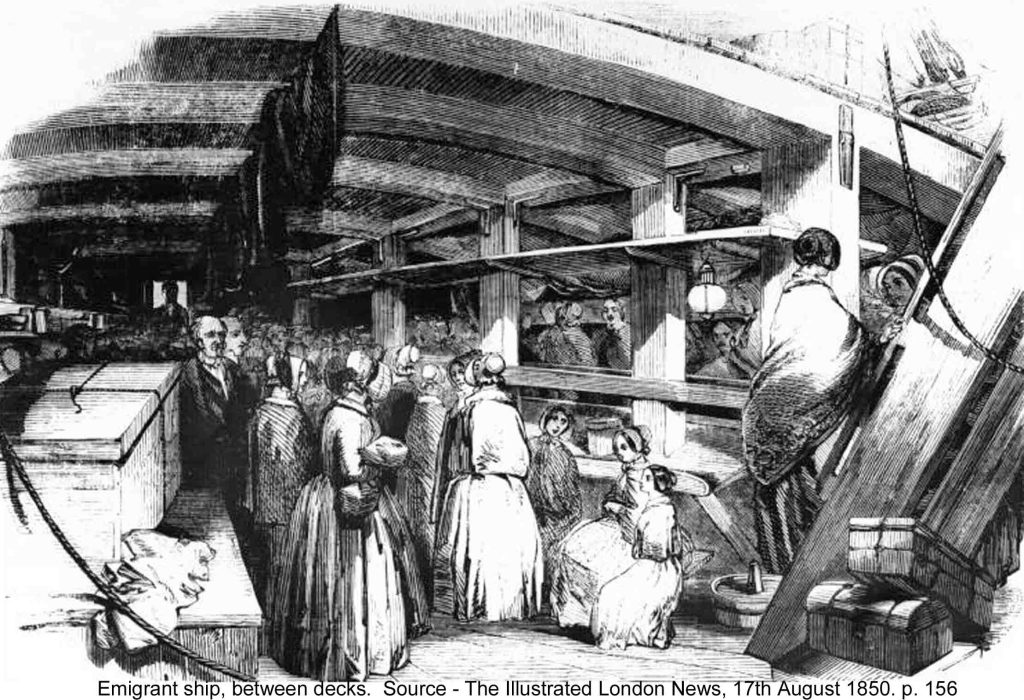
The Venus was one of four little ships sent to help, all of the passengers and crew being saved alive, and much of the luggage. The Venus returned to Port Adelaide on 7th August with the Marion’s captain, chief mate, and 13 of the crew, together with two policemen and some of the emigrant’s luggage and cargo. This was nine days after the grounding, so these were probably the last to leave. Conditions on emigrant ships were miserable, and unsurprisingly six passengers died, all but one of them children. But nine babies were born on the voyage. [191] The wreck was sold for salvage, and after the buyer had first pickings, it was sold again, this time to Bob. Later he too sold the hulk.[192] Such was the fate of many ships. The new owner of the Venus sailed her to Sydney but she was driven ashore in a gale near Cronulla and wrecked, with the loss of all aboard.[193]
The Gold Rush
The year 1851 was a momentous and disruptive year in the Australian colonies, as between May and November 1851, gold was discovered at numerous places in NSW and Victoria. This began a mad rush to the gold diggings, with men deserting their jobs and thousands of gold seekers or ‘diggers’ coming to Australia to try their luck. In 1852 alone, 370,000 new immigrants arrived on these shores. No gold was discovered in South Australia, but he exodus of men to the diggings meant Bob had to carry on as a ships chandler with little help, especially during the first two years of the gold rush. His business included a 40 acre market garden in the sandhills near the old port, where he grew vegetables using ‘plenty of Colonial manure’.
Although he claimed to have ‘managed his work without assistance’, [194] he would have had the help of his family, including young Ann Harriot his housekeeper-nanny, 11-year-old Robert, eight-year-old Elizabeth and seven-year-old Harry.[195] Child labour was not unusual then, especially on farms, and it remained common well into the 20th Century. The vegetables were used to resupply the ships, and also to feed his pigs. It was a lucrative two years. He claimed the vegetables realised £800, but this probably included meat and other ship’s supplies. Meat not sold fresh to locals he salted and packed for export to India and Great Britain. In London the preserved meat was inspected and passed, and then supplied to migrant ships bringing thousands of new settlers.
In November 1851 Bob must have decided to visit Andrew Harriot, probably to purchase livestock for butchering, and also to let him know how his daughter Ann was faring as nanny to Bob’s five boys. He stayed overnight at Mr. Lines’s Inn, at Noarlunga, and got chatting to another guest. One can assume they had a few drinks, then Bob went to bed in a shared room with another guest. He hung his clothes over the bedpost, which gives us an inkling of hotel accommodation at the time. No wardrobe or safe place to put valuables, and only dull lighting by candle or oil lamp. Electric light was more than thirty years in the future. Next morning Bob discovered eleven £1 notes that he had in his clothes pocket were missing. It was a substantial sum: $2,000 in 2023 values! Fortunately for Bob, the culprit was found and arrested. [196]
Bob’s electioneering
During this time there was an election for the Legislative Council seat of Port Adelaide. Bob and many other Port personalities supported Captain Hall, who was opposed by a man called Gilles. Both advocated civil and religious liberty, but it became clear that Gilles considered himself an intellectual, was anti-Catholic and a puritanical: he proposed the shutting down of theaters. Bob turned up at Gilles’s rally with a ‘true blue electioneering flag’ – the first to appear in Adelaide. But Bob’s flag was in support of Hall![197] Bob next penned a loquacious and sarcastic letter to Gilles which was published under to pseudonym of Slow Coach.
People who have a good deal to lose are naturally slow coaches in changing laws which are framed for the protection of property. You said…the possession of property is no proof of the possession of ‘mind’ [i.e. intellect]. I perfectly agree with you, and I consider that you, my dear Sir, are a living example of the truth of the assertion. Men who are foresighted enough to attend to their own affairs, and the comfort of their family, are not men for us: no, no; we want men who neglect themselves and their families…[with] no squeamish notions about burning down theatres or book shops which lend out novels, but would, if necessary, confiscate the property which people did not properly use.
Gilles also said he would look to the interests of his constituents, but Bob would have none of it:
‘…these priest-ridden fools at the Port say that you are only trying to humbug them. Even Bob Venn, the butcher, who is as knowing as the most of them, whenever this subject is referred to, puts his tongue in such a position, as to shove out his right cheek; he closes his left eye, and patting his extended fingers to his nose, he balances upon one leg and whirling round, strikes every one with astonishment…it becomes a matter of prudence and policy on your part not to shock the obstinate antiquated prejudices of the Port people… Bob Venn has considerable influence among the ignorant people at the Port, I would advise you to soothe him down. Don’t be buying his meat or offering him anything, for Bob Venn will kick at that, but just try and make him believe that you have the same ideas about civil liberty that he has himself. But say no more about burning theatres, or public houses, or improper shops…[198]
Ann’s task as nanny to Bob’s boys must have made a good impression and Bob proposed marriage. She was 20 years old, and Bob was a burly 37 years, but he was clearly lovable nevertheless, and wealthy too. After 15 years in the young colony, he had amassed a huge fortune of £40,000, or about $7,000,000 in 2023 values.[199] So after the customary two years of mourning, Bob and Ann married at Dalkeith Farm, the Harriott home in Noarlunga on 19th January 1853.[200] At the time of her marriage, Ann had five other surviving siblings.[201]
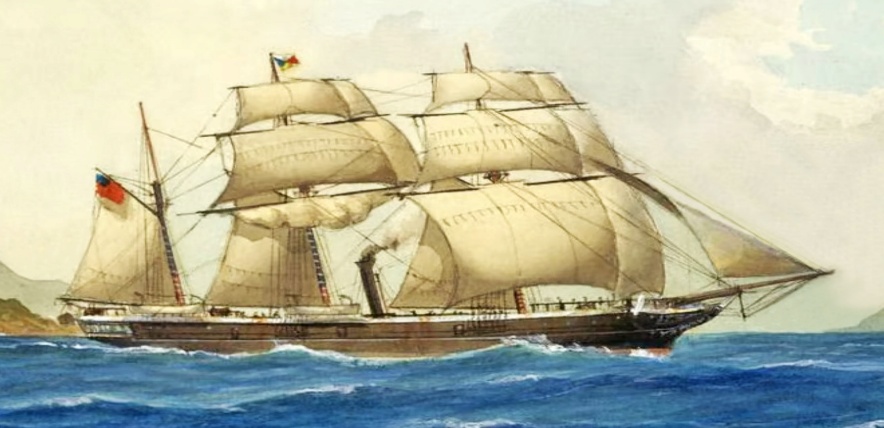
It seems Bob purchased a very unusual wedding present. With the gold rush under way, shipping companies had been quick to put new and faster ships on the Australian run. One of these was the famous P&O Barque rigged steamship, the S.S. Chusan. She was the first ocean going steamship to provide regular England – Australia service, and was awarded the first government mail contract. She was also equipped with twelve canons to ward off the pirates which prowled the China and Java seas in the 1850’s.[202] The Chusan called at Port Adelaide in September 1852 on its maiden voyage, and on its next visit in December it arrived at Port Adelaide with a cargo that included some exotic animals and birds, including two boa constrictors. These Bob promptly purchased! One soon died, but the other was ‘eating voraciously’ three weeks later.[203] He kept an emu and a kangaroo at Rose Cottage too.[204]
The marriage seems to have heralded new directions for both the Venn and Harriot families. Port Adelaide was getting busy, with 23 ships berthed one day in April, but Bob decided to quit butchering, lease his premises at the Port and sell all its stock-in-trade.[205] The inventory of his stock-in-trade took up three columns in the newspaper! Soon afterwards, Andrew Harriot, now Bob’s father-in-law, decided to sell 30 of his stud horses and some associated equipment.[206] Some months earlier Andrew had leased the Edinburgh Castle hotel in Currie Street.
Bob’s Fateful Purchase
But whatever he planned to do after the sale of his business and his remaining coastal ships, everything changed when the 257 ton Brig Empress sailed into Port Adelaide with a cargo from Shanghai. [207] Bob had developed the notion of owning a real ocean-going ship, on which he could sail home to England. He claimed his doctor had advised that a sea voyage would help him recover his health.[208] Now here was Captain Newman, master of the Empress looking to sell the ship! (Quite likely Newman wanted to desert the sea and dig for gold in Victoria). At the time communications were frustratingly slow, it taking six months to send a letter by sea to London and receive a reply. The first telegraph link with England was still 20 years in the future, so Bob had to take the word of the Captain Newman that he was the owner. He wasn’t.
Bob’s purchase of the Empress was registered at Port Adelaide on 26th March 1853, with Captain Robinson as master.[209] Bob had engaged Robinson over breakfast to take the ship to Port Lincoln and Flinders Island on the Eyre Peninsula,[210] then make a further voyage to Hobart Town for a fee of £20 per month. He went on board with Bob and arrangements were made to leave soon afterwards, but the captain became ill. Bob decided to wait for him to recover, but the delay seems to have caused a loss of patience, so on 22nd April Bob went aboard and after an abusive altercation dismissed Robinson, appointing Captain Allen in his place. The Empress set sail on 8th May for Hobart, arriving on the same day as the 26 gun frigate HMS Calliope.[211] Later Robinson sued Bob for £30 of wages he felt entitled to for the period the Empress would likely have taken to sail to Hobart and return. The court agreed and also awarded him £15 compensation.[212]
Bob had a passionate and extroverted personality which could be engaging or daunting. During his negotiations to purchase the Empress, gossip circulated that he was about to sail away from South Australia, so some of his debtors became nervous. Bob responded by a series of newspaper advertisements assuring readers that he had
‘… no other intention than, to make South Australia his permanent residence, and is happy to say that he is abundantly prepared to pay every just demand upon him… Outstanding accounts to a very considerable amount are due to him, and he hopes that the present notice will be considered as a polite invitation to ‘square up’ by all who would not give him pain by necessitating a different procedure.
On the same day he advertised for a man to look after is horses and a female servant. But it looks like what he really needed was a good bookkeeper-secretary! [213]
Bob’s Altercations
Bob was proud of his cousin Tom Spring, the bare-knuckle boxing champion of England from 1822 to 1824, and was not diffident about using his own fists! On numerous occasions this led to trouble. Some months before his marriage to Ann, he was charged with assaulting Henry Wedeking, a man he employed keep livestock at his property on the Port Road. One hot summer day Bob found the water troughs empty and flew into a rage, threatening to break Wedeking’s neck if he found them empty again. This threat was to no avail, as his man preferred to spend his time in the Half Way House hotel rather than pump water, so next day when Bob found the troughs only half full, he grabbed Wedeking by the back of the neck, threw him on the ground and belted him with a double rope!
Bob had served his apprenticeship on sailing ships where this sort of corporal punishment was normal. Teachers in schools used the cane regularly, and naughty children were all familiar with spankings from their parents. Adelaide was still a frontier town, the climate was harsh, the colonists had to be tough and livestock was valuable. Witnesses made it clear that Wedeking was lazy and probably an alcoholic. A certain amount of rough handling by employers was acceptable and clearly the magistrate thought so, as while finding Bob guilty of assault, he reduced his fine to £2 plus costs.[214] Bob was sometimes a target too, as the Port was not exactly genteel. [215]
But Bob eventually overstepped acceptable limits. He owned Rose Cottage near the Half Way House Inn on Port Road. [216] This pub was the scene of an altercation where Bob again lost his temper. He had been negotiating with Luther Scammell, a wealthy dispensing chemist, to purchase his half share in the Brig Hero, a vessel of 163 tons with two masts. (This was after Bob’s purchase of the Brig Empress).
At a chance meeting at the Inn, Bob was surprised to find Scammell had added substantially to his previous asking price. Bob had been drinking and not only became abusive, but landed a punch on Scammell’s face.
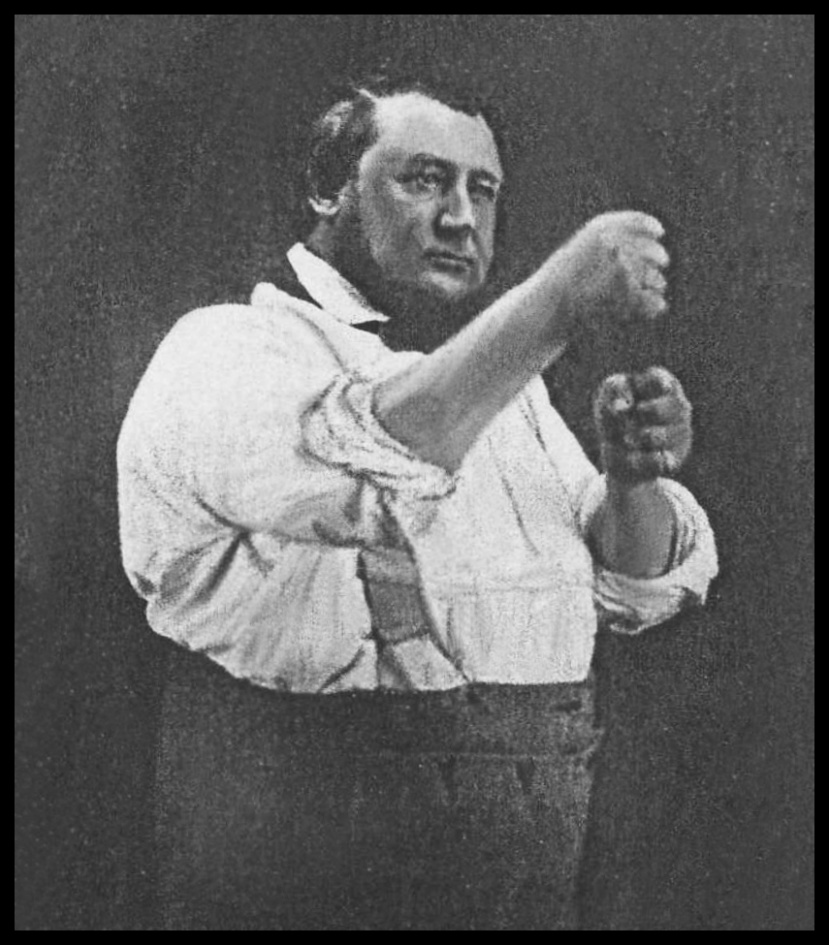
This time he had gone too far, and picked the wrong man! Next thing he was in the Supreme Court, the Advocate-General making much of Bob’s bulk and strength relative to the unfortunate apothecary, who was suing for £200 damages – a sum that would buy a cottage. Bob had sent a written apology but Scammell was going to have his pound of flesh. The jury found Bob guilty and he was fined £50 – a very sobering punishment.[217]
Humiliated, chagrined and out-of-pocket, Bob hassled Scammell when they chanced to meet one day as the chemist was driving his gig home from the city. Bob was on horseback when they met near the New Market Inn, at the corner of North and West Terrace.[218] Scammell sought protection of the court, claiming Bob hounded and threatened him for a mile or so as he drove towards Thebarton. Bob seems to have enjoyed the hearing, telling the magistrate that Scammell had sold him medicine that made him ill, but that he endeavoured to make peace by delivering some smoked beef to the chemist. While there he asked if Scammell had a diploma, and on learning he had not, asked what he would do if any of his medicines proved fatal. The magistrate imposed a £50 bond on Bob to keep the peace for six months. Bob then mischiefly asked if he could go to Mr. Scammell’s shop to get medicines or to obtain advice. His Worship said it would be far better for him to go somewhere else![219] It was later found that Scammell was indeed unqualified, and his treatment of a man with kidney disease had exacerbated the condition, and the man had died.[220]
Bob was also in trouble with his tenant. He had been working from his butcher’s shop in Commercial Road, Port Adelaide since 1840 [221] but decided to retire soon after his marriage to Ann. He arranged to lease his shop to Henry Ranford for seven years from February 1853. The lease included two store houses on land behind the shop, and a lane giving this area access to Lipson Street. Or so Ranford thought. Of the two store houses, Nos. 7 and 8, Bob gave Ranford immediate use of No. 7. He also agreed to allow his new tenant to build a small sheep pen on the land behind the shop. Bob undertook to hand over No. 8 store as soon as he had sold its contents. He was still clearing this store at the end of April, but then came a change of mind.
Bob had been lax in leasing his business, as the two stores and the lane were on Captain Hall’s property. He had a verbal agreement to use the land, and an option to purchase, but the land was still Hall’s. Bob had also had second thoughts about retiring, and wanted Ranford to quit his lease. But Bob resorted to bullying and intimidation to get his way, and in May he refused to grant access to No. 8 store, fenced off access to the lane and sheep pen, and even knocked down a wall of No. 7 store, exposing Ranford’s property to pillaging. He claimed the wall needed rebuilding after a flood, but it all back-fired on Bob, as Ranford sued him for £200 for disturbing the ‘quiet enjoyment’ of his lease. The case was heard in the Supreme Court, Ranford’s counsel calling Bob an eccentric wealthy butcher and Bob’s counsel arguing the lease was invalid as the land at the rear of the shop was not Bob’s. But the court held that the lease was valid at the time it was agreed, and that Bob had caused Ranford loss and expense. The jury agreed, and after 50 minutes deliberation, awarded damages of £100 (over $18,000 in 2023 values).[222]
Ranford was not the first neighbour to get Bob offside. A year earlier he sued the owner of the Commercial Hotel for £200 due to a new wall of the building encroaching three inches on Bob’s land. In the Supreme Court hearing, it turned out the new wall rested on Bob’s verandah plate and had forced it out of level, and that misunderstandings had ensued. So, Judge James consented to a nonsuit.[223] In order to pay his legal fees and fines, Bob sold his rights to the wreck of the Marion and then some land he owned adjacent to the Port Adelaide wharves.[224]
In January 1854, just two days short of her first wedding anniversary, 21-year-old Ann gave birth to her first child, a girl they named Margaret Ann, after her grandmother and mother.[225] Later that year Bob returned to his trade,[226] and opened a butcher’s shop with accompanying storeroom, stable and outhouse near the wharf end of Lipson Street, opposite Elders & Co’s store, which is now the South Australian Maritime Museum.[227] Lipson Street is parallel to Commercial Road, where Ranford had taken over Bob’s previous business. Predictably, Ranford was annoyed at the competition,[228] as Bob was well known and had also made his home in Lipson Street next to his shop.[229] It seems Bob’s family had for some years been living half way along the Port Road towards Adelaide, near the Half Way Inn.[230] Now with the move to Lipson Street Bob advertised Rose Cottage for sale, a ‘handsome residence’ which was also known as Venn’s cottage.[231]
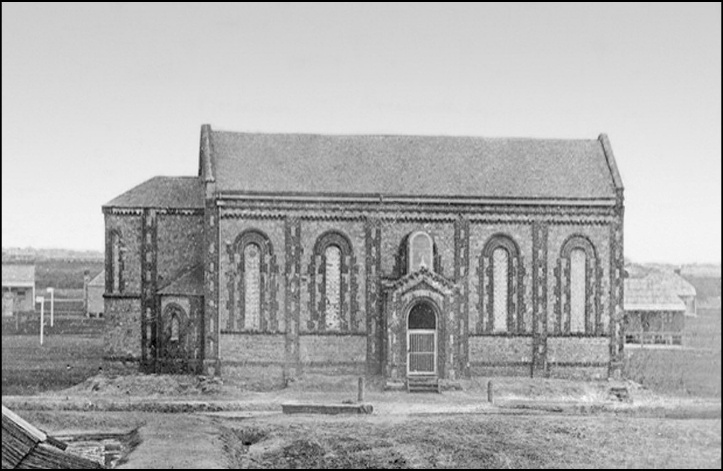
Soon after moving to Lipson Street, Ann gave birth to her second child; a boy they named Andrew Harriot Charles, after Ann’s father.[232] The birth was two days after the wedding of Bob’s youngest sister, Rosetta (Rose) Matilda, at St. Paul’s Church of England in nearby St. Vincent Street.[233] Only the third Church of England (Anglican) church in South Australia, the simple weather board building of 1841 was replaced by a new brick and stone structure in 1852, after a flood had washed the old church off its piles![234] This was probably the same flood that had earlier damaged Bob’s No.7 store, mentioned above.
Only a block away from Bob and Ann’s new home in Lipson Street the Port Adelaide railway station was being erected. It was to be the terminus of the first railway in South Australia, linking the Port with Adelaide at North Terrace. The line opened on 19th April, 1856, just twenty years after the founding of the colony. Celebrations included a sumptuous ‘champagne lunch’ provided at the South Australian Company building, right across Lipson Street from Bob and Ann’s home and shop. Their boys must have enjoyed seeing 200 guests hurrying up the street from the station in a shower of rain.[235]
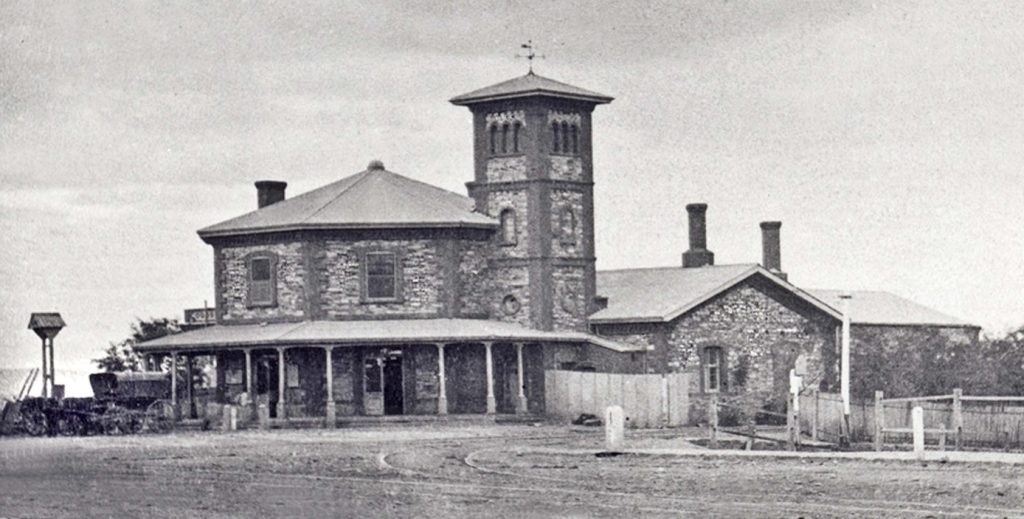
Nearly two years passed after Bob’s costly dispute with Ranford, but then he was in trouble again. This time the scene was the deck of his ship, the Empress, which Bob was preparing for a voyage to London. He had given instructions to the Mate, John Crapper, to have certain supplies brought aboard, but the mate did not comply. An annoyed Bob came alongside in a boat with the ships supplies and climbing on deck accused Crapper in no uncertain terms of not attending to his duty. Crapper claimed he was busy getting the ship ready for sea, and rolled up his sleeves ready to fight. Crapper had been drinking and Bob threatened to throw him overboard and demanded the keys to the cabin. In the cabin below deck Crapper refused to hand over the keys and waved a musket at his employer in defiance. A very noisy melee ensued, during which Bob knocked the mate unconscious. The loud tussle was witnessed by the chief officer and second mate of the S.S. Bosphorus which was tied up alongside the Empress.
The Bosphorus men watched Bob come on deck and triumphantly announce that he had ‘tied him up like a bloody sheep’ and heard him give orders that to prevent further trouble no one should unloose the mate before he returned to the vessel. Crapper eventually freed himself and came on deck with a bloody face, torn clothes and dishevelled. Four days later the matter was before the court, but the Port Adelaide magistrate, no doubt used to disputes among sailors, took a pretty mild view of it all. He found them both guilty of assault. Probably aware of their differing financial status, he fined Bob £3 and Crapper £1.[236] The Empress embarked on a fateful voyage London that same day.[237] Port Adelaide was a rough place and society was then more tolerant of physical persuasion!
Bob was in form, and eleven days later was in another punch-up. Ranford’s annoyance at Bob for opening up nearby in competition boiled over. Bob explained to the Police Court magistrate that Thomas Simpson, one of Ranford’s men, came onto his premises and ‘approached him in a surly manner, and addressed him…in a most insulting manner’. Some ‘disgraceful language’ flew back and forth, and Bob told the Court that Simpson had jostled him more than twelve times, accusing him of ill-treating his dog. Bob claimed he ‘acted with great coolness’ and made a ‘retreat to a dray which was at some distance; but then, as it was with Marmion against the rock, he could retreat no further, and struck in self-preservation.’ Simpson was ‘felled by the blow’. Then assuming the offensive, Bob ‘seized him by the throat, when a few of Mr. Ranford’s men ran out to separate the antagonists.’ The magistrate fined Simpson 10s with costs, as he had ‘put his fist against [Bob’s] face several times before he received chastisement’.[238]
The Empress Case
As mentioned earlier, Bob had purchased the Brig Empress in March 1853 from Captain Richard Newman Jnr. To begin with Bob used it for inter-colonial trade, its first voyage under his ownership being to Hobart.[239] Having sailed for London in February 1855, it probably arrived about three months later, [240] but after some time it drew the attention of Richard Newman, father of Captain Newman who had sold the ship to Bob. Richard Newman Snr then made a complaint that the Empress was stolen, and it was impounded pending a hearing in the Admiralty Court. Bob probably did not get word until early 1856, as communications were painfully slow. (The Crimean War was in progress, but the colonists were always three months behind with news).[241] Bob had to set about arranging a defence, but it was to be an expensive business.
Bob had already made substantial borrowings from Andrew Harriot, his father-in-law, and from George Elder, of Elder & Co., for in all, to finance the purchase of the Lipson Street property, some £1,700 in all.[242] The security on these loans was the Empress. [243] The Admiralty Court decision was on 28th November 1856. It transpired Richard Newman Snr was the owner, and that his son had sold it to Bob illegally and absconded with the money. Bob was an innocent party, but had no rights to the ship at law, so it was returned to its rightful owner.[244] Bob not only lost the ship but had to borrow £700 for legal expenses (about $125,000 in 2022 values).[245] So the Admiralty Court judgement was a disaster. He suddenly had no security on his borrowings, and no ability to repay them. Bob was bankrupt!
Bob’s desperate attempts to keep afloat
In October 1856 Bob made a friendly out-of-court ‘composition’ with his creditors, notably Andrew Harriot and George Elder, paying them five shillings for each twenty shillings (one pound) he owed.[246] This lost him his second fortune, but it might have been worse had it gone to the Insolvency Court. Desperate to recover every debt owed him, and stall payment of every debt he owed others, he soon found himself in Court. In March 1857 he appeared in seven cases in one day! [247]
A man named Carmichael had done some work for Bob, who had withheld payment. He had also been supplied with a large quantity of bread that was unfit for sale. Carmichael won both cases. But then Bob won his case against Mr. Buck for non-payment of provisions. However, he lost the next one to Mr. Hence for writing a cheque which was dishonoured. Bob acknowledged this before the case was heard and agreed to immediate payment, explaining that he had given the dud cheque to punish Hence for giving him ‘much annoyance by his musical performances at the opposite side of the way where they both resided.’
Next Crapper, the mate of the Empress who had been ‘chastised’ by Bob a month before, sued his employer for withheld wages. The Bench required Bob to pay, allowing a deduction of £2.10s. for a plank broken by Crapper. Then came a claim by Mr. Philips over a disputed promissory note. The legalities of the note were questionable, but it was held Bob had a moral obligation to pay up. Finally, Mr. Durrant sought payment for brickwork done and material supplied that Bob argued was not done. Bob lost that one too. The claims against Bob amounted to £56 3s 3d, and his claims granted were £29 9s 9d. So his day in court had left him out of pocket £26 13s 6d, or about $3,900 in 2023 values. What was Bob to do? His butchering business in Lipson Street was able to continue, but it was not as lucrative as he had hoped, as there was more competition.
The Port Adelaide Fire
Added to Bob’s problems was a fire that began in the early hours of a Tuesday 24th March 1857 in the Commercial Hotel. The four people asleep in the Hotel awoke to a ‘roaring crackling noise’ and managed to escape through blinding smoke before the building was engulfed. In the meantime, the inmates of the adjoining shops were aroused and with the help of bystanders frantically began clearing their goods and furniture and piling them into the middle of Commercial Road. It wasn’t long before the fire spread to the shop and house next door. These were still owned by Bob, although he had leased them to Ranford, who lost his business and home in twenty minutes.
Lake’s confectionary shop adjoined Ranford’s, then came Gates’s drapery and Michelmore’s general store. The roofs of Lake’s and Gate’s shops were soon alight, and efforts were made to stop the flames reaching the general store, which contained quantities of pitch, tar, camphine (a turpentine based lamp fuel), resin, sails, and other inflammable materials, besides gun-powder. These stores were quickly removed, and to reduce the fuel load, the verandahs of the shops dragged to the ground, then flooring, doors, and windows were torn down and the roofing ripped off, one man being injured in the excitement.
It was feared that the fire would also spread backwards towards Lipson-street, threatening Bob’s home and business. To prevent this, the paling roofs of several outhouses and a stable were removed. All the while the few fire engines available were standing unused. After an hour or so someone took command, and the spread of the fire was checked before it reached the general store. It was nearly under control by 6am, but burning debris from falling walls set fire to the roofs of several nearby buildings, including one behind Ranford’s store, only saved by the relentless help of neighbours.
Fighting the fire was a community effort, with many taking perilous risks. These included bargemen and sailors, most likely Bob was in there helping too. It must have been an anxious time for the Venn family, as the flames were only 60 to 75 metres from their property in Lipson Street. As it was, a stable in adjoining Divert Street caught fire and threatened adjoining buildings. The fire was extinguished about 7am, leaving a dreadful mess to clean up. The damage was estimated as £8,000 to £10,000 (or $1,080,000 to $1,250,000 at 2023 values). Most of the properties were under-insured, but Bob’s house which was leased to Ranford was fully insured.[248] About a month later Ransford was given permission to erect a temporary shop in a street nearby.[249]
Death of young Francis Venn
In the middle of Bob’s financial troubles, he and Ann received awful news. Their 12-year-old son Francis had been living at the Harriot family farm in Noarlunga since he was four years old. On 17th May he suddenly took ill from ‘inflammation of the bowel’, and died a few hours after medical help arrived.[250] It was a terrible blow for the Harriot’s: especially fifty-year-old Margaret. She had given birth to twelve or thirteen children, and witnessed five of her own die. Now here was another child death. [251]
BOB’S INSOLVENCY
Bob struggled on through 1857 and into 1858, hoping to trade his way out of his bankruptcy. The 1850s saw a significant influx of immigrants, driven by the promise of economic opportunities and the discovery of gold in Victoria. The population of South Australia grew rapidly, from approximately 150,000 in 1851 to over 200,000 by the end of the decade. This surge of immigrants kept the economy humming. In June 1857 the Colony’s second railway was opened from Adelaide to Salisbury, with construction underway to the copper mining town of Kapunda. In July 1858 Adelaide was linked with Melbourne by telegraph, which quickly became indispensable,[252] but the influx of immigrants slowed. Some 30 immigrant ships arrived at Port Adelaide in 1855 but by 1858 only ten came.[253] Economic development brought more competition, which limited opportunities for the quick and lucrative profits that had favoured Bob’s earlier ventures.
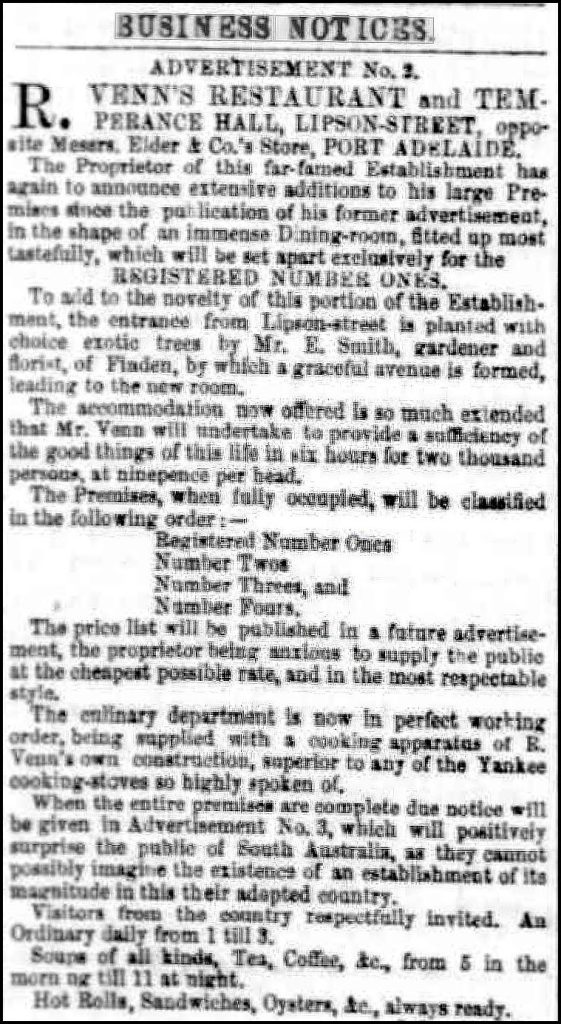
He decided to open a restaurant[257] in nearby Lipson Street to supplement the income from his butcher’s shop. He had to borrow more for repairs, improvements and fitting out the building as a restaurant, believing his businesses, albeit mortgaged, would increase in value more than his liabilities. As there was another restaurant over the road, Bob’s strategy was to provide customers with generous helpings at prices below his competitor. He applied himself to this new venture with ‘the greatest energy of character… laudable energy and perseverance’, opening the restaurant in June 1858.
Trading hours were 5am to 11pm.[254] Imagine the workload on the family! In the winter months they would have laboured by the dim light of kerosene lamps for hours. Lamp fumes, cooking odours, tobacco smoke and rowdy sailors every day. But the venture was ill-timed, and the business strategy benefited customers at the expense of profitability. Soon it was hemorrhaging money, losing £400 to £500 over two years ($54,000 – $67,000 in 1923 values).[255] There was just not business enough for two restaurants and both finished up insolvent.[256]
In late May 1858 the court approved a distress warrant, which gave Bob’s creditors the power to seize goods in Bob’s shop to the value of his debts. The forced sale of his business was also messy, with goods being needlessly sacrificed.[258] Bob was desperate, but like the Dickens character Mr. Micawber, he was always hopeful that something would turn up. One of his creditors, Charles Haimes, said he ‘always had trouble to get his money; in some instances, having had to call fifty times before he could get a settlement.’ By the winter of 1858 Haimes was insisting Bob must have cash for everything he purchased. Bob replied ‘never mind, I will make it all right after the sale’. But when asked for the money some days later Bob complained ‘you are in a hurry for your money’ and after provocative words were exchanged shoved his fist in his Haimes’ face! [259]
One of Bob’s difficulties was finding capable staff. In June 1858 two of his cooks were sometimes drunk and abusive. The first was jailed for a fortnight and forfeited his wages. The second had also purloining some articles, and was careless. ‘He would have put wrong thickening into the soup, if not prevented. He took up a paste-board, and if it had descended, as intended, on one of the black assistants, it would have split his skull; but it caught the oven, and was shattered to pieces.’ He threatened to rip Bob open with a knife! The magistrate took a dim view of this, and ordered the cook forfeit his wages and be jailed for a month.[260]
By then Bob was really struggling to keep afloat, and was withholding wages again. He owed a man named Porter three and a half weeks wages, and was instructed to pay him £5/5s [261] A few days later Bob agreed to pay Mr. Scarfe £29 14s. 10d owing for groceries sold and delivered.
One of the items auctioned to cover Bob’s debts was a box of lucifer matches. These were consigned by train to Adelaide, but not realising the box was potentially hazardous, they were not registered as dangerous goods. (There had been a number of fires on the Railway, and lucifer matches were certainly dangerous). [262] The consigner was a man named Deane, who was charged by the Railway’s Traffic Manager. He was the local carrier and collected the box from Bob and took it to Port Adelaide station. Because the box was damaged both Bob and the carrier saw it contained lucifers. After having it repaired, one of his ‘black men, gave the box to the carrier’. Questioned by the prosecutor if Bob was actually the sender himself, Bob retorted he ‘should think not – Oh, no! ’ Neither did he know ‘whether Jacky Jacky was the sender, it was delivered by one of his darkies…[he] had several of them.’ Neither did he know ‘what part he held in the affair, [he] held so many; that was why he could not tell…[he] was too busy cooking.’ [263]
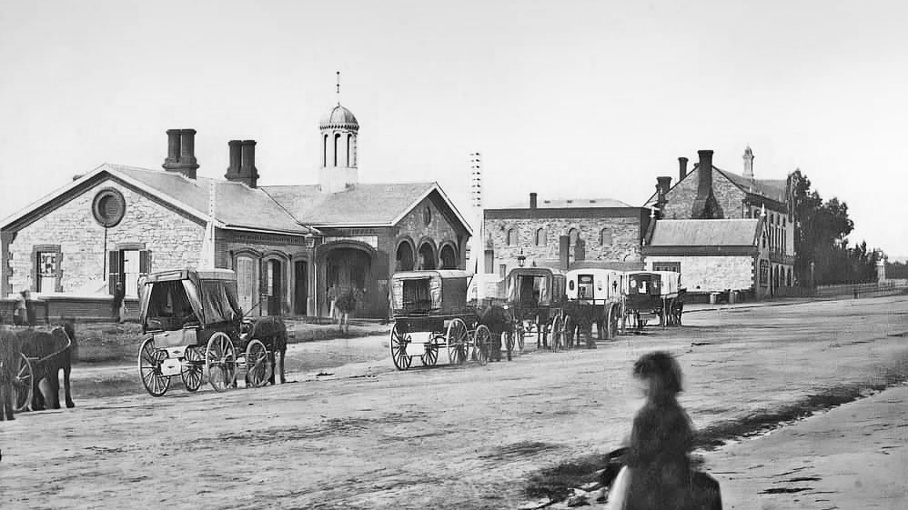
About the same time two of Bob’s creditors. Gabriel Bennett and Hurtle Fisher, sued for payment, but instead he applied for protection via a private bankruptcy arrangement on 27th August 1858. But three weeks later his petition was dismissed, at which time he should have filed as an insolvent. Instead, he sought to defend Bennett and Fisher’s action, hoping, like Mr. Micawber, to gain more time. But his time was up, and two months later he was in the dock before Commissioner Mann of the Insolvency Court. In the meantime, everything the Venn’s owned was auctioned. This included a block of land near the new railway line in Alberton, just south of Port Adelaide, and six allotments on the Lefevre Peninsula, north of the Port.[264]
Bob’s Insolvent’s Auction
Mann found that between 1st January 1858 and 2nd August that year Bob had racked up debts of £1,500 while having only £295 of assets; [265]this ‘without rational expectation of payment.’ The judge went on; ‘it is with great pain I arrive at the conclusion that the trading of the insolvent has (at least during the present year) been against good faith, and contrary to the policy of the insolvent law…
The absence of a proper cash-book, and of anything like an attempt to ascertain the profit and loss of the transactions entered into since the composition in 1856, render still more untenable the position in which he has placed himself… the judgment of the Court is that the insolvent shall be imprisoned… for the period of three calendar months.’ [266]
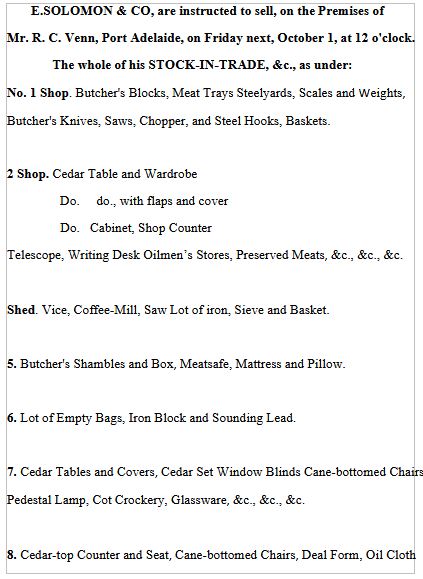
Commissioner Mann’s judgement was reluctant as he knew Bob was not intentionally fraudulent, and was aware of his family of wife and six dependent children. He was also aware that hardly one in ten butchers kept cash-books! [268] He meant it when he said sentencing Bob gave him ‘great pain’. Judges hated the insolvency law, and its reform was one of the most intensely debated issues in 19th century legislative circles. Debtor’s prisons were a disgrace, and novelist Charles Dickens helped raise public indignation that led to their abolition in 1869.[269] Mann knew what degrading treatment followed bankruptcy, and that the Venn family had already born the humiliation of all their possessions and property being listed for auction in newspaper advertisements. They were left with practically nothing.[270] Bob was jailed throughout the summer of 1858-59, but where did his family live? Most likely Ann’s father, Andrew Harriot, came to the rescue and accommodated them at Dalkeith Farm during and after Bob’s incarceration.
Andrew had twice been licensee of the Golden Fleece in Currie Street, Adelaide but had relinquished in June 1858 to James Schmidt.[271] He then appears to have relocated to his farm at Noarlunga, as he was soon offering a reward to anyone dobbing in the person shooting geese along the creek that ran through his property. ‘Should any Trespass after this notice they shall be prosecuted’! [272]
But with Bob needing work after his release, and his family needing accommodation, Andrew must have arranged with Schmidt to allow the Venn’s to ‘take over’ the running of the Golden Fleece in May 1859. But Schmidt remained the technical licensee another four months, when Bob formally gained the licence.[273] The Venn’s stayed at the Golden Fleece until mid-1860, when the licence was transferred to another.
However, it seems Bob’s mother Elizabeth found other accommodation. Just when we don’t know, but when she died in 1866, she was living with James and Rosa Grosse in Port Adelaide. The Grosse family were old friends. In 1850 James advertised as a grocer and ironmonger at Port Adelaide, and five years later married Bob’s youngest sister, nineteen-year-old Rosetta Matilda (Rose, or Rosa). The following year James was referred to as a storekeeper and also a councilor of the Port Adelaide West Ward.[274] What does a widowed mother do? Quite likely after helping out with Bob’s young children, she went to help her own daughter establish a household.
Bob’s heart for battlers
An aborigine called Jemmiza, the servant of a Port Adelaide fruiterer, was charged with embezzling £1 16s 6d. The magistrate reduced the sentence to four months due to a good character reference given by Bob.[275] (Bob had been sentenced himself only six days earlier). Benjamin Boothby, the judge who sentenced Jemmiza, was disliked in Adelaide.[276] Some months later he was hearing a case against Catherine Rafferty, who had been working as a cook in the Black Bull Hotel in Hindley Street. She had almost certainly been framed for the theft of wine to the value of £1/1/8d – about $200 in 2023 values. After her dismissal from the Black Bull, and prior to her trial, Bob and Ann had employed her at the Golden Fleece, and gave her a character reference as ‘a most sober, honest, and excellent servant… [and] he would take the young woman into his service as soon as she was released.’ Boothby said ‘he was glad to hear it and complimented Mr. Venn for his humanity and kindness’ but still sentenced her to one month’s solitary confinement.[277] Bob’s recent time in jail would have impressed on him what how hard prison was, and how all prisoners dreaded solitary confinement. At the time of his sentence Bob was 42 years old, but after his release he still kept getting into trouble!
Bob was encountering some of the colony’s miscreants too. Richard and Eliza Collins were a pair of thieves – she having several aliases. They were being followed by a couple of policemen, who noticed them enter the Golden Fleece. Sergeant Badman tapped them on the shoulder and placed them under arrest. Richard was tightly clutching five £1 notes in his fist, and taking the two of them into an adjoining room with Bob’s help, they searched and found another £1/3/10d in silver and copper coins; a total of £6/4/2d. This this pair had pinched about $1,130 in 2023 values! As he was being led away, the culprit was heard to complain ‘You were so damned sharp on us; I suppose you were waiting for us. It was only out of spite because I bailed her out.’ [278]
Bob had an unwelcome visit from the law himself. Inspector Reading had noticed ‘impure water’ running from the Golden Fleece into Rosina street and ‘traced it positively … from a drain in Mr. Venn’s yard, where he also saw some boiled carrots’. It was not the first time this had happened, as the previous licensee had been similarly charged.[279] Bob conducted his own defence, as two boarders at his Inn attested to the ‘clean and wholesome state in which Mr. Venn kept his premises’. More likely, this was due to his wife Ann’s efforts. Bob assured the Police Magistrate that ‘the drain alluded to was one made for the purpose of carrying off the water pumped out of the cellar. The carrots which were seen were merely the leavings of his poultry, as the waste of the table was always thrown down at that spot for the consumption of the winged members of his family; and if the Inspector had waited their returning appetite, his anti-vegetable eye would not have been offended with even the ghost of a boiled carrot’. This was Bob in fine fettle. Mr. Beddome SM had encountered Bob before, and was no doubt smiling. Nevertheless, because the Inspector ‘had sworn positively…he could not avoid imposing a fine.’ So, Bob had to fork out 10 shillings plus costs.[280]

A few weeks later Reading called again to investigate the same drain. He was the Inspector of Nuisances (!), and was accompanied by Mr. Coles, the Parklands Ranger. Bob gave them a very hostile reception accompanied with some very bad language. The pair charged Bob with Obstructing a Corporate Officer, but they had neglected to obtain a warrant so Mr. Beddome ruled that the ‘objection was fatal, and the information was dismissed’. But the offended officers had another card, and charged Bob with Abusive Language. This time Mr. Beddome ‘expressed himself obliged to levy a fine of 10 shillings and costs.’ [281]
A disappointing fishing venture
During 1859 and probably into 1860 Bob was under insolvency protection, and sometimes had to appear before the Insolvency Court.[282] But he was allowed to run the Golden Fleece, although it appears that Ann was actually the manager. It was she who advertised for a cook and a housemaid in August 1859.[283] Bob was launching a new venture next door. He called it ‘The South Australian United Fishing Company’, and its catch would be sold three times a week.[284] He chartered the cutter ‘Sarah’ and employed William Williams and a crew to sail her to fishing grounds near Kangaroo Island. Bob’s sanguine expectation of 10 to 13 tons of fish a week was quickly dashed. Three weeks later Bob terminated the venture and was soon in court again before Samuel Beddome.
Bob explained he had ‘made a most beggarly return of the venture, the most successful of the trips resulting in the catch of 60; and the last in which he was out eight days, yielding the enormous number of seven, and those with fins of microscopic size.’ After the third trip, Williams told him ‘that the punt and two seines [nets] worth £40 had been sacrificed to the perils of the trade, and [after bringing] to him that agreeable news, he made a demand for his wages £11.’ Bob ‘did not lose his pluck by the ill success of the…endeavours, and told him not to despair, but try again; but instead of exhibiting the same hopeful spirit as his master, he declined to repeat the experiment and at the same time told him that he intended to try his luck amongst the cannibals of Feejee. Upon hearing this [Bob] refused to pay him his wages.’ Magistrate Beddome ruled that Bob must pay Williams £10 and costs of the Court forthwith.[285]
Undeterred by the failure of his fish venture, Bob arranged to sell vegetables. Then a week later he had expanded into selling game – ducks, teal, quails, landrails, plover and lots of kangaroo ‘hourly expected’. He had also found another supplier of fish from Kangaroo Island.[286] Sadly, the second fish venture failed too, and after a month was auctioning all the equipment of the ‘South Australian Fishing Company’ ‘bv order of the Manager and Director, R. VENN.’[287] But he was soon advertising 60 native geese for sale,[288] and for ‘a good Lad, to look after Horses, and make himself generally useful’ [289] He would not have to pay a boy much.
It was a difficult year for the Venns. While still a bankrupt, Bob had creditors chasing him in the courts. In September 1859 he had three actions pending against him, with some more to come.[290] The first of these heard before Commissioner Mann was an action for £7 19s. 6d., for work and materials unpaid, but Bob claimed the sum was set-off by board and lodgings he provided at the Golden Fleece. The reporter for the South Australian Advertiser often relished Bob’s appearances: –
‘There was nothing remarkable in the case, except the manner in which the defendant gave his evidence, which excited a good deal of merriment in Court, as he described the beautiful dishes he had prepared for the plaintiffs, and the extreme gusto with which they always partook of them. He said it seemed they had been laboring under the mistake that he sumptuously fed people, and never giving them less than four courses, for nothing. The plaintiffs had told him they expected to be entertained gratis, because they were friends, but he declined that reason, because he knew he had “not no friends in this ’ere blessed world,” and besides, he said, “publicans has no friends except wot pays!” The defendant’s eloquence, pathos, and fun was rather good, and the proofs in support of his plea produced by his counsel still better; so good indeed, that he got the verdict.’ [291]
The next day Bob was not so lucky. Mrs. Elizabeth Smith had been caring for his wife Ann as monthly nurse, at 25s. per week (about $225 in 2023 values). This was probably before and after the birth of Ann’s fifth child at the Golden Fleece on 15th July 1859.[292] She had been pregnant every year for six years, and was also busy as Bob’s bookkeeper and managing the hotel.[293] Not to mention mothering her children: by then a girl and four little boys. Elizabeth Smith attended Ann five times and was paid, but then she remained with Ann for 11 weeks. She admitted a set-off of £3 5s. 6d (about $600 in 2023 values) for board and lodgings at the Golden Fleece, but Bob had underpaid her, claiming she had overcharged. Commissioner Mann disagreed, and awarded Elizabeth £5 10s and slugged Bob with £3 14s. 6d Court costs. Ouch! [294]
The next month Bob had four more actions against him.[295] One of these was a man named Dodgson, who sought to recover £10 11s. 2d. for goods sold and delivered. Clearly Bob knew he hadn’t a leg to stand on, and Commissioner Mann made him pay up.[296] Bob was under bankruptcy protection, which enabled him to defer payment to creditors for a period, but it did not apply in this case.[297] Another of the four cases that month was brought by a man named Bennett. The case was not reported in the press, but it seems to have resulted in a forced auction of Bob’s furniture at the Golden Fleece.[298]
Soon afterwards he was before Commissioner Mann again, accused of purchasing two horses and a cart for the purpose of carrying on business, but Bob said that as a dealer he intended to sell them again. He had already sold the cart. In the course of the hearing Bob said he had shaken hands with his creditor Goodman Hart, who was a brother Freemason. Mann cautioned Bob against disposing of any of his property, except in the way or legitimate business, and allowed Bob to remain under bankruptcy protection. [299] Nevertheless, he had to pay his debt to Hart of £7.10.0 plus Court costs of £6.5.10.[300]
It looks like Bob was chastened, and a few days later decided to sell his fish, game and vegetable business, which he euphemistically termed his Fish Depot and Refreshment Rooms, as he was ‘retiring from that business’.[301] He was in a spot of bother for using unstamped weights and measures. Bob pleaded before Mr. Beddome that as a dealer and chapman he kept them for sale and not for use; that he dealt in all sorts of commodities, fish, flesh, fruit, vegetables, horses, carts, brooms, shovels, spades, and a variety of other things. Beddome, now well acquainted with Bob, queried why the weights were ‘found lying near the commodities which were exposed for sale’ and ordered him to perfect the weights and pay £1 costs.
Two weeks later Bob was yet again before Mr. Beddome, this time for whacking his servant on the head and shoulders with a fish! Edward Deery had upset his employer by selling fish too cheaply, and wrapping them in newspaper which cost 4d. (about $3 in 2023 values). Ed’s response was to immediately up and leave without giving notice, which was an offence under the Masters and Servants Act. The longsuffering Mr. Beddome fined them both 5/- (about $45 in 2023 values).[302]
In December 1859 hearings were held that seem to have released Bob from Bankruptcy.[303] Bob spent the following year quietly, continuing to maintain business at the Golden Fleece with Ann. A happy event that year, especially for Ann, was the marriage of her sister Young Catharina to Rudolf Wilhelm Emil Henning at Dalkeith Farm, Noarlunga.[304] It is likely the Venn’s and Harriot’s all attended the Grand Championship Ploughing competition and agricultural show at Parkside in Adelaide two days later. Andrew entered his draft horse ‘Young Lion’ and his thoroughbred horse ‘Vanguard’ but neither won prizes. No matter, it was a holiday with beautiful sunny weather, and the Show being so close to the city, a large number of visitors attended, including ‘a fair sprinkling of ladies’.[305]
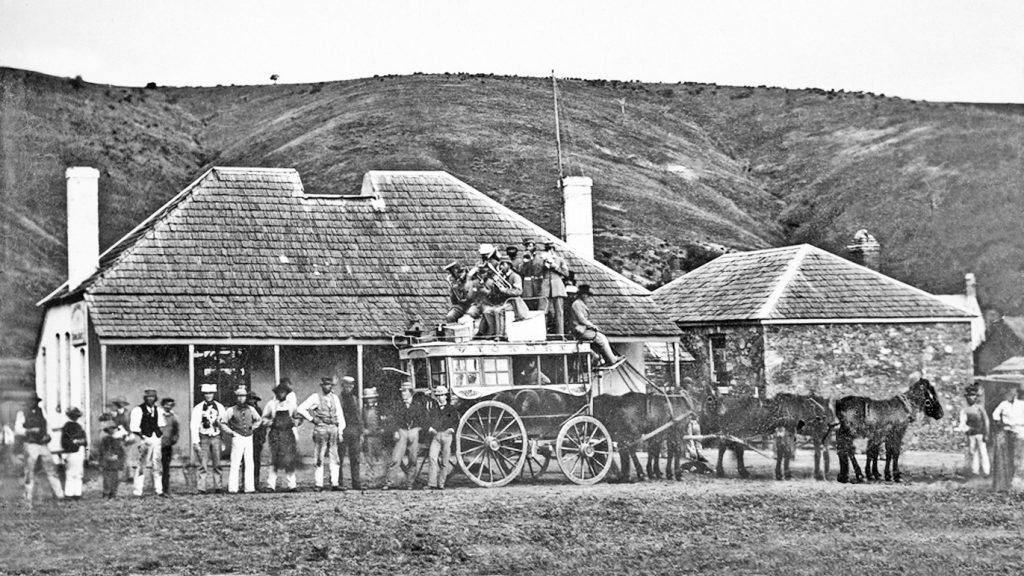
As mentioned earlier, Andrew had been granted the licence of the Guthrie’s Hotel in April 1839, the year after he landed in the infant colony. He renamed it the Edinburgh Castle, and kept the licence for seven years, then taking the Golden Fleece instead. He took the Edinburgh Castle again briefly in 1852-53, then took the Golden Fleece again in 1855, holding it for three years. During that time, he would travel between his hotel in Currie Street and Dalkeith Farm by the Willunga stage coach driven by a man named O’Brien, who received free meals at the hotel.
When the Golden Fleece licence passed to another man in 1859 unsuspecting O’Brien kept helping himself to the hotel’s larder, unaware that this privilege was no longer valid. A few months later the new licensee presented him with a bill for £1/5s! We may wonder if Bob and Ann restored O’Brien’s privilege when, with Andrew’s help, they took over the Golden Fleece’s licence in September 1859.[306] After six months Andrew resumed the licence of the Golden Fleece, but only briefly, before Goodman Hart was granted it in June 1860. Hart had been one of Bob’s creditors and may or may not have allowed the Venn’s to stay on.
It seems they found digs half a mile or more away in Wright Street, where Ann’s sixth child, George William, was born in February 1861.[307] Six weeks later the family moved back to the Edinburgh Castle at 233 Currie Street, which remained their home for the next twenty years.[308]
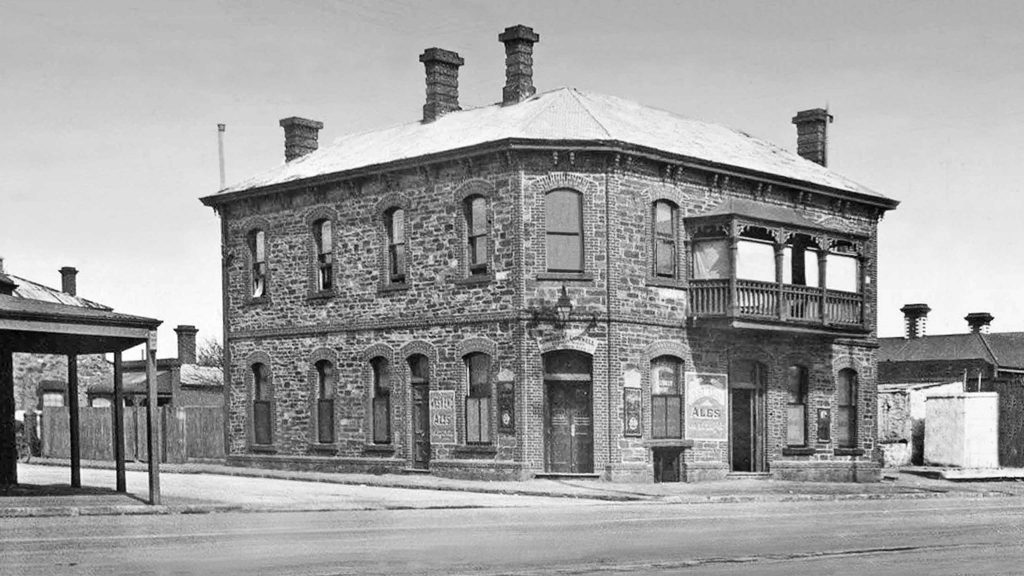
Bob described the location as ‘beautiful west end’ of the city, but it was basically a residential area. The Railway Station and Holy Trinity church were half a mile’s walk, as were the business and shopping centre in King William and Rundle Streets.
Bob starts again as a Butcher.
The hotel included a large yard which Bob immediately set about improving, building a butcher’s shop on the Gray Street frontage. He advertised its opening in July 1861.[309] To drum up awareness of his new venture, Bob needed something to spice up his advertisements. It seems he knew a Member of Parliament who enjoyed using doggerel in his speeches, and enlisted his talent. Or so thought a correspondent to The Advertiser, who wrote ‘no doubt Mr. Venn, who is a knowing one, pays the hon. member for Mount Parnassus to do it for him. [310]
Ye friends of monopoly listen awhile,
And ne’er let ambition your prudence beguile,
Remember those fine Butchers that made so much speed,
And learn from R. Venn how to take heed.
These men with their partners once had all the run;
To impose on the public they thought it good fun,
Till R. Venn stepped in to their aid,
Then the fair alteration was made. [311]
Whether it was the doggerel or Bob’s low prices, the advertisement worked. A week later he was giving his ‘sincere thanks for the liberal patronage so bountifully bestowed on him, particularly by his neighbours and Irish friends, with some of whom he sailed many years ago.’ [312] (Less than five years earlier when seeking a maid to help Ann, he stipulated ‘no Irish need apply’ !)[313]
Two months later Bob was advertising that he had ‘completed all his arrangements’ and now ‘has got the BEST VENTILATED BUTCHER’S SHOP in the province’. Presumably this meant he had completed fitting out the shop behind the Edinburgh Castle so he could ‘carry business out in all its branches’ and continue to undercut other Adelaide butchers![314] While Bob was busy with the butchering, Ann was looking after the Hotel, and needed assistance. She had a large family to care for. Of her surviving step-children, it is likely that 14-year-old Frank and 12-year-old John were still at home, but her eldest daughter Margaret was nearly eight years old and Andrew nearly seven, so they may have been of some help. Thomas was five, Joseph four, Francis two and baby George only nine months old, so she had her hands full, and advertised for a ‘female servant’ in early November.[315]
Bob had been friends with another butcher, Charles Wadey, for about 20 years, but now competition led to a souring of their relationship. Soon they were in the Police Court, once more before Magistrate Samuel Beddome.[316] Bob charged Wadey for assault. It appears Bob had sent a ‘little boy’ with four shillings to collect a fore-quarter of mutton. This boy was probably Andrew Harriot Venn, who was then 4½ years old.
The meat supplied was ‘so hacked about’ that Bob returned it. Wadey refused to provide a replacement, so Bob walked down and found Wadey ‘all excited with his hair sticking up on end like porcupines’ quills – (laughter) – and if it hadn’t been for his having a little ‘science’ which was bred and born in him, for he was a cousin of Tom Spring’s,[317] the champion of England – (loud laughter) – defendant would have fetched him a blow in his ‘peeper.’ (Laughter).’ Wadey threatened to ‘punch his ___ head. Mrs. Wadey then urged him on, saying, ‘Go it, Charles; give it him, Charles:’ and all the little ‘uns urged him on too.’ At that Bob said he ‘beat a retreat across the road’.
Wadey in defence said ‘You called me and Mrs. Wadey liars. My fist might have been near enough to your nut to frighten you. (Laughter.) [I] did not assault you by saying that you shouldn’t have the money nor the mutton either. (Laughter.)’
Wadey made a counter charge. It all occupied some time, and kept the Court in roars of laughter at Bob’s manner. But Beddome ultimately dismissed both, and required each of them to pay five shillings costs. He thought they might each bring an action against the other for abusive and insulting language.[318]
Wadey was represented by a solicitor named Wrigley, who had had a number of previous encounters with Bob, including his bankruptcy hearings.[319] A month later Wrigley was defending Gabriel Bennett, whom Bob had charged with assault. When Bob rose to speak, Wrigley objected that he was ‘a notorious lunatic, a mad fool, and it would be a disgrace for the Court to allow him to give evidence’. Stipendiary Magistrate Beddome cautioned Wrigley for using such language, but nevertheless dismissed the case.[320] Bob was probably stretching the Magistrate’s patience, as only a week before he had been in Court charging a customer for assault. The man had fumed that Bob’s meat was not fit for cats to eat, to which Bob responded with ‘some opprobrious epithets to the defendant, who struck him under the right ear.’ By now well acquainted with Bob’s shenanigans, Mr. Beddome found the customer guilty of assault but only fined him a shilling and costs – just $10 in 2023 values! [321]
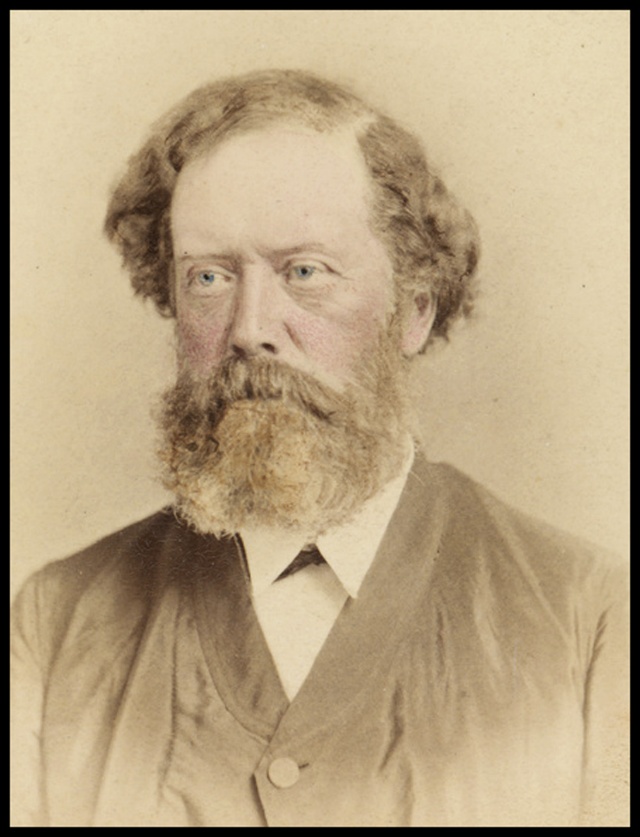
Bob was still struggling. Despite a good start with his butchering business, these cases show he was still in the woods financially. A month after the Wadey altercation, Bob was charged for withholding payment for meat supplied amounting to £10. 18s. (about $2,000 in 2023 values). The Court ordered him to pay up.[323] Soon after he was again before Mr. Beddome, this time charged with ‘feloniously taking and carrying away an adze, value is 6d.’ from an Auctioneer. The selling price of the adze was 1/6d. (about $14 in 2023 values), but Bob put down 8d. and walked off with it. This was the second time he had played this trick. Mr. Beddome acquitted him of a felony, but made him pay the difference and warned that if he played such a trick again, he would be put on a good behavior bond.
Bob had advertised for an assistant butcher a month or so after opening.[324] He employed Henry Shaw at £1. 3s per week, and after a month increased his wages to £1. 5s. Shaw subsequently left, and sued Bob for eight days unpaid wages. Bob did not appear, and Mr. Beddome ordered the wages be paid with costs.[325]
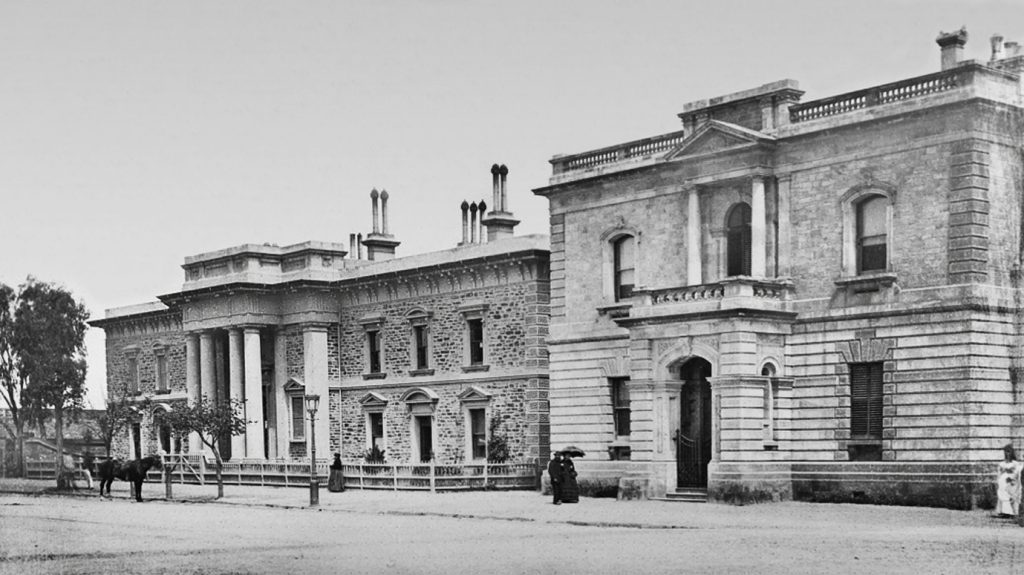
The very next day Bob appeared, explaining Shaw had left his service with insufficient notice, and that his negligence had caused the loss of ‘a good deal of meat’. So, Mr. Beddome, with the wisdom of Solomon, ordered Shaw to forfeit a week’s wages and pay costs, therefore ensuring neither of them won! [326] This effectively ended over a decade of litigation involving Bob, both as a plaintiff and a defendant.[327] He was slowly getting on his feet again after the Brig Empress disaster and his ensuing bankruptcy. But he had one more foray into the public limelight.
BOB STANDS FOR PARLIAMENT
One evening in late November 1861 there was a meeting in the West-terrace Hotel to nominate a man to represent Adelaide in a forthcoming election for the South Australian parliament. Captain John Hart had lost his seat of Port Adelaide in the previous election and was trying for re-election. (He later became Premier). He was opposed by a 30-year-old barrister and radical, James Boucaut. (He also had a distinguished career, later serving as Premier and also a judge, and receiving a knighthood). Boucaut opposed assisted immigration at public expense, which was the hot issue of the day, as the economy was in recession. Hart favoured immigration, and in an attempt to split the vote for Boucaut, his supporters nominated Bob Venn. This was carried ‘amidst deafening cheers’. [328]
It all happened quickly, probably none being more surprised than Bob. John Hart had been one of the early seafarers at Port Adelaide and would have known Bob well.[329] The sitting member resigned on 21st November, and nominations to fill the vacancy closed just two weeks later, and the election just four days after that.[330] Bob called himself ‘The Working-man’s Friend.’ [331] He made his policy speech at the Cumberland Arms three days after his nomination, where a Boucaut supporter said:
Two days later there was a rowdy meeting at the Hamburg Hotel. The Chairman called on Captain Hart, who ‘was received with groans and cheers’. He was followed by Boucaut, who drew attention to the fact that the Secretary of Hart’s Committee arranged for a friend to propose Bob, and ‘got a German to second him, and then got Mr. Venn to sign the acceptance of the proposal. If they allowed themselves to be hoodwinked in that way, the working men of the colony were not worthy of their suffrage.’ Boucaut was expressing the reserves of many, that uneducated working men could not be trusted with the responsibility of the ballot.[333] Only five years earlier, in 1856, South Australia made a law giving all adult men the vote; only the second place in the world after France to introduce universal male suffrage.
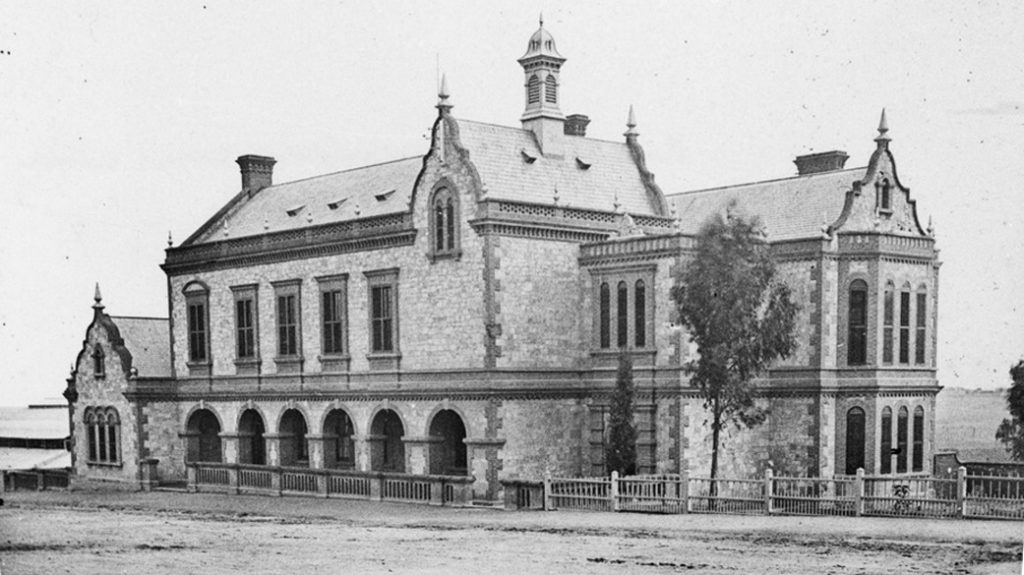
(SLSA B-41734)
But Bob relished the opportunity! The Chairman ‘proceeded amidst some confusion, which increased into a deafening roar as Mr. Venn was announced. Mr. Venn made his way to the gallery… amidst loud cheers, hisses, catcalls, confusion, and cries of “Put him in the Asylum.” He repeated the gist of his policy, lapsing into mock German in a nod to that section of the colony’s settlers.
‘Mr. Venn commenced – Brother Workmen, Fellow Citizens – I did not think to come here tonight, but I was sent for, and I am always at your service by night or by day; but I can’t neglect my own business. (Laughter.) As sure as the sun rises and sets I’ll never deceive you, and if you have any cause to say that I have done so, that moment I’ll leave that House. I aint to be taken in by the limbs of the law, and if they don’t retract vot they’ve said agin me, vy-(here Mr. Venn clapped his hands). I’m a cousin of Tom Spring’s (shaking his fist, which excited loud laughter). Ve don’t want no immigration, and ve vont have it. We broke the great monopoly in meat, and I’ll break all the monopolies in the colony. I came here in the year 1838, and I sailed all round the colony before there was any inhabitants. (Laughter.) I’ll always do my best for you all, and for my friends the working men.’
An Elector asked Mr. Venn’s opinion on the law of primogeniture and entail? Mr. Venn hadn’t exactly made up his mind, but he’d be very happy to give that gentleman a blow out of kangaroo-tail soup, or mock turtle if he wanted it.
Another Elector asked if Mr. Venn had considered the probable operation of the new Dog Act, and whether he would be prepared to reduce the price of mutton pies and sausages when it came into operation. The CHAIRMAN could not allow so insulting a question to be put.
Bob fielded other questions like this and must have enjoyed the fun, but when it came to a vote, Boucaut received a large majority. Bob got few votes and Captain Hart not much more. [334]
But next day a meeting at the Golden Fleece found Bob amongst many friends, and enabled him to answer more questions. Asked if he thought there were a lot of ‘duffers’ in the House of Assembly, Bob said ‘I rather think so. When I go there I’ll overhaul all their contracts. (Laughter.) I will visit the Gaol – (laughter) and see that every prisoner gets his just due. I’ll go to the Asylum too – (loud laughter)-and see that the contractors deliver to the inmates what they are paid for.’
Asked if he would push the Bills through the House as fast as possible, Bob replied ‘Oh yes; I’ll try to represent the locomotive steam engine as much as I can. (loud laughter).’ Another said ‘There is a lot of immigrations coming out. (Loud laughter.) Would you like to see the Germans come here at the public expense as well as the English? ‘Most decidedly’ said Bob, ‘I have no objection to foreigners coming here, exceptin’ those fellows the Chinese. (Loud laughter.) I know them beggars too well. (Continued laughter.)’ Here he was voicing the widespread prejudice that was to remain in Australia for over a Century.
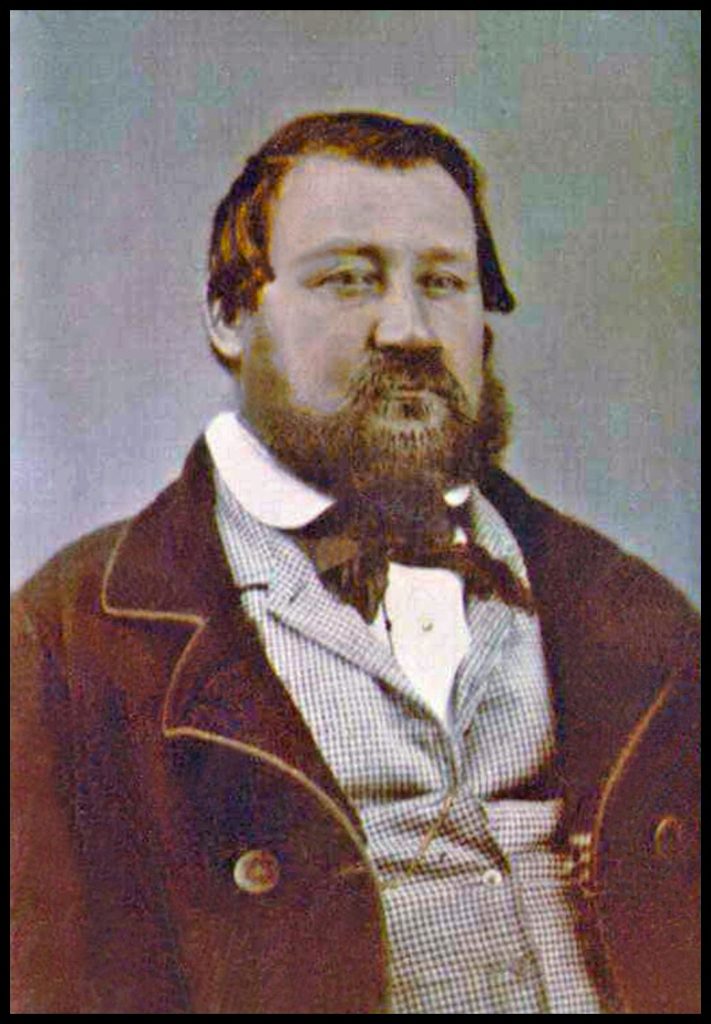
A man named O’Reilly claimed he had ‘seen Mr. Boucaut go into Mr. Venn’s house and try to buy him over. (“Shame.”) …He would propose “Mr. Robert Venn as an honest man and a fair representative of the working classes in the House of Assembly.” (Loud laughter.)’ This was seconded, then the Chairman put it to the vote, which was carried.[335]
The Boucaut camp were clearly worried, but on election day their concerns vanished. It turned out to be a two-horse race. Boucaut received 638 votes, Hart 583 and Bob just 45. Therefore, even if Bob had not stood, and all his votes had gone to Hart, Boucaut would still have won.[336]
SETTLING DOWN
The excitement and publicity Bob received during his brief tilt at politics ended over a decade of litigation, and for the next decade he settled down, keeping busy providing for his growing family. His eldest boys (by his first wife Katherine), Robert Evans and Henry Whittal, had moved away to Robe. This was a town on Guichen Bay, on the South-East coast of the colony, then South Australia’s second port. Bob’s friend George Ormerod owned the jetties and the General Store at Robe, and was a very successful Shipping Agent. Between 1856-66 he shipped close to £2 million worth of wool, mostly direct to London. It was probably during Bob’s bankruptcy difficulties that Ormerod gave young Robert a job. In Robe he boarded at the Caledonian Hotel, and must have done well. Robert was nearly 21 years old in January 1861 when he entered his horse ‘Ben Bolt’ in the local races, where it won a couple of heats.[337] He and his then 15-years-old brother Henry were Private soldiers in the Robe Volunteers (Robe Town Rifles), a militia corps.[338]
George Ormerod’s cottages were used as barracks for British troops in 1857, sent to control an influx of about 15,000 Chinese. They landed that year to avoid a poll tax imposed by the Victorian government, and then walked to the Goldfields, the closest of which were 150 miles away. The influx subsided but Robert stayed and became a successful district identity, [339] and Henry subsequently became a Western Australian pastoralist, explorer and politician.[340]
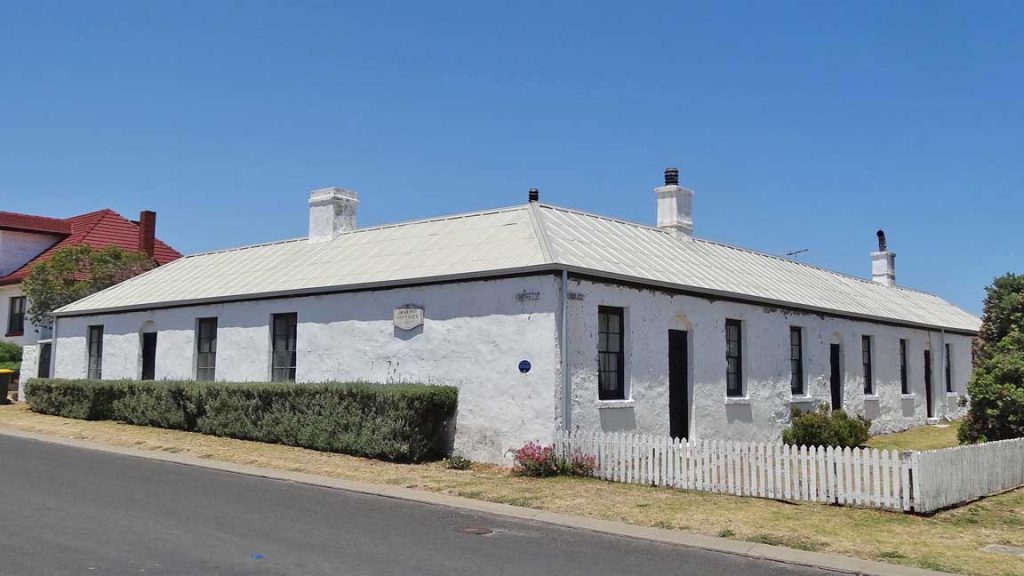
Andrew at Dalkeith Farm
With the Venn’s living at the Golden Fleece and then the Edinburgh Castle, Bob’s father-in-law Andrew seems to have settled down at Dalkeith Farm, Noarlunga.[341] However, we may conjecture that he made the 2½ hour stage coach trip to Adelaide[342] on business, and probably stayed with Bob and Ann. It seems that Andrew was granted a slaughtering licence at Noarlunga in July 1860, a month after his licence for the Golden Fleece was transferred to another.[343] Andrew had been a flecher (butcher) in Scotland in his youth, and was always around farm animals. He put a notice in the newspaper six months later, signed ‘And Harriot, Dalkeith Farm’, and shortly afterwards gave a good character reference to a local man wrongfully charged with stealing wheat.[344]
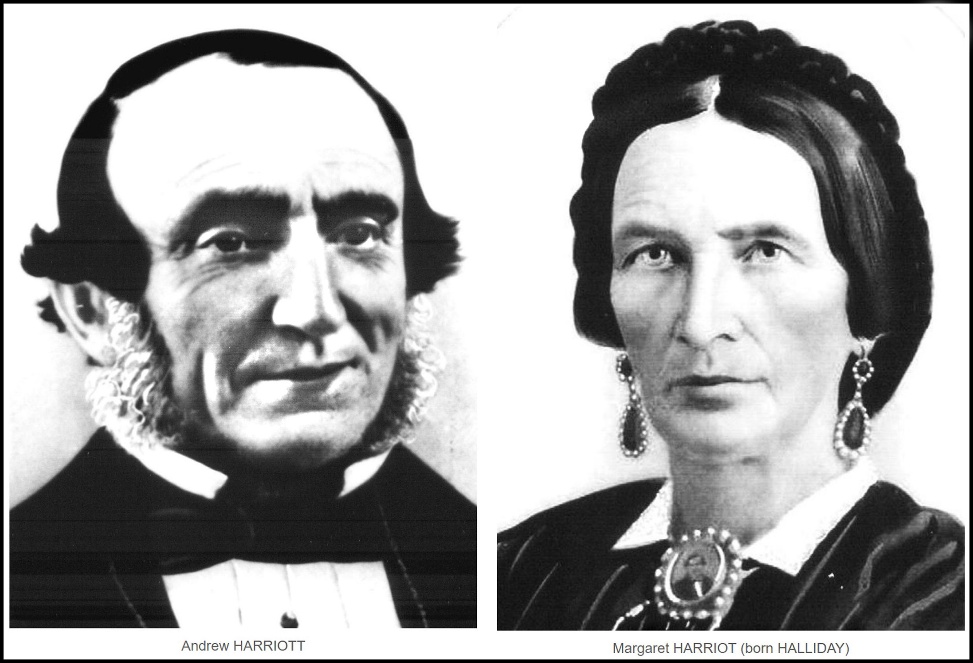
circa 1863
Andrew had long loved horses and in the winter 1861 was offering his powerful ‘Entire Draft Horse’ of 16 hands named Emperor to district mares for £2 10s per service.[345] The services of his thoroughbred horse Vanguard were similarly advertised for £1 3s. Every nine days Vanguard made a round trip to Yankalilla, stopping one night, and home by way of Myponga the following day.[346] In October that year he entered a fat stall-fed bullock in the annual Livestock Show in Adelaide. It was a fine beast, but came second to Prince Albert, who ‘was a universal object of attraction’.[347] These stud animals were probably earning Andrew thousands of dollars a week in 2023 values. (One wonders what the colonists thought of a prize bullock being named after Queen Victoria’s beloved husband, who was still very much alive!).
In early 1862 Andrew tendered for and won the contract to build a bridge over Harriot’s Creek, near his property. The contact was for £150 plus extras (about $30,000 in 2023 values). He arranged for a neighbour named Adams to supervise construction of the low timber bridge with masonry wing walls. It was finished by mid-year and provided district famers carrying their produce a welcome shortcut to the Noarlunga jetty for shipment to Port Adelaide.[348]
In August 1862 the Agricultural and Horticultural Society held its annual ploughing match at Stepney, just north of the city. Andrew entered his stud horse Vanguard, which won £3 (second place) but his big draught horse Emperor failed to win a place. A few days later he put Emperor up for auction.[349] The following October Andrew was one of the judges of pigs at the Society’s annual Show of Stock, held at the Adelaide Cattle Yards. ‘At early dawn the approaches to the great rendezvous were filled with a heterogeneous throng of horses, sheep, oxen, and swine… and the stalls, yards, and pens one after another became filled with restless and noisy occupants. Such a scene can only be witnessed once a year…[providing] encouragement and promotion of friendly rivalry among the various stock producers [which] cannot easily be overrated…’ This was Andrew’s domain; he clearly loved being around animals. But his stall-fed bullock again failed to win a place.[350]

The annual Morphett Vale races in February 1863 provided the opportunity for Andrew to try his luck with his horse Gamecock. A race track was prepared in the paddock of the Wheatsheaf Inn, and spectators enjoyed the day. But Gamecock was unplaced in both heats.[351]
Nevertheless, Andrew did not give up, and was exhibiting again at the Show of Stock near Adelaide in October 1863. His draught horse Scotchman was unplaced, but we wonder what Andrew felt when Emperor, the horse he sold the year before, probably because it failed to win a prize, came second with a £1 prize for its new owner.[352]
It looks like this discouraged Andrew, as no other record can be found of his animals being exhibited. But he was persuaded to enter his horse Gamecock in the New Year’s Day ‘Hack Races’ at the Noarlunga racecourse. Only local residents could enter, and with competition thus limited, Gamecock won both heats easily, but his horse Fisherman was unplaced. Nevertheless, ‘the lovers of the sport enjoyed themselves much’ and we imagine Andrew was among them.[353] Two weeks after Easter that year Gamecock came first at the Morphet Vale races.[354] A happy event that year was the marriage of Andrew and Margaret’s 19-year-old daughter, also called Margaret, to William Goldsmith.[355]
Andrew was then 60 years old, and decided not only to retire from racing and exhibiting, but to give up farming altogether. Early the following year, 1865, he advertised the auction of his ‘Blood Horses Brood Mares Harness Horses Plough and Draught Horses Saddle Horses Colts and Fillies Working Bullocks Cows and Calves Pigs, large Stacks of Hay Reaping, Thrashing, Moving, and Winnowing Machines Ploughs, Harrows, Drays, Carts Harness, Spring-Cart &c’ [356] But it appears the auction did not take place, as over a year later he was warning shooters and trespassers they would be prosecuted and stray livestock impounded. [357] What gave him second thoughts?
Two Deaths
As noted above, by this time Bob’s mother Elizabeth was living with James and Rosa Grosse in Port Adelaide. James was a grocer and Port Adelaide councillor, but also served the local Congregational Church as the Superintendent of the Sabbath School, which had 99 students and sixteen teachers.[358] In addition to that he was the Treasurer of the Church and the Depository of the local branch of the Bible Society.[359] But James he was acquainted with suffering.
They had two daughters,[360] but his wife Rose was in poor health, and further children were unlikely. Perhaps that is why Bob and Ann’s eighth child was named James Grosse, after his uncle. The lad was born in October 1864,[361] when Elizabeth was 71 years old, and probably feeling the strain of nursing her daughter Rose. The summer of 1865-66 was very hot and dry in Adelaide,[362] so much so that concerns were held about the quality of water remaining in the City’s reservoir.[363] It must have been the last straw for Elizabeth. She died at James Grosse’ home on 29th January 1866.[364] She was 72 years old, and some four weeks later Rose also died ‘after a painful illness, borne with Christian fortitude, and in the sure hope of a joyful resurrection.’ [365] She was just 30 years old. So Bob lost his mother and a sister within 32 days of one another, which must have been a grievous time. Their grief was alleviated a few months later by the birth at the Edinburgh Castle of Ann’s ninth child, a boy they named Charles Rudolf Arthur.[366]
Bob Gets Back on his Feet
After opening his butcher’s shop next door to the Edinburgh Castle in August 1861, Bob’s business slowly improved, as he was able to afford a gift of £1/1s to the Lancashire Relief Fund in September 1862. About $190 in 20223 values, this gift was to help textile workers out of work due to the shortage of cotton during the American Civil War. [367]
His litigious days were all but over too. The only reference to a case was in September 1864, when a man called Hickey was listed with a case against Bob. Nothing seems to have come of this.[368]
The following year Bob and Ann’s family expanded again, with the birth at the Edinburgh Castle of Elizabeth Emily Catherine, their seventh child.[369] In 1864 their licence for the hotel was renewed.[370] The City Council must have thought the Edinburgh Castle was thriving, as it levied a substantial 31 percent increase in rates for 1864 compared with the previous year. Bob appealed, and succeeded in having the assessment reduced from £55 to £30.[371] Perhaps this had something to do with his complaint about state of the water-table in Gray-street, which was referred to the Public Works Committee.[372] Later that year he offered his services to the Council as Inspector of Cattle, to prevent the slaughtering of diseased cattle in the City.[373] It is not known if his services were accepted.
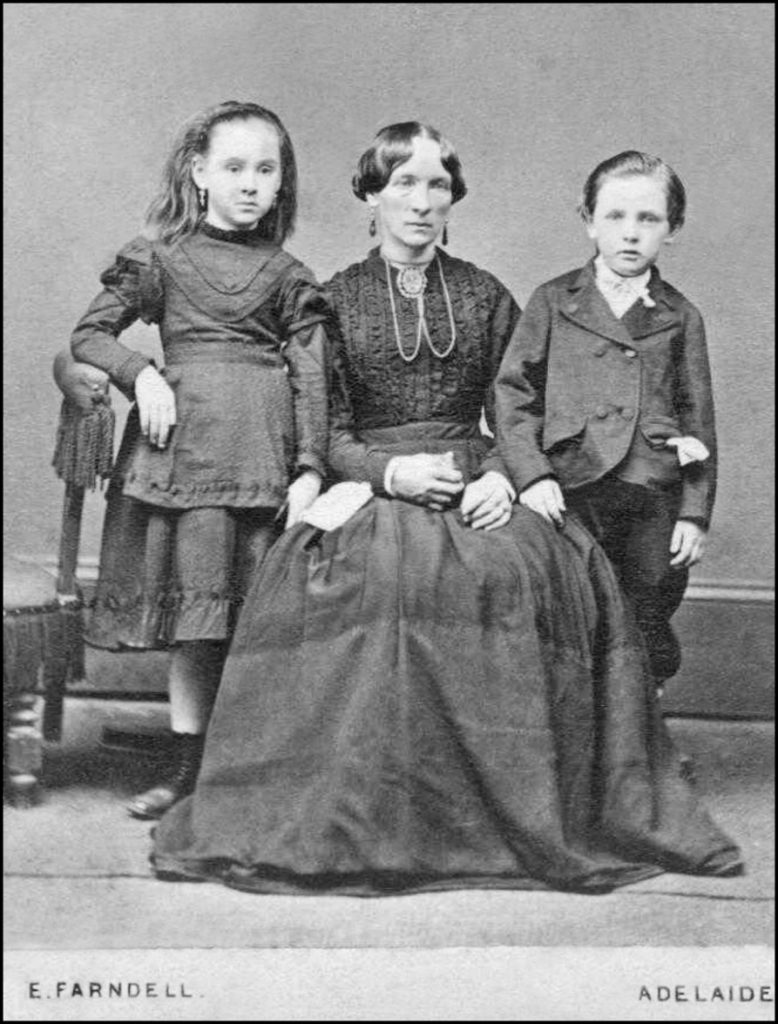
Andrew’s Son in Trouble
Not long after the death of Bob’s mother and sister in early 1866, Andrew’s son Francis had to come up to Adelaide to face the music. Francis was bankrupt, and due to appear before the Insolvency Court. He had been looking after his father’s lease on the Coorong,[374] but in 1859, and again in 1861 he had travelled to Melbourne, possibly drawn by the lure of the gold rush, but like so many he was disappointed and the venture only added to his burden of debt. The road to the city had to thread the Adelaide Hills, and it was on this stage of his journey with two other men that the brakes on their four-wheeled trap failed at a dangerous curve known as Snapper Point.
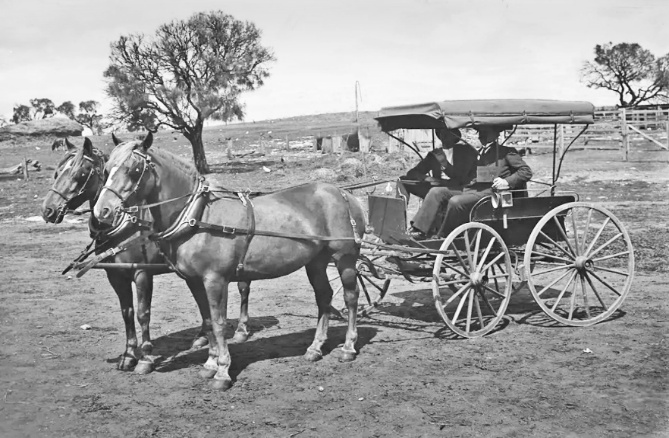
AGSA
The two horses bolted and Francis jumped out, as did one of the other passengers. The trap then crashed through a fence and careered down the hill with the remaining passenger holding on, until the horses fell, sustaining severe scratches. Thankfully, catastrophe was averted for both men and horses, and the trap was undamaged. A following coach stopped to help them get back on the road and finish their journey, arriving with minor injuries and somewhat shaken.[375]
When Francis faced the Insolvency Court, he had liabilities of £85 1s. 9d (about $15,500 in 2023 values) but no assets at all. The judge granted a second-class certificate.[376] Quite likely the hapless Francis stayed with his sister Ann and brother-in-law Bob at the Edinburgh Castle. No doubt they shared their experiences of bankruptcy! Francis then moved back to his father’s lease at McGrath’s Flat on the Coorong.[377]
It appears Andrew got news of his son’s bankruptcy and decided to keep the farm. The same month he was in the local court over a dispute regarding payment for services of one of his stud horses,[378] and was asking permission from the Shire Council to graze cattle on the roads through his property.[379] In November that year (1866) he was one of the farmers the South Australian Register considered ‘competent to give reliable answers’ about expected crop yields in the colony.[380] By then, South Australia was providing half of Australia’s wheat, and exporting much of their surplus to the eastern colonies.
Bob’s licence for the Edinburgh Castle was renewed again in March 1866,[381] but six months later he decided to let his butchering business in the shop adjoining the hotel. Included were ‘all Tools and every requirement to carry on a large Business, with Sitting Room, Bedroom, Kitchen, Salting and Small Goods Room, Copper and Smoking House, Sausage Filler, two Cutting Machines, &c.’ This offer was quickly taken up a man named White.[382] Why he did this is a mystery, but soon afterwards he would be needed to keep things going in the hotel.
Bob’s father-in-law Andrew became ill, and during the summer of 1866-67 he found it necessary to leave Dalkeith Farm and stay with his daughter Ann at the Edinburgh Castle. Most likely his wife Margaret accompanied him. Ann had most likely had the running of the hotel while Bob attended to butchering at his shop next door. But with Andrew very ill, she and her mother would be caring for him. Furthermore, Ann was nursing baby Charles Rudolf who was seven months old that Christmas.
Although his health was declining, Andrew still owned the Golden Fleece, but had let it to a man named Poole, who held the publican’s licence. Andrew was disturbed at reports of ‘bad and riotous characters who were allowed to frequent the house’ and was intent on removing Poole. When it went to the Supreme Court on the 19th March 1867, Andrew could not attend as he ‘was very ill and his life was despaired of. He was suffering from heart disease’. The case was held over till the end of the month. In the meantime, there was licence renewal hearing by the Board of Magistrates. Despite Andrew’s opposition, Poole was granted an extension of his licence.[383] Then two days later Andrew’s case seeking recovery of Poole’s overdue rents and his ejection was heard in the Supreme Court. Poole was ordered to pay £107 4s. 6d. an insolvent and was behind in his rent some £58 13s. 4d (about $20,000 in 2023 values),[384] and he apparently lost his licensee.[385]
Involvement in a fractious dispute was the last thing a very sick man needed, but Andrew fretted about Poole, and two weeks later notice was given of a new trial.[386] His son Francis was back at McGrath’s Flat at the time, but soon returned to look after Dalkeith Farm.[387] Poole was before the Insolvency Court on 19th August that year, with Andrew as one of his creditors. After hearing evidence, the Judge adjourned the case for eight days to enable Poole’s lawyer to prepare a reply.[388] But Andrew never lived to know the outcome. He died at the Edinburgh Castle on 24th August 1867, the day before the case was to conclude.
The family inserted this death notice in the South Australian Advertiser:-
On Saturday, the 24th instant, Mr. Andrew Harriot died at the Edinburgh Castle Hotel, in his 64th year. Mr. Harriot was a colonist of about 30 years’ standing, having in the early days of the colony established himself as a farmer. By dint of perseverance and energy he succeeded in pushing his way, and became a successful squatter. He has been long known and universally respected in the Noarlunga District, where he has been a resident during the greater part of his career in South Australia. He leaves, to mourn their loss.
And this one in the South Australian Register:-
HARRIOT.—On the 24th August, at the Edinburgh Castle, Currie-street, Adelaide, after a long and painful illness, borne with Christian fortitude, Andrew Harriot, Esq., in the 64th year of his age, being an old colonist of 29 years; born in Dalkeith, Scotland.
— Dalkeith paper copy. [From page 2]
The Register also reported Andrew’s death in their news items, that same day:-
Death of Mr. A. Harriot.— We have to chronicle the death of another very old colonist, Mr. A. Harriot, of Dalkeith Farm, Noarlunga Mr. Harriot arrived in South Australia about 30 years ago, and was one of the earliest squatters, as well as being one of the first landholders in the district in which he has lately resided. Although never mixed up in public affairs, he was well known as a thorough business man. He leaves a widow, one son, and six daughters, all well provided for. Mr. Harriot had been failing in health for the last few months, and died on Saturday afternoon, aged 63.
[From page 4]
Andrew was buried in the West Terrace Cemetery.[389]
Andrew had a substantial estate, and to provide for the family the farm was put up for rent:-
DALKEITH FARM, Property of the late Andrew Harriot. TO be LET, for seven years, the above very valuable Property, comprising 640 Acres of first-class Land for either Agricultural or Grazing purposes, situate about two miles south of Noarlunga. The Farm is well fenced and subdivided into six paddocks, and is Watered by Harriot’s Creek running through the property all the year. The House is well built and commodious, containing eight rooms, with underground kitchens and outhouses. The Stables, Barns, and other Farm Buildings are first-class. Possession can be given after growing crop is removed, or, if tenant desires, crop and stock on Farm can be sold at a valuation. Offers in writing will be received in all October, addressed to the Executors of the late Andrew Harriot, Box 30, Post-Office, Adelaide.
In addition to Dalkeith, he owned the Golden Fleece, and probably the Edinburgh Castle, as well as holding squatters’ leases on the Coorong and further south.
Mourning for Andrew was mixed with fears for the life of little Charles Rudolf, Ann’s ninth child. He died on 25 September 1867, just 14 months old, and only a month after his grandfather. It must have been a harrowing time for his grandmother Margaret and mother Ann, who was then six months pregnant. This child was to be her last, and was born at the Edinburgh Castle on Boxing Day. They named him Young Robert.[390]
One bright spot for the family was the visit of Prince Alfred, the Duke of Edinburgh, who landed at Glenelg on 31st October 1867. He was the first member of the Royal Family to set foot on Australian soil, and was received in Adelaide by a huge crowd, including thousands of Sunday School children assembled on a platform outside the Post Office, who sang the National Anthem. The ‘effect was overwhelming’.[391] It’s almost certain the six of Bob and Ann’s children of Sunday School age would have been part of this, as they were members of Holy Trinity, North Terrace. Margaret (13) and Andrew (12) were the oldest, and must have remembered it all their lives.

Nevertheless, 1867 was an annus horribilis at the Edinburgh Castle, and it affected Bob’s health. At the end of the year he decided to become a Commission Agent, buying and selling goods on behalf of others for a fee. Included were ‘Squatters’ and Farmers’ Hides and Skins…also, Colonial Produce of any kind.’[392] Soon afterwards he took the little coastal steamer SS Penola to Robe, where his son Robert Evans Venn was established with the Shipping Agent George Ormerod & Co.[393] Returning on the same ship to Adelaide after a month at Robe,[394] probably with new business connections, he was soon involved in the trial of English and Australian preserved mutton.
The tins were opened by Mr. R. Venn in a workmanlike style, and the contents emptied into separate dishes. Both kinds turned out solid and perfectly fresh to the smell.’ The imported mutton had a ‘washy flavourless taste’ and the colonial product did well. It was proposed to establish a meat processing works, and export mutton to England. But someone warned that ‘the English public was an obstinate mulish kind of animal’ and would be slow to adapt to the colonial product! The consensus was that both the English and colonial tins were over cooked. ‘Mr. Venn mentioned that he had made trial of the plan of only partially cooking the flesh, and had found it to answer very well. A letter produced by him from his son, who is engaged on the works at Guichen Bay [Robe], confirmed this statement, and recommended that the meat should be used immediately upon being taken from the tin.’ [395]
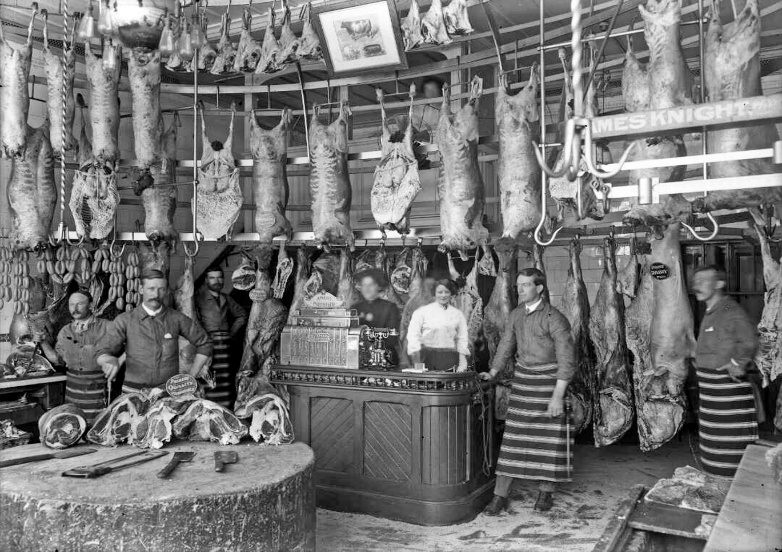
(ATL 1/1-004208-G)
How Bob fared over the next few years we can only guess, but another sad note occurred in mid-1869, when Ann’s tenth child, 1½-years-old Young Robert, died at the Edinburgh Castle. The death notice read ‘youngest son of Robert Charles and Ann Venn, aged 19 months and 3 days.’ [396] Bob’s publicans’ licence was renewed again that year,[397] but in 1870 he decided to return to his old trade.
In the winter of that year, he purchased the shops at Nos. 99 and 101 Hindley Street, from the late S.E. Boord. This was nearer the commercial heart of Adelaide, and he spent some weeks preparing the address as a butcher’s shop.
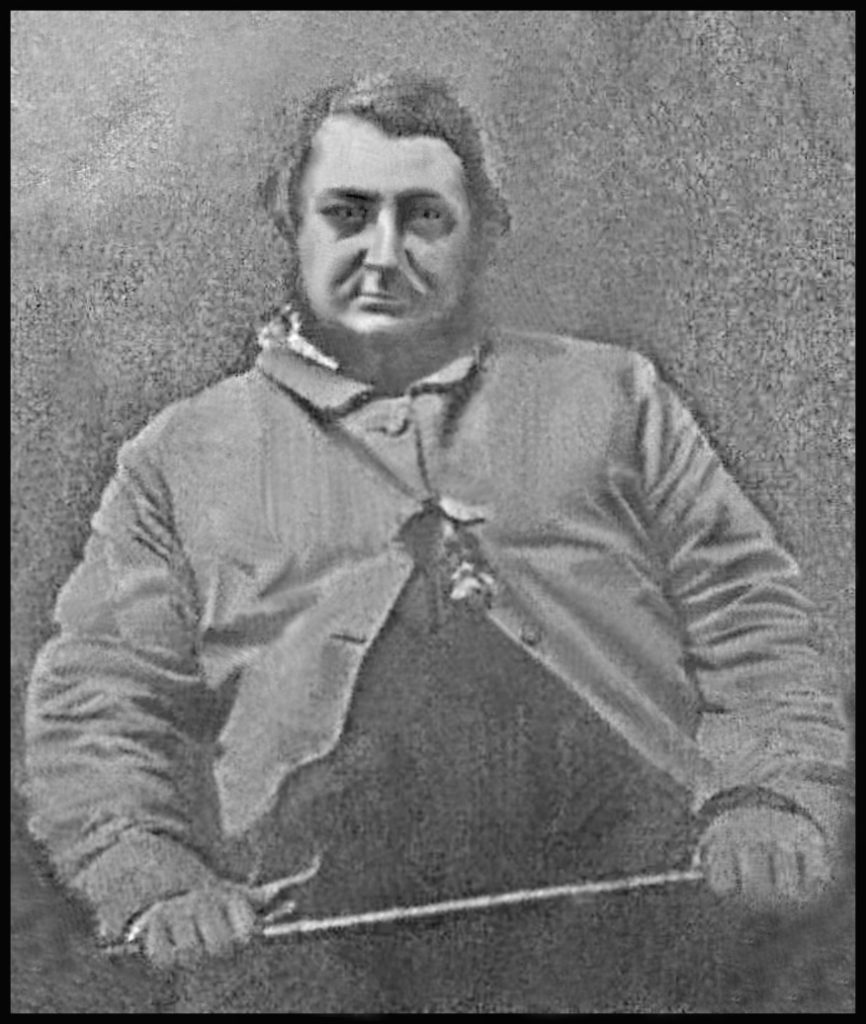
The advertisement for the opening on 30th July was headed by three small Masonic symbols, in an understated appeal for custom by fellow Masons.[398] He had borrowed about £500 ($91,000 in 2023 values) for this venture[399] but his tenure was to be brief indeed. A month after opening the Hindley Street business, Bob died of dropsy at the Edinburgh Castle on 1st September. He was only 54 years of age.[400] He was buried the following day at the West Terrace Cemetery.[401] His headstone is inscribed:
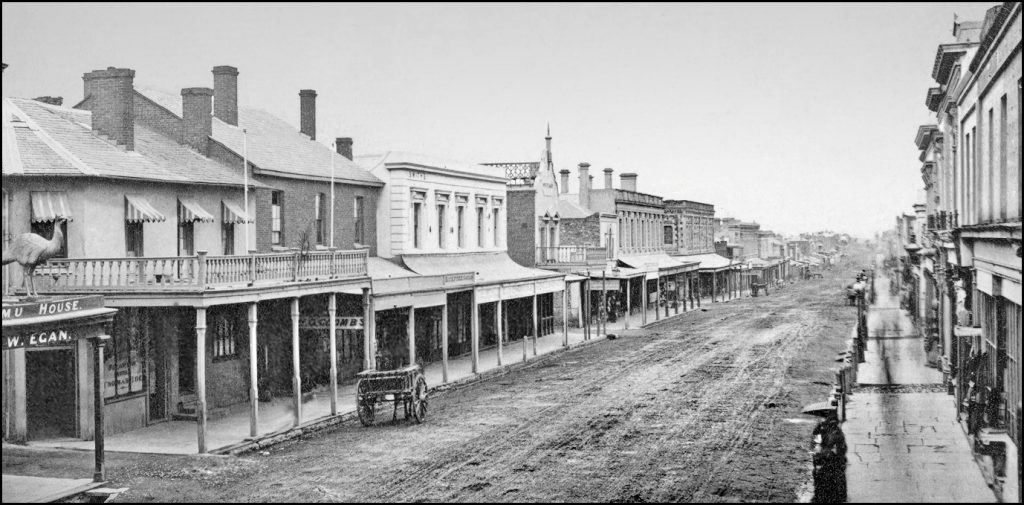
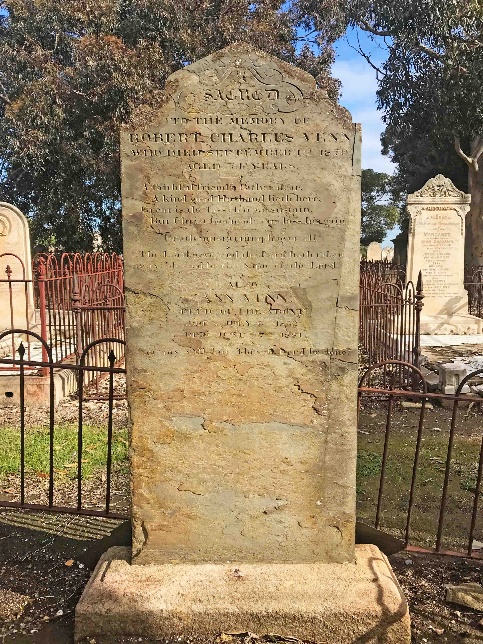
Sept 1st, 1870 aged 54 yrs,
A faithful friend and father dear,
A kind good husband lieth here
Great is the loss that we sustain,
But Christ has made our loss His gain,
Death must triumph over all
The Lord gives and the Lord had taken
And blessed be the name of the Lord.’
ALSO
Ann Venn
Relic of the Above
Born July 6 1832
Died June 27 1881
Not my will but thine oh Lord be done.
Bob’s last Will and Testament was made nine days before his death. He left £150 ($27,250 in 2023 values) to his wife Ann, who he also nominated as his executrix.[403]
At the time of Bob’s passing, his mother-in-law Margaret was 62, and his wife Ann was 38. They still had the care of eight children aged between sixteen and (nearly) six. Little is recorded of the family during the 1870’s. Margaret died only five months after her son-in-law Bob, on 2nd February 1871, aged 57.[404] Ann took over the licence for the Edinburgh Castle the following year, and held it for ten years. All her children grew up there. A happy day for Ann was 23rd November 1878, when her son Andrew Harriott Charles married Sarah Wigzall at St Andrew’s Church, Walkerville on 23rd November 1878.[405] This was the only marriage of her children Ann was to witness.
She must have done well, as in mid-1878 tenders were called for the re-building of the Edinburgh Castle.[406] Her great grandson Colin Venn recalled that his ‘Dad used to say’ that Ann and her boys would walk from Currie Street to Holy Trinity in North Terrace. Colin’s grandfather Andrew, one of her boys, had to carry the large family bible. She ran a good hotel, and stood no nonsense, and was strengthened by a sure Faith. A devout woman, she wrote poems and prayers, at least one little volume of which was published. Colin had a copy but mislaid it. Ann died on 27th June, 1881, just short of her 49th birthday.[407]
Whereas Bob Venn and Andrew Harriott were among South Australia’s pioneers: others of our forebears arrived in Adelaide a decade or so later. These included William Danks Wigzell who arrived in 1849 and his soon to be wife Mary Ann Flin in 1851. Then William Richardson and Sarah Foster arrived on the same ship in 1853 and married two years later. We only know a little of the families they left in England.
PART TWO
LATER ARRIVALS: THE WIGZELLS AND RICHARDSONS
SYNOPSIS
Details the migration and establishment in Adelaide of the Wigzell and Richardson families, which were later joined by marriage to the Venn family.
The faming background of the Wigzell family in Kent, and the migration to 20 year old William to Adelaide in 1849. His future wife Mary Ann Flin, a servant girl who came unaccompanied as a government assisted migrant in 1851 and their marriage 59 days after her arrival. Their daughter Sarah’s birth. William’s establishment of a successful fruit and vegetable business in Rundle Street and his interest in horticulture. His accidental shooting by a boy with a loaded gun on Easter Monday 1868 and death a few days later, at just 38 years. The business carried on by Mary Ann.
The migration of William Richardson and Sarah Foster as unaccompanied teenagers in 1853. Their background in the grim mining towns near Birmingham. Life aboard sailing ships on long voyages in crowded and shared steerage accommodation. Their marriage in Adelaide in 1855 and settlement in Norwood. William’s occupation as a building contractor and commitment as a Freemason. The naming of the last of their thirteen children, Gertrude Louisa May.
THE WIGZELL MIGRATION
For generations the Wigzell family had been living and dying in and around the village of Kemsing, about twenty miles South-West of London in Kent. The oldest gravestone in the churchyard dates to 1669. The Danks family also came from there. [408] William Danks Wigzell emigrated to South Australia on the 700 ton barque Asiatic , enduring the privations of steerage accommodation on the long voyage, and arriving in Adelaide the day after Christmas in 1849.[409] He was born on 20th September 1829 at Kemsing, [410] and became well known in Adelaide. But we know little of his parents, although they too later came to South Australia. They were William Wigzell and Sarah Elloner Wigzell (nee Gunner), both born in Sevenoaks, about three miles from Kemsing. They married at Halstead about five miles from Kemsing, on 10th August 1828 and after raising a family they followed their son to South Australia aboard the barque Grand Trianon in 1860, along with son Alfred and daughter Fanny.[411] This is ever the way with migration: an adventurous one makes the first journey, then sends news that draws many more.[412]
William and Mary Ann Wigzell
We may wonder what the passengers on the Asiatic were thinking on that Christmas Day in 1849, as the ship slowly entered St. Vincents Gulf. William no doubt wondered what Adelaide would be like, and what opportunities awaited. Whatever, it was not long before his future bride arrived. She was Mary Anne Flin, and came as a government assisted immigrant on the 527 ton barque Prince Regent, landing on 5th March 1851. During the 97-day voyage three children were born on the ship, and one of the 242 passengers died. This was a fairly typical emigration experience. [413] The only record we have of Mary Ann appears in the 1841 England census. It contains a rather dubious entry listing Mary Ann Flinn (not Flin) as a seventeen-year-old ‘Female Servant’ in the Gravesend household of a Grocer. Gravesend is near the mouth of the Thames, and about twelve miles from Kemsing. Had William been friends with Mary Ann in England? Had they been writing to one another? Or was William just a fast worker! Because they were married at Holy Trinity Adelaide on 3rd May 1851, just 59 days after she stepped off the ship! [414]

William established as a fruiterer (green grocer), and by 1854 had a shop in Rundle Street.[415] Their daughter Sarah was born that year, on 8th September. She was their second child, their first was a boy named William, born the year after their marriage.[416] Three years later he was expanding as an agent for the Highercombe Nursery, with 590 English Horse Chestnut, Oak, Elm and other trees for sale at 116 Rundle Street, and also shipments of oranges from Burra.[417] Like Bob Venn, he resisted temptation to join the gold rush to Victoria, and his business prospered. He began importing fruit from Victoria after his wife visited Melbourne in early 1857.[418] She was to take a significant part in the business.
By 1858 William he was one of two judges of fruit at the Adelaide Horticultural and Floricultural Society’s Show, and was on the committee the following year.[419] But like Bob, he got in trouble when he found a nine-year-old lad and another boy throwing stones at his pigeons. He gave the boy a thrashing; a common means of discipline in those days. But the lad’s mother took him to court! One again we meet Stipendiary Magistrate Samuel Beddome, who was used to this sort of thing, and fined William 10s., but only half the costs.[420]
In March 1863 William and Mary Ann’s two-year-old daughter Elizabeth died of croup. Mary Ann was three months pregnant at the time, and in September that year gave birth to a son.[421] William continued to do well, and in 1868 opened a Nursery in partnership with Henry Copas.[422] But the partnership was only to last nine months.
William is Shot
During the public holiday on Easter Monday 1868, William and Mary Ann were on a picnic at the North Arm of the Torrens River[423] with some friends. At about 4 o’clock young George Stanton and a couple of mates were enjoying the afternoon, rowing up the river hunting and fishing. Stopping near the jetty at North Arm, George began climbing up while holding his loaded double-barreled shotgun. William was leaning over the rail of the jetty as the hammer of the gun caught in George’s sleeve. Both barrels discharged at point blank into the back of William’s knee, which bled profusely ‘like water out of a bottle’. William exclaimed ‘The villain has shot me…get a rope and tie up my leg.’ Mary Ann was about 20 yards way, and people quickly came to help. William was moved onto a piece of canvas had lifted onto a cart. Meanwhile young George had sloped off, and was later retrieved from a boat over 200 yards away.
Dr. Gosse was called, and extracted about five pieces of shot from the wound, which was quite large. For the next three days William seemed to be recovering, but at daylight on Thursday morning a sudden change had taken place. A serious inflammation had developed in is thigh, and he died about half-past 1 o’clock that afternoon, 16th April 1868. Before he died, he asked Dr. Gosse to tell any subsequent inquest that he knew it was accidental.
The Coroner’s Inquest empanelled a jury of fifteen men, who considered that George was guilty of most culpable conduct, not only in the careless manner of handling his gun, but also in his utter want of sympathy after the accident had occurred. Nevertheless, after twenty minutes most of them agreed the verdict should be accidental death, but two held out for manslaughter. The coroner accepted the majority finding, but cautioned the lad before telling him he was free to go.
When they got news of Williams death, all the nearby shops in Rundle Street closed for the rest of the day. His well attended funeral was at St. Paul’s on Pulteney Street.[424] He was 38 years old, and Mary Ann was left a widow. But she was a strong woman, and kept the business going.[425] But perhaps the shock of William’s death impacted harshly on his mother Sarah, as she died four months later, aged sixty-five. She was living at Moonta with her husband and William’s brother Alfred at the time.[426] (Her husband William soldiered on at Moonta, passing away in March 1880. He was 73 years old [427]).
Apparently, Alfred Wigzell went into partnership with Mary Ann, and in 1869 was purchasing the whole of the crop of fruit and vegetables grown at Bailey’s Garden, which later became part of the Botanical Garden. Being so close to Rundle Street, the produce was always fresh. The garden had been supplying William for fifteen years, with an annual value of about £500 (over $90,000 in 2023 values).[428] Mary Ann and daughter Sarah also got busy with other Freemason’s wives making things to sell for their Building Fund.[429] But lightening was about to strike twice in her life. Alfred began to suffer heart disease, and after a long and painful illness died in July 1871. He was only 29 years old.[430]
Mary Ann carried on the business in Rundle Street through the 1870’s, and had the joy of seeing her daughter Sarah Rose marry Andrew Charles Harriot Venn at St. Andrews Church, Adelaide on 23rd November 1878. Two months later an event changed Mary Ann’s life. A customer of hers was John N. Hines, the Parliamentary Caterer. His wife Sabina died at the end of January, aged only 42, and leaving him six children. This put him in a desperate situation, just as Bob Venn had been when his first wife Catherine died at 29, leaving him five little boys. Within days, Hines advertised for someone to ‘Place three children aged 9, 11, and 13, in a Family or School about eight miles from Adelaide, where they can be Educated and cared for’. The oldest son, William John, was seventeen, and possibly the other two were teens also. Mary Ann came to the rescue, and at 55 years of age, she married John Hines on 4th December 1879. But tragedy still dogged them, the eldest boy dying two years later, just short of is 20th birthday.
THE RICHARDSONS MIGRATION
Information about William Richardson’s life and family in England is meagre and confused. Richardson is a very common name, as was William and his mother’s name Mary Ann. Efforts to piece together a Richardson family tree prior to 1853 are frustrating, but we can glean a little from available records.
William and Mary Ann Richardson
The parents of our South Australian Richardson forebears were William (after whom his son was named) and Mary Ann. He was born about 1806, although where is not known. She was born Mary Ann Manders in 1816 in the coal mining town of Dudley, west of Birmingham. She was about eighteen years old when she gave birth to their son. [431] Three years later they had a daughter (Sarah). Then two years after her birth they were married at the Church of England in Dudley on 9th October 1839. Her husband’s occupation was given as Builder, and both Mary Ann and her bridesmaid signed with an “X” – they were illiterate.[432] In 1841 William and Mary Ann were living in Sedgley, a coal mining village about ten miles north-west of Birmingham and three miles from Dudley. The census collector recoded all the people living in Broad Lane, and nearly all the men were miners.[433]
Theirs was a story all too common in early 19th Century Britain. Many couples were not formerly married, especially in the working and lower middle classes. Nevertheless, they lived as husband and wife, and had families. Life expectancy and literacy were both low, and child labour the accepted norm, even in the mines, where conditions were unspeakably horrible. Injuries and deaths were ever-present. Days were often cold and grey, and smog from thousands of coal fires in closely packed row-houses and factories caused much illness. Perhaps that was what caused the death of William when his son was a young teenager, or maybe he suffered a work accident. It must have been very difficult for Mary Ann, widowed in her Thirties with three or more children to support. A few years later she married widower Edward Spokes and subsequently migrated to South Australia, where they had a son in 1855.[434]
William Richardson and Sarah Foster migrate to Adelaide
Young William grew up in Sedgley.[435] He followed his father into the building trade, probably as an apprentice when still a child. He was only a teenager when his father died, and no doubt had to help support his widowed mother. However, he was learning a trade and may have garnered enough money to pay for a passage to distant South Australia, or have obtained an assisted passage. He was nineteen years old when he made his way to Liverpool in 1853.[436] Boarding the 741 ton barque Ann Holzberg he joined 200 or so others in the cramped and very stuffy steerage quarters below deck.[437] Quite likely it was an unhappy voyage, because most of the crew refused to work once docked in Adelaide. They thought three months gaol preferable to remaining with the ship![438]
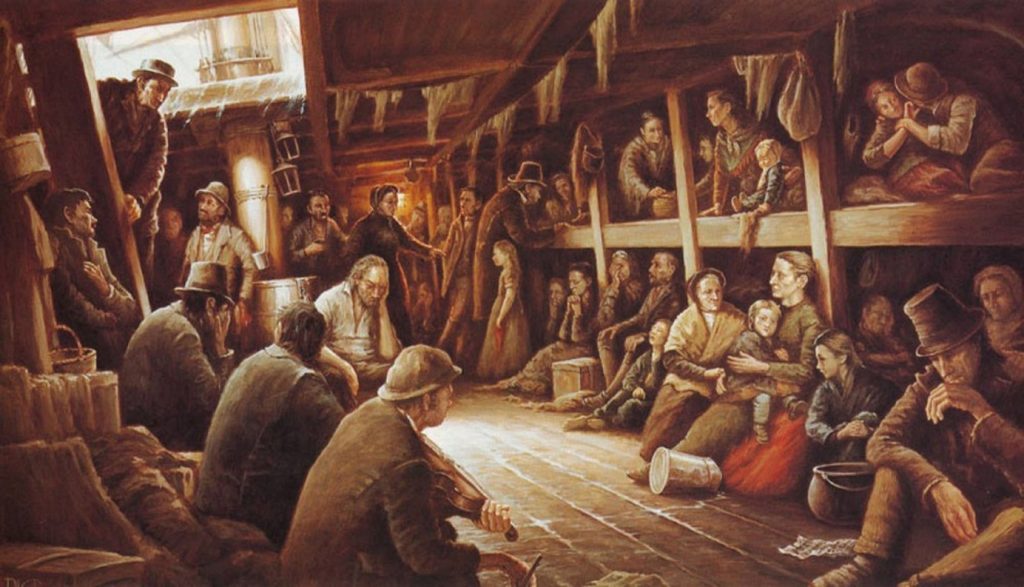
Aboard the same ship[439] was seventeen-year-old Sarah Ann Foster, who was also from industrial Dudley, another coal mining village three miles from Sedgely. There is scant information about her parents.[440] Like William, she travelled in steerage, beneath the main deck. Steerage accommodation was segregated, with single men usually berthed in the bow, married couples in the middle, and single women in the stern. It would have been difficult for William and Sarah to meet during the voyage, although church services were for everybody.[441] But it is possible they may have already been acquainted, as they lived in the same area. However their romance happened, they were married two years after their arrival in the colony. The ceremony was on 27th August 1855 at St. Andrew’s Presbyterian Church in Wakefield Steet.[442]
William and Sarah settled down in the suburb of Norwood,[443] and began a large family. First to arrive eleven months later was a son, Edward William Spokes Richardson. William after his father and grandfather, but Edward Spokes after his grandmother’s second husband. More babies followed quickly: Henrietta, Sarah, Louisa, Elizabeth, Florence and Helen. Six girls in ten years! But the kids kept coming: Alfred, Alice, William, Horace, Frank and lastly Gertrude Louisa May, who was an aunt before she was born![444] Her mother was then 46 years old, and of the thirteen children, only one had died: nine year old Louisa in 1870. So Gertie, the first girl born after Louisa’s death, was given that name, and the name of the month of her birth. William’s mother Mary Ann died at Norwood in 1876 at 60 years of age, but her second husband lived on, dying as an old man at Norwood in 1891.[445]
William worked as a building contractor, but like many in that industry, he had some ups and downs. In early 1863 he and his partner were before the Insolvency Court.[446] What the outcome was is not known, but there is no evidence of the trauma Bob Venn underwent. Three years later they tendered for a building job advertised by the Colonial Engineer, but were unsuccessful.[447] Nevertheless, a few months later William was discharged as a bankrupt.[448]
William was one of the founders of the Duke of Leinster Lodge of Druids, which was inaugurated at the Robin Hood Hotel, Kensington, on 12th December 1861. He remained a member for the rest of his life and was Arch Druid at least ten times. He died on 26th June 1902 at his home in Kensington Parade, Norwood. At the time the lodge had 360 members, and his eldest son Edward was the Secretary. Perhaps it was just as well Sarah had half a dozen girls to help her as more of the children arrived, as it is likely William was at the Lodge more than at home!
Sarah lived on as an old lady but was crippled with arthritis. She died under the care of Gertie, her youngest daughter, in 1920.[449]
PART THREE
SOME COLONIAL BORN VENNS
SYNOPSIS
The marriage of Andrew Harriot Charles Venn and Sarah Wigzell in 1878. Their seven children and home in Norwood. Andrew’s 50 years at Arthur & Co., a fabric and home furnishings agency of a Scottish business. His work as company manager and his vicissitudes as the commercial traveller before electricity, telephones and motor cars. Sarah’s discipline of her boys during Andrew’s absence. The families contribution to life at St. Matthews, Marryatville. The University achievement of their son Arthur and his subsequent war service and death on the battlefield at Cambri, France in March 1918. Their retirement and handover of the business to their son Robert (Bob), and his marriage to Gertrude Richardson.
Bob and Gert’s early marriage years growing grapes at Renmark. Their returning to Adelaide and the birth of their two boys, Colin and Lance, and unofficial adoption of Amy Boehm. Bob’s appointment as Arthur & Co’s Australian manager and the families relocation to Melbourne in 1926. The closure of the company during the Great Depression and subsequent difficulties. Gert opens of cake shop. The marriages of Colin, Lance and Amy. The war and birth of grandchildren. Bob’s death in 1949 and Gert’s in 1964.
Of Bob and Ann’s surviving children, five married and two remained single. Their eldest was Margaret Ann, who remained a spinster. Their eldest boy, Andrew Harriott Charles, got a job as a warehouseman with Arthur & Co, Importers. He married Sarah Rose Wigzell on 23rd November 1878.[450] Both were 24 years old and were colonial born.[451] Their mothers were then widows: Andrew’s father Robert (Bob) Venn dying in 1870, and Sarah’s father William dying in 1868 after being accidentally shot. After Andrew came Joseph, who married in 1882,[452] then Francis married in 1890, George remained a bachelor, Elizabeth married and lastly James married in 1897.[453] This account focuses on one of these families, that of Andrew and Sarah.
Andrew and Sarah Venn
Andrew was 26 years old when his mother died in June 1881. He retained a seventh share of the land and premises of the Edinburgh Castle Hotel until buildings until September 1890, when the Hotel was sold to the South Australian Brewing, Malting and Wine and Spirit Company. Andrew’s share of the sale was £475 (about $89,000 in 2024 values).[454] The early 1890’s saw Australia’s worst financial crisis, with thirteen banks closing in Easter 1893. Enormous amounts of money were lost in the panic. There was a family legend that Andrew knocked on the door of a closed bank to deposit £400, which he never saw again. This cannot be corroborated, but thousands of investors were ruined at the time.[455]
In 1881 Andrew is listed as a ‘dealer’, living in Queen Street, Norwood. Then in1882 and 1883 he is listed as ‘warehouseman’, probably with Arthur and Company Limited. In 1884 he moved to ‘Dalkeith’ No. 15 (now 21) Pembroke Street, Kensington Park,[456] near the terminus of the Kensington Road horse tram.[457]
Sarah had seven children over fifteen years, of whom five survived:- Rose Ethel, September 1879; Robert William (Bob), 1 December 1881[458]; Harry George, March 1884 (he died aged 12 months); Charles Louis (Lou), January 1886; Arthur Danks, June 1888; Fred Wigzall, September 1891; and Andrew Harriot Cyril, September 1894. The last boy died when only five months old. They were living in Queen Street, Norwood when their son Robert William (Bob) was born,[459] and later moved to 15 (now 21) Pembroke Street, Kensington. They named this house ‘Dalkeith’ after Andrew’s grandfather’s farm, and it is still there in 2025 but with a swimming pool and modern additions at the rear.
Compared with their parents, Andrew and Sarah led quiet lives. That’s if having seven children and caring for a sister’s daughter could be called quiet! She was to spend many weeks of each year alone at home, while Andrew was away on business. Her helper in disciplining her boys was a leather riding crop, which she later gave to her daughter-in-law, saying ‘Gert, I raised my boys and you’ll need this to raise yours!’ Arthur & Co was an Agency for a Scottish company, selling carpets, linoleum, soft furnishings, curtain hangings, and clothing fabrics. Andrew was the first of four generations of Venn’s associated with the garment industry and commercial travelling, and spent more than 50 years with this firm. Each day except Sunday he would catch the horse tram in nearby Kensington Road and travel to and from his business in the City. (Electric trams replaced the horse trams from 1910).
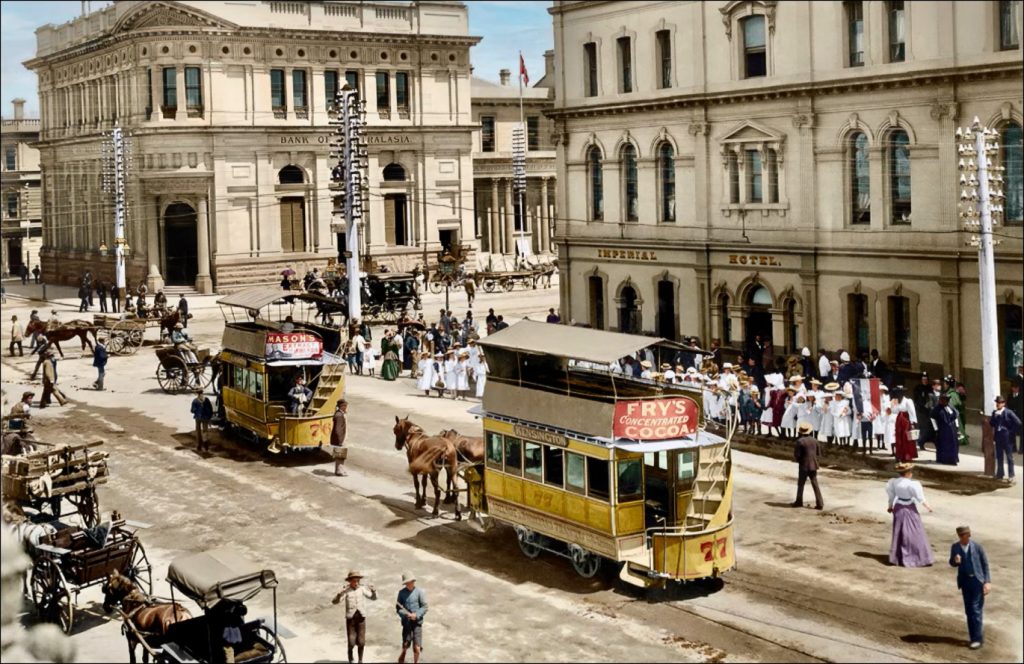
From 1891 until 1915 Andrew is listed as the manager of Arthur and Co Ltd, at Universal Building, 14 Grenfell St, Adelaide. This meant the family were comfortable, but by no means wealthy. The company was a small Agency, with only a few employees. Andrew had to both manage the business and look after sales.
From 1912 to1915 the company’s address is given as Lindes Lane, Rundle Street. Andrew continued making the selling trips until 1915 or thereabouts. His children were used to their father being away for many weeks in the year on sales trips to rural South Australia and Western Victoria, all by train and before the age of electricity and telephones. On the days their father was due back from a sales trip his children would rush around cleaning things up! [460]
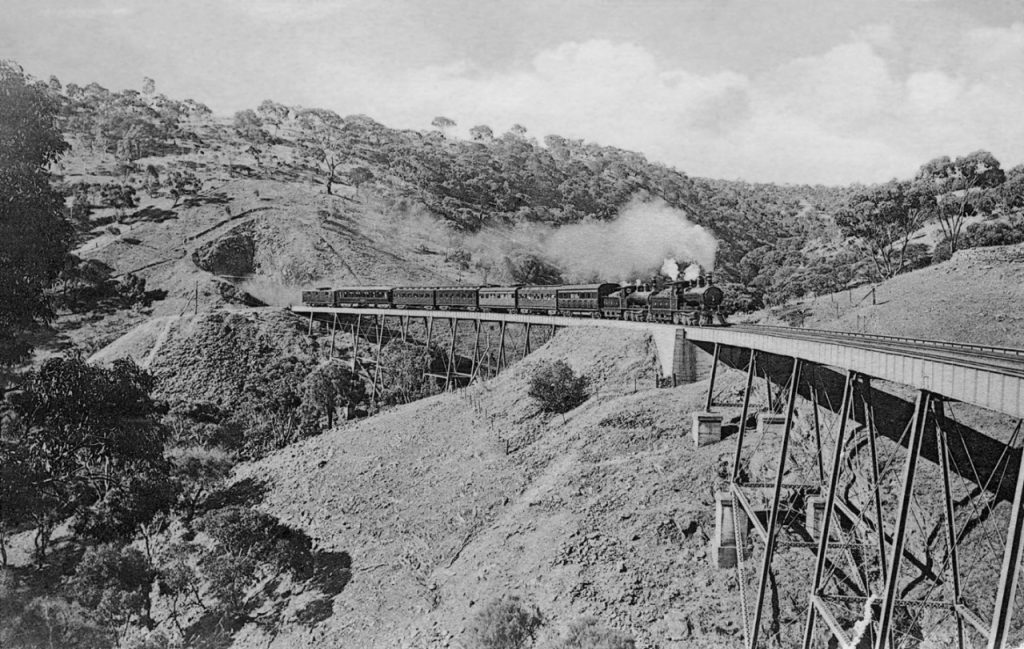
Commercial Traveling in Andrew’s day was often a cheerless occupation. Andrew covered all the settled parts of South Australia, plus the Wimmera and Mallee in Victoria; all by train.[461] There was no telephone at home, and if a hotel had a phone, it would be in the public foyer. The rooms were generally bare and cheerless, with linoleum floors, maybe a rug, a bed, a wardrobe and a kerosene lamp. Andrew travelled with a large and heavy hamper full of samples, and would book a special room in the hotel in which to show these samples to prospective clients. Sometimes he would have to detrain at an up-county railway station in the wee hours of the morning, in the dark, then drag his hamper to a hotel and check himself into his room. On the return he might have to be up at two or three in the morning to catch the Express.

The family church was St. Mathew’s Marryatville, one of the first churches in Adelaide and a fifteen minute walk down Kensington Road. It was a focal point for their family, and in 1907 Andrew was licenced as a Lay Reader: that meant he was qualified to take Church of England services in the Kensington Parish. [462] Their son Arthur taught Sunday School there, and their only daughter, Rose, was married there in 1903.[463] Adelaide was small then, and we might smile at Andrew and Sarah’s choice of holiday destination. In the summer of 1914, they spent a few weeks at Port Noarlunga, near to the old Harriott homestead which Andrew knew as a child.[464] Now the area is covered in Adelaide’s suburban sprawl!
Like many families, Andrew and Sarah’s was not immune from tragedy. In 1903 Andrew’s brother Joseph Augustus, who was three years younger, died when just 46-years-old.[465] Then in 1910 his big sister Rose died at 30-years-old. But worst of all was the loss of his son Arthur, who had showed so much promise. He had joined the British Army at the outbreak of World War I and in 1918 he was posted missing following the battle of Cambrai, in France. It was seven months before they had notification of his death via the Red Cross, and over a year waiting for official confirmation. Their grief can only be imagined, but at least it was shared by hundreds of other Australasian families. In 1924 Arthur was honoured as one of about 80 names on a war memorial unveiled at the nearby suburb of Burnside.[466] On the tenth anniversary of his death, he was mentioned along with five other Adelaide soldiers who died on the same day in a the Register newspaper’s Notices under ‘Their Name Liveth Forevermore’.[467] Such notices were almost everyday occurrences long after the war ended.
Andrew remained in charge at Arthur & Co. until 1915, when his son Bob returned from Renmark and took over as manager. Andrew continued working as a semi-retired clerk, and would ‘hold the fort’ while Bob was commercial travelling. Alan Richardson remembered that he would announce himself at Arthur & Co as ‘John the Baptist’. (The forerunner, or the unworthy?)[468] In the 1918 and 1920 Almanacs he is listed as a ‘clerk’, living at Dalkeith, Pembroke Street.[469] He retired in 1920, having turned 65. , he retired and sold ‘Dalkeith’ to finance the setting up of a shop in Woodborough Road, Exeter, a working class suburb near Port Adelaide. There was no pension, so he and Sarah needed an income.
Andrew and Sarah’s shop sold haberdashery, white goods (sheets, towels, etc), needlework and fancy work and lived above the shop. Andrew may have continued working part time at Arthur & Co, while Sarah managed the shop. Clearly, she was a talented lady. She was accomplished at embroidery and needlework, and was awarded a certificate for Irish crochet in the Adelaide Exhibition in 1905.[470] In September 1915 she exhibited at the Adelaide Arts and Crafts Society for a wartime fundraiser. She was quite likely a member, and helped staff the exhibition with her pregnant daughter-in-law Gert.[471] Later, she was awarded a bronze medal for “Art Needlework – Cushion” at the 1925 S.A. Chamber of Manufacturers All-Australian Exhibition.[472] These are just the awards we know about.
When Sarah’s grandchildren Colin and Lance were little, they would walk the three blocks from May Street to ‘Dalkeith’ after breakfast and enjoy the cold toast she served. They admired her beautiful and unusual crockery, and her embroidery, but she had her strict side and would stand no nonsense!
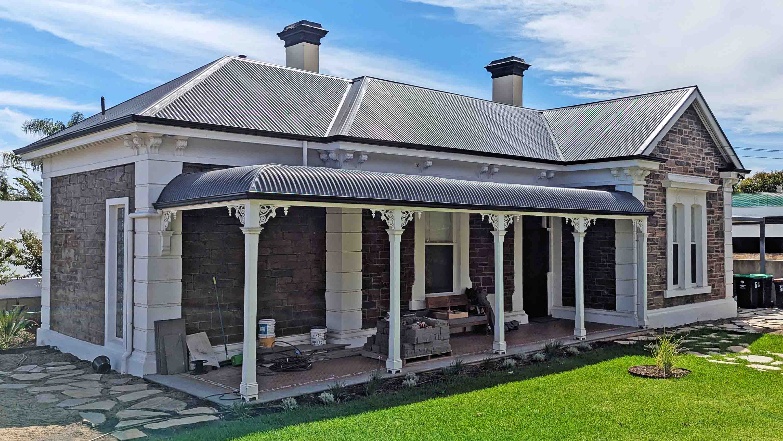
But Andrew and Sarah were aging, and they sold the shop about 1923 and moved to a flat in Marryatville, near Victoria Park. It was owned by a racehorse trainer, who kept horses in stables at the rear.
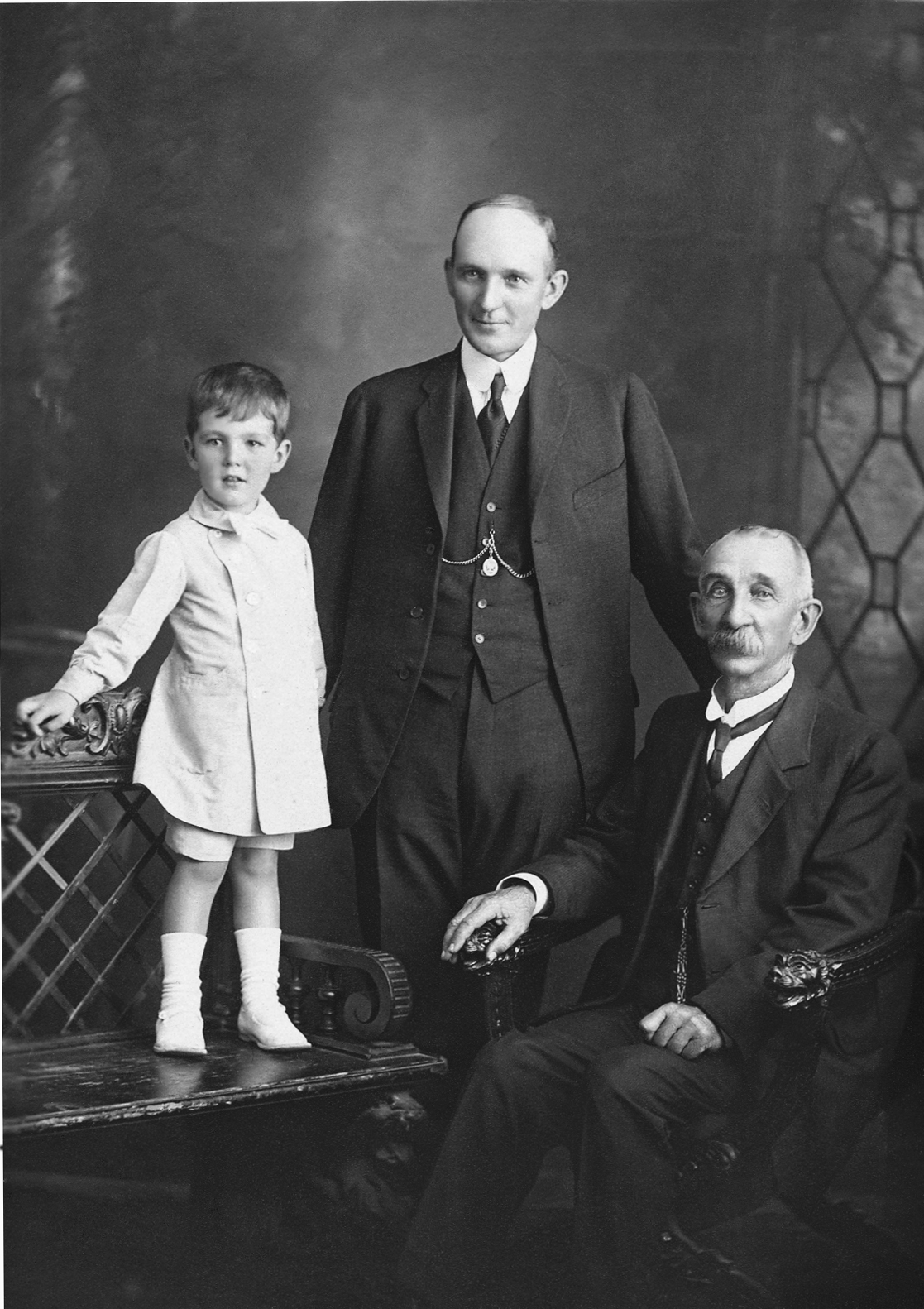
About 1920 she and Andrew decided to sell ‘Dalkeith’ to finance the setting up of a shop in Woodborough Road, Exeter, a working class suburb near Port Adelaide. They sold haberdashery, white goods (sheets, towels, etc), needlework and fancy work and lived above the shop. Andrew continued working part time at Arthur & Co, while Sarah managed the shop. Clearly, she was a talented lady. But they were aging, and they sold the shop about 1923 and moved to a flat in Marryatville, near Victoria Park. It was owned by a racehorse trainer, who kept horses in stables at the rear.
By this stage Andrew looked like an ‘old, old man’, with a walrus moustache and stooped posture. He had bandy legs, and wobbled about on a stick. But the family joked that when nobody was looking, he could ‘go like the wind’! [473] More likely he suffered from arthritis, which can make a person very stiff when getting up, but eases after a bit of movement. He died on 20th April, 1928[474] aged 73, sixteen months after his son Bob had migrated to Melbourne. Sarah then went to live with Bob and Gert in Melbourne, but she died the following year, 1929. Her body was taken back to Adelaide and the whole family went over for the funeral.
THE CHILDREN OF ANDREW AND SARAH VENN
Rose Ethel
After Rose Ethel married the Harry Freemantle King, they lived in Park Road, Kensington Park, close to the Venn’s home. [475] Their son Stewart was born there in 1904.[476] Sadly, Rose died on New Year’s Day 1910,[477] shortly after the birth of her second son Russell. She was only 30 years old. Harry was an Estate Agent,[478] and was left with two little boys.
Robert (Bob) and Gertrude (Gert or Gertie)
Andrew and Sarah’s eldest son Robert (Bob) married Getrude Richardson in 1905. Their story is elaborated in detail below.
Arthur
Arthur was a very good student. Andrew and Sarah must have been encouraged to send him to the new Muirden College in 1902. He won the three-legged race at the school picnic that year. [479] Arthur passed the State Civil Service Cadets’ examination in mid 1903 with honours while at Muirden.[480] He was dux of the school in 1904, passing the University Junior Commercial Examination all subjects and with credits in commercial geography, bookkeeping and shorthand.[481]

Arthur also passed the entrance exam for the University of Adelaide in December that year.[482] But to keep him humble, he was later caught riding his bicycle on the Kensington Road footpath, and had to appear before the Norwood Magistrates Court. He was fined 5/- and costs (About $50 in 2023 values).[483]
Arthur’s first year at university was disappointing, passing in only one subject.[484] Perhaps he was distracted, as he tried some amateur acting, appearing in plays, as did his brother Fred.[485] That year he also passed with honors the annual examination of the Church of England Sunday School Union, qualifying him as a teacher at his local church, St. Matthew’s, Kensington.[486] In 1907 Arthur had passed an exam set by the Australian College of Theology.[487]
Arthur passed his Senior Examination at the University in March 1908, and a few months later resigned his position as a library clerk with the Public Library, Museum, and Art Gallery. At his farewell he was given a travelling trunk, as he was about to embark for England, where he studied theology at Oxford. He was given another send-off by his singing teacher, Miss Lilian Lucas, who was a popular performer at events around Adelaide. Arthur’s brother Lou was also a singer, and gave an item.[488]
Arthur was still at Oxford studying for the Anglican ministry when war broke out. He immediately enlisted, serving in the 23rd Royal Fusiliers Regiment. He gained the rank of Sargent, and nearly made it through that terrible conflict. But he was reported missing on 25th March 1918 following the second Battle of Cambrai. He was buried three days later in a collective grave near Bois du Vallidart, France. The lack of information about his passing must have been very difficult for Andrew and Sarah. In early May, just over a month after he was killed, his parents requested the Red Cross to make enquiries. A cable (telegram) was sent to England on 4th May, but no news arrived from the Red Cross until 27th November that year, sixteen days after the Armistice that ended the ‘War to End all Wars’. But it was another year before official confirmation was received from the Australian Graves Services. Even that was meagre indeed, with no reference to Arthur’s service record. Whatever was in his military file was destroyed during German raids in World War II. See Appendix 4.
Louis (Lou)
Charles Louis was known throughout his life as Lou. He was an accomplished singer. At the age of eighteen he sang at a bazaar in aid of the Walkerville Children’s Home, and two years later at a fundraiser for the St. Matthews Hall.[489] He joined the Philharmonic Society of Adelaide and travelled up country. After one function in March 1907 at Two Wells, north of Adelaide, he was driving some girls back to the Barossa Valley when the Truro coach collided with his Trap, throwing a couple of passengers out. One of the girls sustained facial scratches, and the Trap £7 of damages (about $1,300 in 2023 values). Later that year he won first place for a bass solo at Strathalbyn.[490] There are many references to his singing in the newspapers of the day, and he was also a sportsman, being a member of the Hillsides cricket team.[491]
He started working with the Bank of Adelaide and worked at several small branches throughout South Australia and Victoria. From 1912-1913 he was working as a bank clerk at Brinkworth, moving to Balaklava in 1916 as a clerk. The following year he was promoted to branch accountant, serving there until 1923, then as manager of the Karoonda branch from 1924 to 1926.
finished as an Accountant at the Port Pirie branch. At some date he went to live in Perth WA.
Lou married Nellie Stokes in 1915,[492] and they had two children, Dorothy and Keith. As noted, they had to frequently move from one small town to another in the early years of their marriage, making the best of the accommodation the bank provided. Then Lou took the job as Accountant of the large Port Pirie branch.
His son Keith followed him into banking. Like her sister-in-law Gertrude, Nellie had to wait ten years for the birth of her first child. Dorothy married Noel Massey in 1951, and has three children; Rosemary, Stuart and Susan. Keith was sent to New Zealand with the ANZ Bank, and there met and married Shirley Anderson in 1950. They returned to South Australia, and had three boys; Bill, Ross and Peter.
Lou died in 1950 and was buried in the North Road Cemetery, north of Adelaide. The inscription reads ‘Charles Louis, 1896 – 1950’. His wife Nellie is buried in the same plot with an inscription reading ‘Nellie Leonora, 1892 -1982’.
Fred
Lou’s brother Fred is frequently mentioned in connection with cricket and baseball.[493] There are references to him playing cricket in Renmark in 1911 and 1913,[494] so he may have been helping out Bob for a while. In 1913 there are many newspaper references to his cricket matches, but also four civil cases are listed, three of them before the Supreme Court![495] There is no report of what these were about, or any outcome, but he was in trouble again four years later for using ‘indecent language’ in Currie Street. He was fined £5 with £1 costs, totaling about $1,100 in 2023 values.[496]
He spent some time in Renmark, probably helping Bob and Gert on their grape block, and also taking part in amateur theatricals[497] Back in Adelaide he was working as a warehouseman and living with his parents at ‘Dalkeith’, Kensington Park, when news of his brother Arthur’s death came through. He tried to volunteer for the A.I.F. in July 1918 but was rejected, having a history of stales rheumatic fever.[498] Fred remained a bachelor, and was quite personable, possibly a bit of a ladies man: Gert he was the ‘ants pants’! But when he died, his nephews Colin and Lance were the only ones at the funeral, which they and Mary Solomon paid for.
Mary Solomon
Sarah’s older sister, Fanny Jane Wigzell, married V.L.(Sol) Solomon, a Jewish tobacconist with a business in Rundle Street, but she died while still young, leaving a daughter named Mary. Bob Venn was very close to his cousin Mary, as Sarah had a lot to do with her upbringing. The Venn’s went to St Matthew’s Marryatville, so Mary was raised an Anglican. However, when Mary grew up she returned to the faith of her parents, and married Leon Abrams.[499] They lived in St Kilda (Melbourne), and had two children, Rebecca and Sidney.
BOB AND GERT’S STORY
Bob Venn may have joined the firm of G. & R. Wills & Co. as a teenager. They were clothing manufacturers and an import agency, and fielded their own football team. Bob was one of the players as a nineteen-year-old,[500] and also played for the Harrow Cricket Club. He was also on the Club’s committee in 1901, and three years later was elected secretary and treasurer.[501] He was also a bird fancier, and enjoyed breeding birds. In his early twenties he won prizes two years running in 1903 and 1904 at the South Australian Canary and Pigeon Show. [502]
But whether he was employed by Wills or his father’s firm, Arthur & Co., his work involved sales trips, as he was accepted a member of the Commercial Traveler’s Association in mid-1906. He was then 24 years old.[503] Two weeks before his 24th birthday Bob married Getrude Louisa May Richardson at the Clayton Congregational Church, Norwood on 15th November 1905.[504] She was three years older.[505] Their first home was in Kensington Street, Marryatville and then in 1908 and 1909 they were living in May Terrace, Kensington Park, just a few streets away from Bob’s parents at ‘Dalkeith’ in Pembroke Street. Bob was listed in the Almanac as a commercial traveller. He seems to have worked the Upper Murray district on his sales trips, and was already well known at Renmark when they decided to move there. They arrived on the paddle steamer PS Ruby in January 1909, and rented a house there.[506]
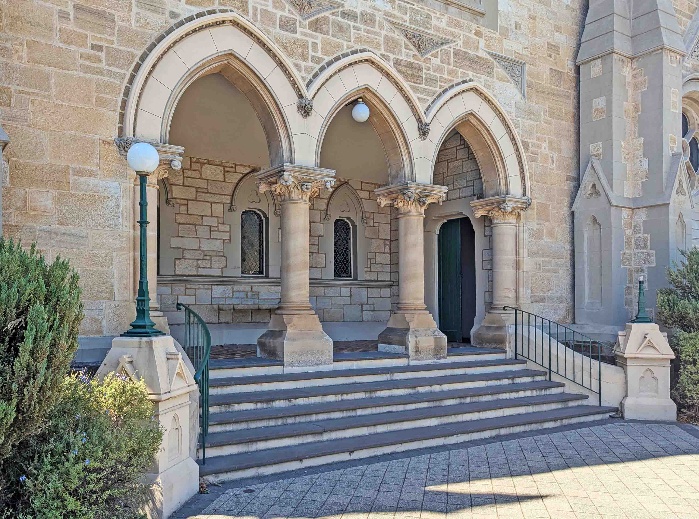
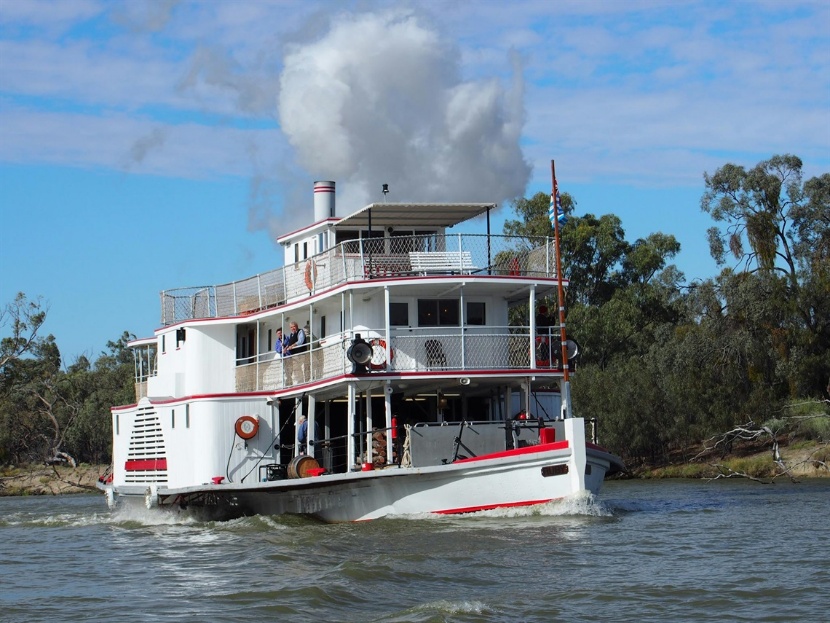
Bob was soon on the committee of the Renmark Show, Poultry and Dogs section. His Silver Wyandotte Cock and Hen also won prizes at the Renmark Show that year. [507] The following year, 1910, his Wyandotte rooster won again, and his White Leghorn hen was also a prize winner.[508] In 1911 he was convenor of the Poultry, Dogs and Cats section of the Show, which was ‘incontestably the best’ yet held in Renmark.[509]
Bob opened a cash store in Renmark in December 1910,[510] and regularly placed an advertisement in the Renmark Pioneer newspaper. He was also nominated for the Renmark Hotel Committee. This was the first Community Hotel in the British Empire. The local community elected a committee of five as the Board of Directors for a three-year term. Three of the five in 1910 were Labor Party men, and one of them had resigned. But Bob’s political sympathies were elsewhere, and he was outvoted.[511]
Irrigated blocks were being advertised for grape and citrus growing, some with established plantings and homesteads.[512] Bob and Gert obtained one of these not long after moving to Renmark, as in 1910 the Almanac lists them as fruit growers.. Quite likely they continued to run the Cash Store, which may have been established as an adjunct of Wills & Co, or Arthur & Co. But this has not been established. Passengers and freight for Renmark at the time had to take the train from Adelaide to the river port of Morgan, then change to a paddle steamer which left the wharf about 7pm. After two nights and a day twisting and turning with the bends of the river, they arrived at Renmark about breakfast time. If you were wealthy, there was a car that connected with the train at Morgan twice a week and would cover the 110 km in about four hours, but it would cost £1/10/- (about $250 in 2023 values).[513] The 260 km from Adelaide to Renmark can now be driven in three hours.
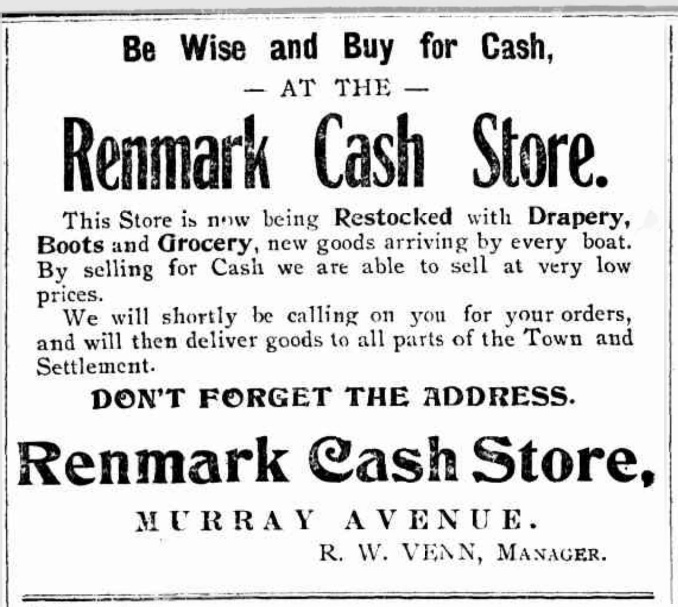
Bob continued playing cricket. On the eve of his 30th birthday he made 31 runs and his brother Fred 30 with an Australian born team against a team of English settlers at Renmark. The Aussies won.[514] Gert used to tell a story about their time there, during which the grape pickers went on strike. There was indeed serious industrial unrest in the Riverland in 1911 by the very radical United Labourers Union.[515] Bob and Gert were called ‘scabs’ for picking their own crop. Then one night they were startled by an explosion, and thought they were being shot at, but the noise had come from a bottle of home brewed Ginger Beer that had blown its top off! They tried fruit growing for three years or so before moving back to Adelaide. But Bob always loved fruit trees, and kept a back yard orchard wherever he went. ‘They had so many grapes in Adelaide that they couldn’t give them away!’ [516]
Bob and Gert moved back to Adelaide in 1915 and Bob took over the management of Arthur & Co. His father was then sixty years old, and travelling was tough on him and on Sarah. Andrew stayed on as a clerk, ‘holding the fort’ while Bob was travelling. They lived at ‘Wenonah’, 18 May Terrace Kensington Park until 1924, when they moved a few streets away to Desaumarez Street, Kensington Park.
Gert was pregnant on their return from Renmark. Their son Colin Danks was born on 7th December 1915, a few weeks after their tenth wedding anniversary. What a joy after many years of yearning. Gert was then 38 years old, and wisely decided to have her first birth at Miss Laurence’s Private Hospital in Wakefield Street, Adelaide.[517] Just over two years later her second son, Lance Foster was born, but Gert was confident to have the birth at her home in May Terrance.[518]
Bob was 34 years old in 1915, the year of Gallipoli and the year Colin was born. While not too old to volunteer for service in the war raging in Europe and Palestine, volunteers were usually much younger. Australians rejected conscription at two bitterly fought referendums in October 1916 and December 1917. With his new family and his responsibilities at Arthur & Co, Bob stayed home.
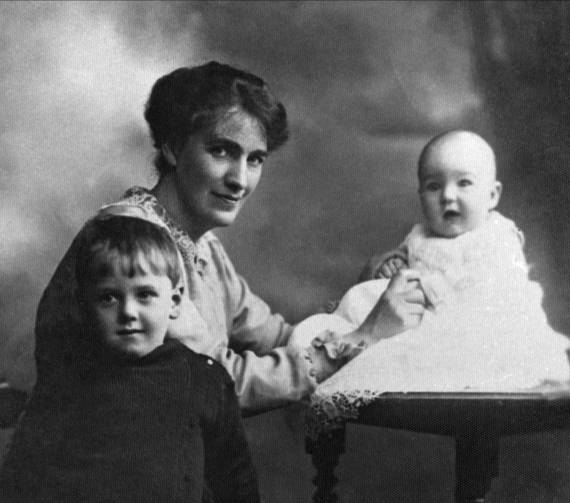
Gert found herself with two little boys and arduous housework. There were no washing machines, vacuum cleaners or dishwashers then. Supermarkets and packaged food had not been thought of, and they had no car to carry their shopping home. So, just as his mother had done in caring for his cousin Mary when her mother died, Bob and Gert unofficially ‘adopted’ a girl, who became one of the family.
Amy Boehm
There was no dole or pension in those days, as few thought it was the government’s job to ‘look after’ people. The poor had to fend for themselves, but sometimes families who were better off stepped up to help. Bob and Gert did this, and Amy Boehm came to live with them in Kensington Park, helping Gert with the household chores, and later migrating with the family to Melbourne. She was like a big sister to the two boys.[519] Amy was probably about fifteen years old when she came to help Gert.[520]
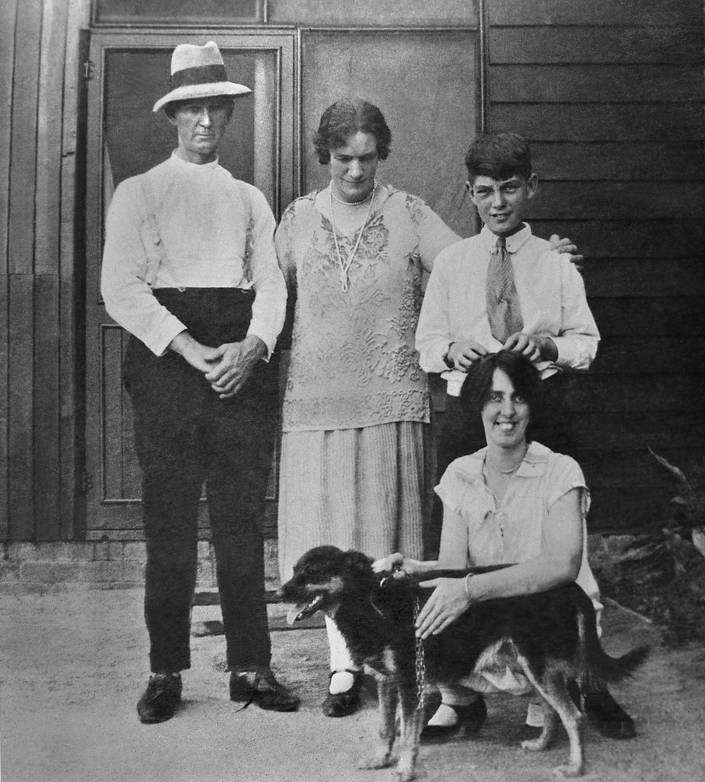
Across an empty paddock between their home in May Terrace and Alpha Street was the home of Alf and Jenny Richardson, and their children Alan and Jean. Alf was one of Gert’s brothers, so the children were first cousins, and about the same age too. They spent a lot of time together. Every night after work, Alf would get off the tram in Kensington Road and drop in at the Venn’s, where his mother was living. Colin remembered that his ‘Granny Richardson’ (Sarah) lived with Bob and Gert for about nine years after their return from Renmark, but her other daughters were also carers. Most of those years she was bed-ridden with arthritis: in those Alf would read the paper to her for about half an hour every evening, then walk across the paddock to his own home for dinner. There were other relatives close by too; just four doors down May Terrace lived Gert’s sister Alice Rhodes. Bob’s parents were also nearby, and another of Gert’s sisters, Nell Pitman, lived within walking distance.
Sarah developed bed sores, and her daughter Gert shouldered much of the caring load. She had to dress her mother’s sores with methylated spirits, which stung terribly. ‘Oh Gert, your so cruel’ she would howl, but no other treatment was available in those days. Putting arthritis sufferers to bed was the wrong thing, as it was not understood that exercise and movement were vital. Sarah’s other daughters helped too, and it was at one of their homes where she died on 4th September 1923.[521]
In 1924 Bob moved his family to nearby Desaumeraz Street, still in Kensington Park, but their stay there was to be brief. His work as a Commercial Traveler often took him away from his family; three months travelling, followed by three months at home. Like his father before him, he covered all the settled parts of South Australia, plus the Wimmera and Mallee in Victoria; initially all by train.[522] He experienced the same cheerless hotels, but most by then had electric light and at least one telephone in the foyer. He still had to carry a large hamper of samples, like his father, and check himself into country hotels in the middle of the night. The Traveller’s axiom was ‘don’t get sick’. Bedding was not often changed between guests, and frequently reeked of tobacco smoke. Some, like Bob, brought their own sheets, to avoid skin contact with the hotel blankets. It was a tough and lonely occupation, many Travellers spending the evenings at the hotel bar and playing games like darts, snooker and billiards. Bob was a member of the Commercial Travellers Association, as was his son Colin.[523] In 1919 Bob won the Second Division of the CTA Billiards tournament in Adelaide.[524] He advised his sons always to expect their employer to book them the best accommodation possible, because no matter how good it was, it was worse than home!
Travelling was a hard life, and most travellers were in dead end jobs. But Bob was a very good salesman and a manager as well. In 1924 the Company bought him a Dodge car, which revolutionized the travelling. He could cover more ground in a week than before, but motoring was not without its hazards, as all the roads were unsealed and petrol supplies were few and far between. A shovel and sacks were standard equipment on the car, so that he could dig his way out when bogged in the sand. He also carried tins of petrol, strapped onto the running boards.
One terrible trip from Broken Hill to Adelaide took three days, with Bob and a travelling companion digging themselves out of sand all the way. During school holidays he took his sons on some trips; Colin remembers going to Kapunda, Morgan and Renmark on one trip, to Moonta on another, plus a day trip to Strathalbyn.[525] Cars were rare then, and Bob’s was one of only three cars in all the Richardson and Venn families. One was a nephew of Bob’s who became Managing Director of the Weymouth Motor Company.[526] The usual means of transport to town was a tram from Kensington Road Marryatville, through Norwood to the City, the fare being 3d, or 1d for children.
In 1925 Bob was selected out of all Arthur & Co’s agents to go to the head office in Scotland. He set sail on the 20,000 ton Orient liner ‘Oransay’. During this trip Gert had a terrible fright when the newspapers announced that an Orient liner had struck a rock in the Mediterranean. Her fears were quelled when she learned the stricken ship was the Oransay’s twin. In Scotland Bob was chosen to manage Arthur & Co’s whole Australasian operations, which would be based in Melbourne. He sailed home on the 16,500-ton P&O liner ‘Maldavia’), and prepared his family for the move to Melbourne. The Orient Liner ‘Oransay’

Bob sent his boys to the Marryatville State School. His favourite Saturday afternoon pastime was the footy – they all barracked for Norwood (same colours as Melbourne), and he would take the kids ‘all over the place’ to watch them play. If they were ‘away’ matches, Gert stayed home, but she reluctantly went when home games were played at nearby Norwood Oval. She hated football, and would always take a long time getting ready! On most Saturday evenings the family would go to the Pictures, which were silent then. Sometimes it would be the Marryatville ‘Ozone’, or the Norwood ‘Star’, or perhaps a show at the Norwood Town Hall – it depended on the program, but every Saturday the movies were different and the theatres were full. Saturday afternoon Matinees cost the boys 3d, and were special programs, including a serial. The best seats on Saturday night cost l/6d. Colin remembered the first time his Aunty Lil saw a movie. As a train came towards them on the screen, she clutched her sister’s arm and cried ‘Oh Gert!’

Occasionally Bob would put a wager on a horse, and they enjoyed parking the car next to the race track at Victoria Park and watching the horses gallop past. The Venn’s were not wowsers, but neither were they boozers. At Christmas time they placed an order for drinks with Coopers, and this included table wines.[527] On Sunday they attended the local Clayton Congregational Church, and Bob would wait as his wife fussed around getting ready. ‘Do I look all right?’ she would say, turning around, and adjusting things, while ‘poor father was biting his nails waiting for her. But they never arrived late!’ [528]
South Australia’s first radio stations were 5CL, which started on 20th November 1924 and 5DN, which followed on 24th February 1925.[529] Bob’s nephew Alan Richardson made a crystal set, and he and his cousins would listen to broadcasts on headphones. This was because radio sets were very expensive.
Not long after the Venn’s arrived in Melbourne Bob bought an Astor receiver for £12 or about $1,200 in 2024 value, and a month’s wages for a working man at the time. Bob bought it on time payment of 2/6 a week ($12 in 2024). One day in 1925, Bob and Gert took ten-year-old Colin to his first Opera: a performance of Faust at the Prince of Wales Theatre, Adelaide, with Contessa Filippini conducting, and her husband Count Ercole singing Valentine’s part. Colin loved opera for the rest of his life!
MIGATION TO MELBOURNE
After his return from Scotland as Managing Director of a company, Bob had to move his family to Melbourne, which was the centre of the clothing and apparel trade in Australia. After packing the car, Bob and Gert, Colin, Lance, Amy and another young man got on board, and so did Rover, the family dog. He was dead-set against their plans to leave him in Adelaide, and refused to get down. With luggage strapped to the running boards and on the back, they headed south-east along the pipe-clay highway. It was a three-day journey, with overnight stops in Mount Gambier and Hamilton. They arrived in Melbourne on Colin’s birthday, 7th December 1926, and initially stayed at Carlyon’s Hotel in Spencer Street.
Bob bought a house in Burke Road, Kew, near the intersection of Mont Albert Road. His mother lived with them until she died. The boys walked to Deepdene State School about a mile away to the east, and the family joined the Congregational Church on the corner of Hopetoun Avenue and Canterbury Road. Bob transferred his allegiance to the Hawthorn Football Club and joined a Lodge, but he was half-hearted about it and stopped going to meetings, as Gert wanted him home! He drove the car into the city, sometimes giving a lift to a young Barrister by the name of Robert Gordon Menzies. (He was later Australia’s longest serving Prime Minister).
Bob lost his job when his company ceased its Australian operations in 1931. He was 50 years old and out of work. He ‘dropped his bundle’, but Gert opened a cake shop next door to their house. His son Colin left school prematurely at the end of 1931 and got a job selling buttons in Flinders Lane, his small wage helping to support the family. Bob sold the car, and the house, and moved the family to a new (possibly rented) place in Chatfield Avenue, Canterbury. After nine months of unemployment, he got a job with Repco, but never attained his previous salary again.
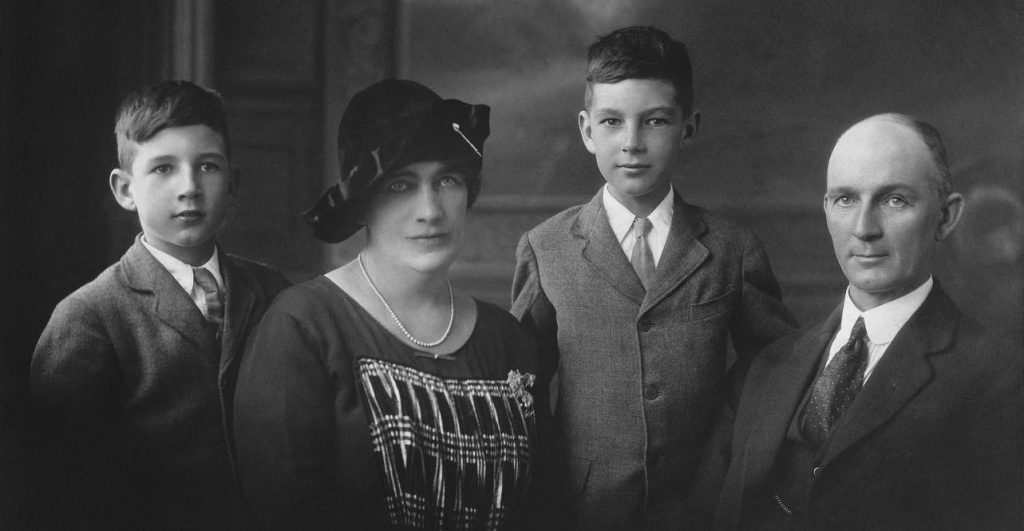
Colin married Jean Margaret Neil at St Marks, Camberwell on 20th September 1939, a few weeks after the start of the Second World War. Lance married Valerie Nance Miechel at St Peters, Box Hill on 7th September 1940. Amy married Cliff Baillie in 1940, and for a time during the war they lived with Bob and Gert.
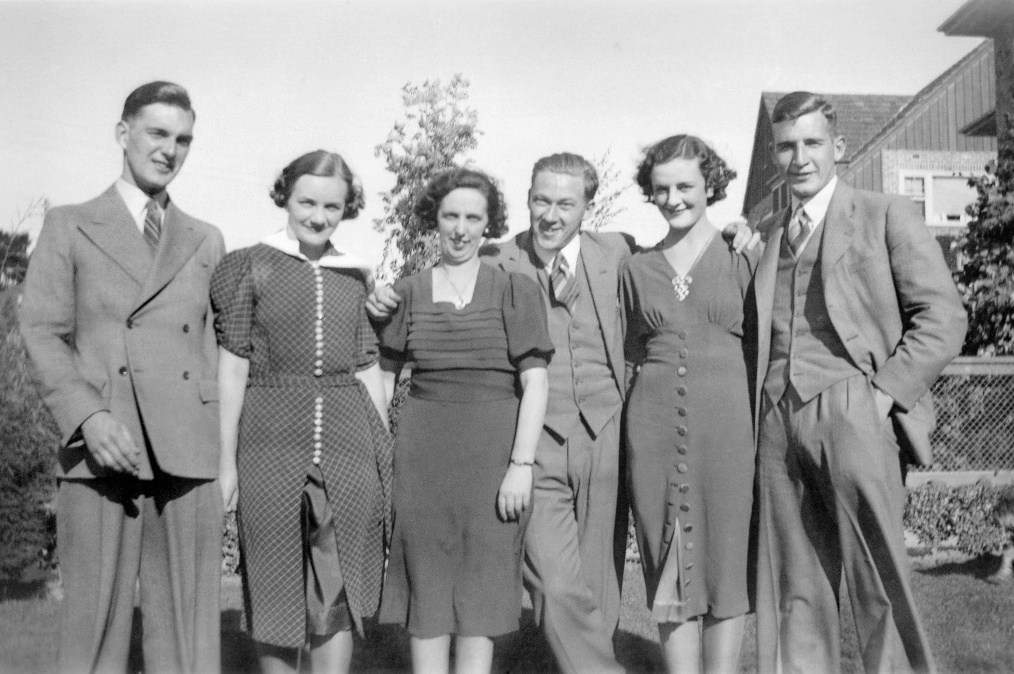
Bob’s first grandchild was born not long before his 59th birthday. This was Colin and Jean’s son Christopher John, born on 30th October 1940. The following (?) year another grandson arrived, Lance and Val’s son Robert. Then there was a long wait during the Pacific War while Colin and Lance served in the Royal Australian Air Force.[530] Bob and Gert were busy during this time supporting their young married daughters-in-law’s, Jeannie and Val, who lived next door to one another on the edge of the suburbs in Belmore Road, Balwyn, surrounded by paddocks. Bob and Gert bought a house at 317 Belmore Road, Balwyn, about a fifteen-minute walk from the girls, and Bob bought another car, which he serviced himself. His back yard had lots of fruit trees, as his thumb was as green as ever – a gift he passed on to his boys.
As the war neared its end, Colin and Lance returned and three more grandsons and his first granddaughter soon arrived. But in 1949 Bob contracted cancer, and died at his home on 5th September that year, aged 68.[531] For the next decade Gert stayed on at 317 Belmore Road, taking in boarders. One was a Mr. Wellings. When Colin and Jean moved from 200 Belmore Road to 26 Trafalgar Street, Mont Albert, Gert sold her house further east in Belmore Road and came to live with them. With money from the sale of her house, Colin was able to build a new room with its own toilet upstairs under the ample roof. She lived there with Colin’s family and Jean’s aunt Mildred Robinson, who also had her own room upstairs. Gert developed cancer, and was looked after at home almost to the last. She died in 1964 at the private hospital on the corner of Trafalgar and York Streets, very close to Colin’s home.
Appendix 1
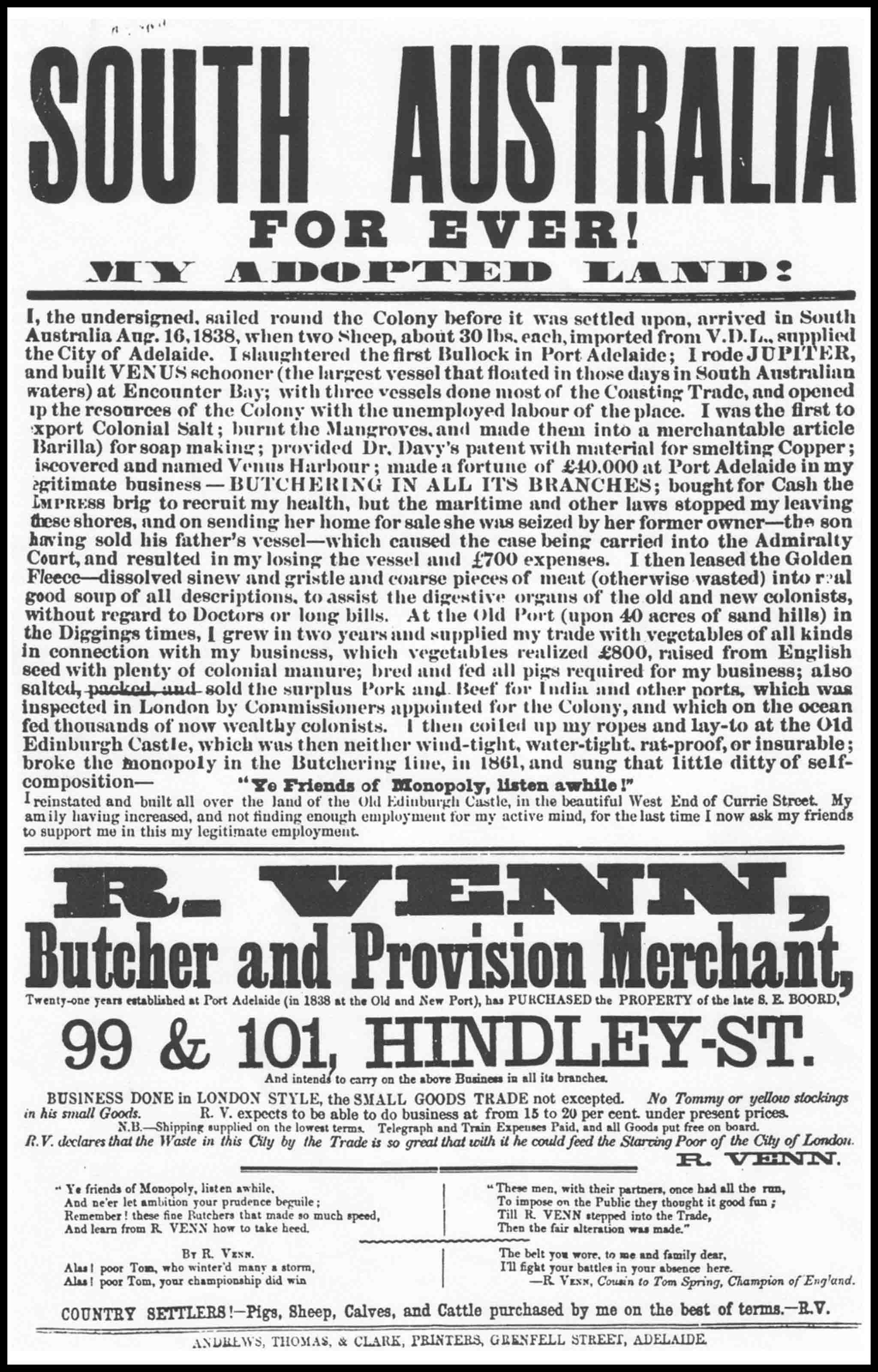
Appendix 2
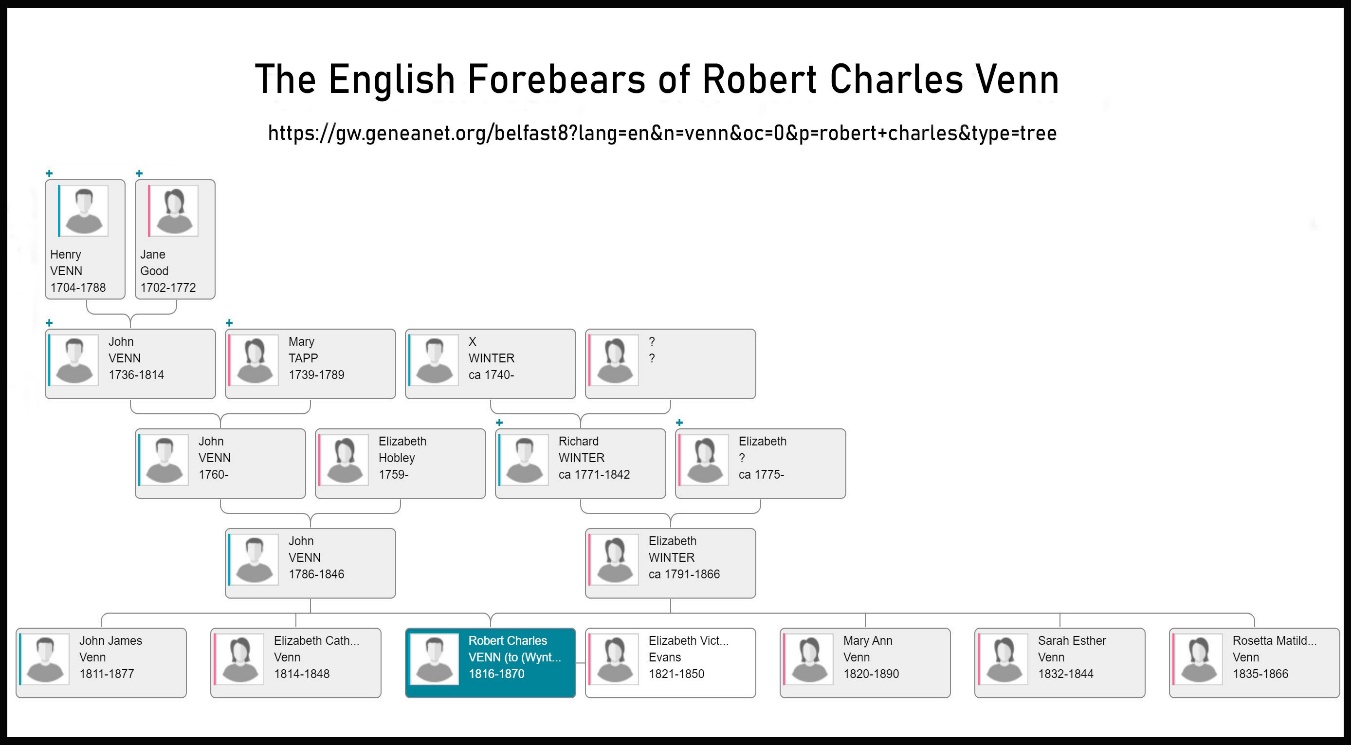
Appendix 3
Andrew Harriott a Smuggler? How the Myth Developed
Seventy years after the wreck of the Nashwauk ‘the oldest inhabitant’ of Noarlunga told the holidaying journalist ‘Eula’ about a mysterious light that shone in the window of Dalkeith Farm’s homestead. He told how ‘sometimes a blue light shone from the window and sometimes a red one. On the night of the blue gleam there was much coming and going, but the red shone when unwanted or unknown vessels were in the vicinity or when strangers were about the shore’.[532]
This romantic yarn by an old man who was a child at the time was debunked the week after the Mail newspaper published Eula’s article,[533] but twenty years later the journalist Geoffrey Shepherd got a hold of the yarn and let his imagination rip. By 1947, ninety-two years after the Nashwauk disaster, Dalkeith farm had grown in imagination to become a ‘two-storey mansion of many rooms, guarded by a solid twelve foot wall…a stern, secretive looking place, with the atmosphere of a fortress’. It was the ‘smugglers’ headquarters’ where ‘contraband…was deposited in spacious, vault-like cellars. The horse teams had the reputation of being so well trained that, at a signal given by their masters in the event of an alarm, they would disperse, and at another signal, reassemble.’ [534]
The old homestead had long since gone by the time this article appeared, and only some remnants of the barn walls remained, so the mythical smugglers fortress became so much a part of local legend that the Adelaide suburb which engulfed the Harriott land was subdivided to include a Dalkeith Road and a Smugglers Drive, close by Pedlers Creek, which was originally named Harriott Creek. [535] Some of Shepherd’s story was given credibility in the 1949 by Adele Pridmore’s local history of McLaren Vale, ‘The Rich Valley’. She is more cautious, ignoring Shepherd’s sillier claims, but repeating that Andrew purchased the whole of the Nashwauk’s salvaged cargo, and goes on to claim that ‘Andrew Harriott had financial interests not only in The Golden Fleece hotel, but also the Crown and The Plough and Harrow hotels, also in Adelaide, the Golden Pheasant at Hackham, and the Horseshoe Inn at Noarlunga’.[536]
No reference is given for this assertion, but it is known the only South Australian hotel licenses Andrew Harriott held were those for the Edinburgh Castle and the Golden Fleece, and these were not held concurrently. She also repeats the details about a 12 foot stone wall surrounding the house, and the light in the attic window ‘which it is said eventually caused the wreck of the vessel Nashwauk’ [but] …‘whether the Captain had mistaken the Dalkeith light for that of the Semaphore is not known.’ [537] Her book was republished in 1977 with at least three printings, and includes an undated photograph of the Dalkeith ruins. What purports to be a surrounding wall may be the ruin of a barn wall, and the 1979 Noarlunga Heritage Study investigation of the site found ‘little evidence left to confirm [the wall’s] existence’, but a photo does show an old Agave Americana (Century plant) in the yard.[538]
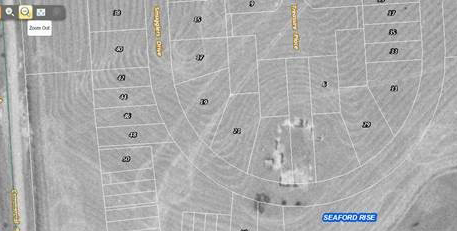
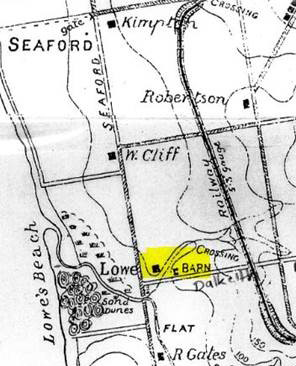
No photograph of the intact homestead could be found until 2016, when an old photograph was donated to the Noarlunga Library, with ‘Dalkeith Farm’ written on the back. It shows a typical single storied homestead with an attic, possibly of brick or stone, surrounded by a veranda, not a stone wall, and with two freestone barns, typical of many South Australian rural properties, and the same Agave Americana (Century plant). So much for the stern and secretive fortress-like mansion! When the farm was sold in 1867 it was described as having eight rooms and an underground kitchen.[540] The 1979 Heritage Study found the remains of two cellars, ‘one fairly large, the other perhaps a small half-buried coolroom’. The large one corresponds to the underground kitchen mentioned in 1867.[541]
Yet the 1947 story repeated yarns about lights in the upstairs window and then categorically claimed they had signalled the Nashwauk to its doom. The journalist had clearly not bothered to read the Board of Inquiry evidence.
But Andrew is further accused of subsequently purchasing the wreck and contents for £684 and using the parts ‘as tools of trade in his particular calling’. In fact, the remains of the wreck were publicly auctioned by Samson, Wicksteed, & Co. on the beach for that sum, of which Andrew contributed £65 for the ‘chance of cargo finding’ and £70 for the hull. [542] A few months later some more ‘goods, fittings, spars, rigging, etc, etc saved from the wreck’ were auctioned at Dalkeith Farm.[543]
Not only did Geoffrey Shepherd not bother to check his sources, but he stated as fact that there was no doubt ‘the owner of Dalkeith feathered his nest well’. His evidence? Andrew ‘became a prominent identity in the district, and a number of buildings which he later erected were financed in such a manner that left little doubt as to the nature of his income.’ But long before the Nashwauk wreck, Andrew had about 8,000 head of livestock at Langhorne Creek alone, in addition to his landholding at Noarlunga and his squatters run at Rivoli Bay, plus a store in Adelaide, an importing and exporting business and at least one hotel. In comparison to these assets, the dodging of tariffs on tobacco and liquor would have been small beer indeed!
But how did the myth gain traction? In 1841, the same year Andrew purchased his first parcel of land at Noarlunga, George Hepenstal established a whaling station at the mouth of the Onkaparinga River. Whalers were notorious smugglers, commonly meeting visiting French and American ships to trade fresh water and food for tobacco and liquor. The police Commissioner was watching Hepenstal, and reported that ‘smuggling to a great extent is now [1841] carried on along that immediate line of coast’.[544] He further observed that ‘Mr. Hepenstal is placed in the best possible position for smuggling with impunity’ and ‘that several of his neighbours have been suspected of running contraband goods’. If one of these neighbours was Andrew Harriott, why was he not named? Andrew both owned the homestead at Dalkeith Farm and a hotel in Adelaide, and so was well placed to benefit, but there is no evidence he did so.

There may have been local speculation, especially in retrospect as he became a wealthy man: cutting down tall poppies has long been an Australian pastime. But if Andrew had something to gain by dodging the colonial tariffs, he had a lot more to lose if caught.[545] Hepenstal closed the whaling station in 1843, after only two years, and was never convicted of wrongdoing. He heroically took part in the rescue of the Brig Tigress a few years later. By the time of the Nashwauk disaster, smuggling had largely died out due to reduced tariffs on liquor and tobacco.
In his 1986 local history ‘A Fortunate Locality’, David Towler provides short biographies of a number of early settlers but omits Andrew Harriott. However, he discusses the Nashwauk shipwreck and smuggling, together with the story about Dalkeith farm, concluding it
‘…seems probable that a strong light was kept burning in the attic window every night which would be readily visible for some considerable distance out to sea. And yet, no mention is made of this light by any of the survivors. However, an earlier wreck, that of the Tigress in 1848, is a much more likely victim of the elusive light. Considerable blame was laid on Captain Guthrie, master of the Tigress…It is entirely possible that in later years, dates and names of vessels have become confused to the point where, in present times, the Nashwauk assumed the tragedy of the Tigress.’ [546]
Perhaps Andrew was also confused with Hepenstal, and the Nashwauk for the large barque Grand Trianon, which narrowly escaped grounding five years later by mistaking a light on shore for the lightship.[547]
Some of the myth was again repeated in a 2004 book which focuses on the subsequent fate of the Nashwauk’s passengers but also questions if a ‘light shone deliberately from Dalkeith to lure the ship onto the rocks?’ It concludes there is no evidence linking the Harriott’s with smuggling. [548] However the City of Onkaparinga website gave the myth official credibility in 2016,[549] which is a shame, considering that Andrew was one of the district’s earliest and most successful pioneers. His obituary describes him as ‘universally respected’ in the Noarlunga District, where he has was a resident ‘during the greater part of his career in South Australia’.[550]
But what is so sinister about a light in an attic window? By the late 1840’s Andrew was friends with Bob Venn, by then owner of three small ships, and later a son-in-law. Both men had done a lot of sailing and knew the perils sailing ships faced nearing coastlines. With wind and currents driving a ship close to rocks and shoals, there was no engine to help manoeuvre away from trouble. Andrew was wealthy enough to afford a favour to Bob and other mariners by keeping an oil lamp burning all night (lamp oil was expensive). Furthermore, in our era of electric light the terrors of being benighted have been forgotten. But on cloudy nights with no moon, open country was pitch black with all sense of direction lost, so a light in the homestead would be welcomed indeed by any family, neighbours or employees not yet safely home.
Appendix 4
Arthur Danks Venn service with the 23rd Royal Fusiliers Regiment
Arthur Danks Venn, the third son of Andrew Harriottt Charles and Sarah Rose Venn (nee Wigzell), graduated from Adelaide University in 1908 and sailed for England that year to commence Ecclesiastical Studies at Oxford University. When the Great War began in August 1914, Arthur was one of many University students to enlist. He joined in September 1914 and survived until 25th March 1918, when he was listed missing following the second Battle of Cambrai. Below are the meagre communications Andrew and Sarah received.
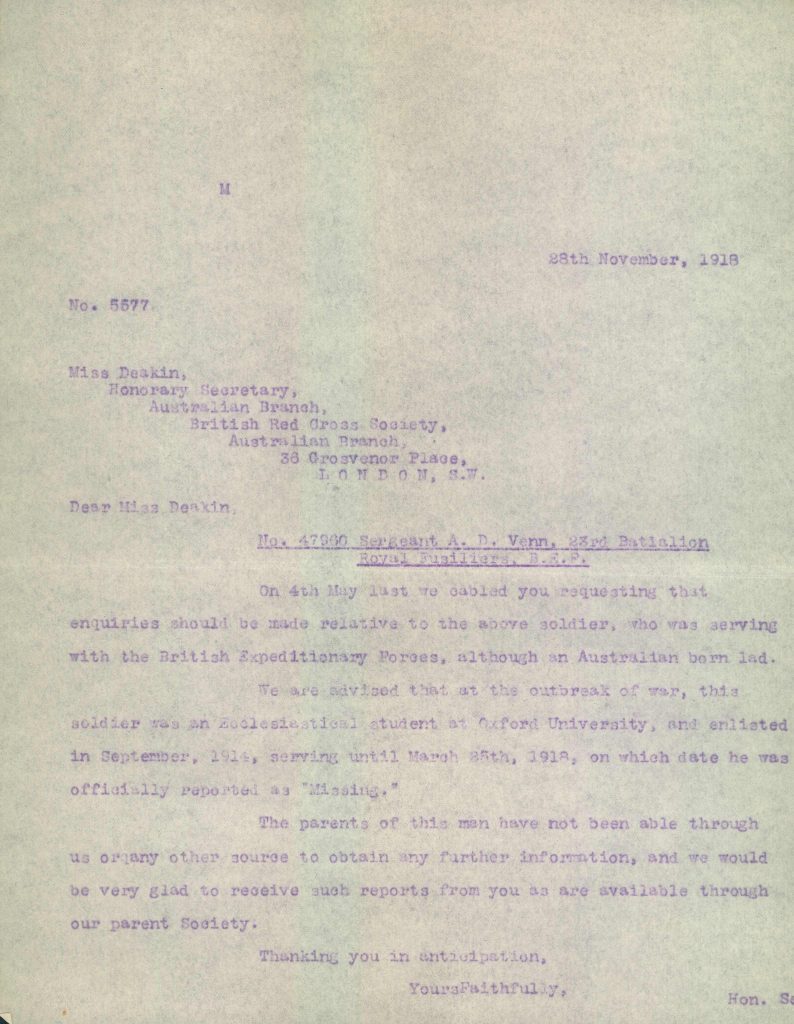
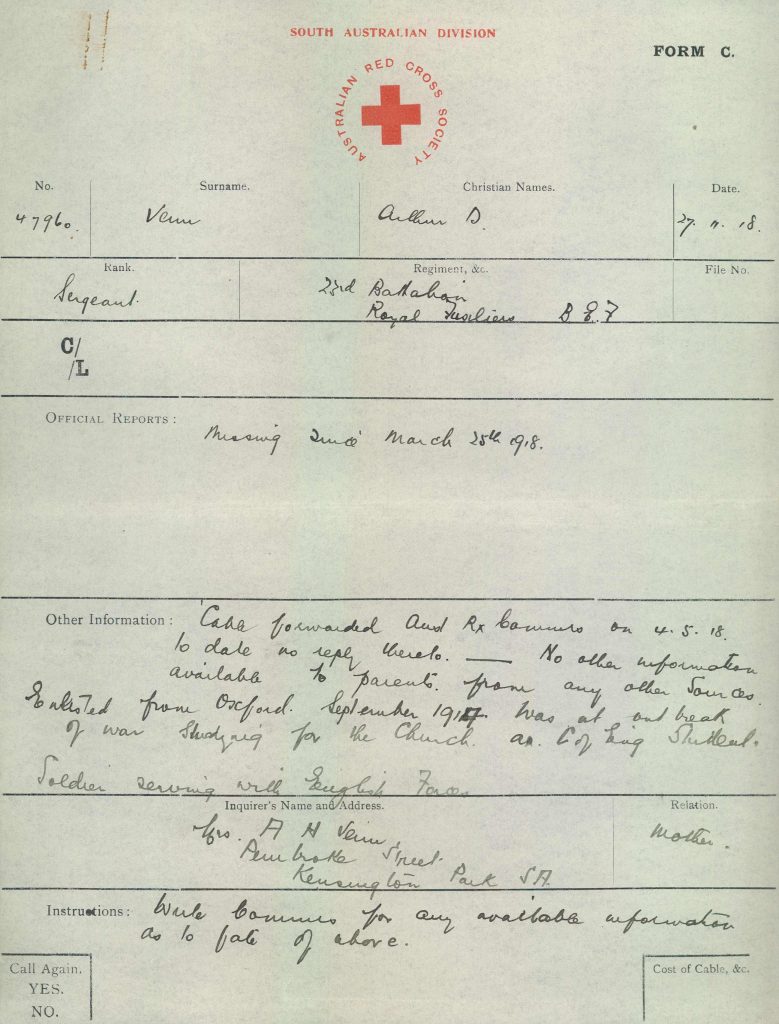
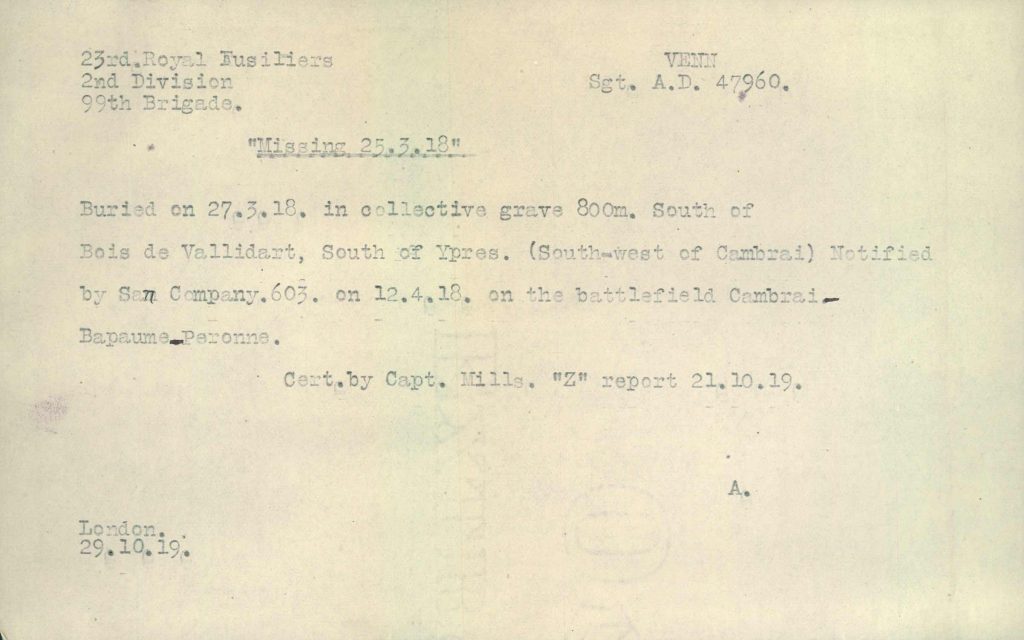
The 1914-1915 Star, British War Medal and Victory Medal
Arthur probably earned all three.
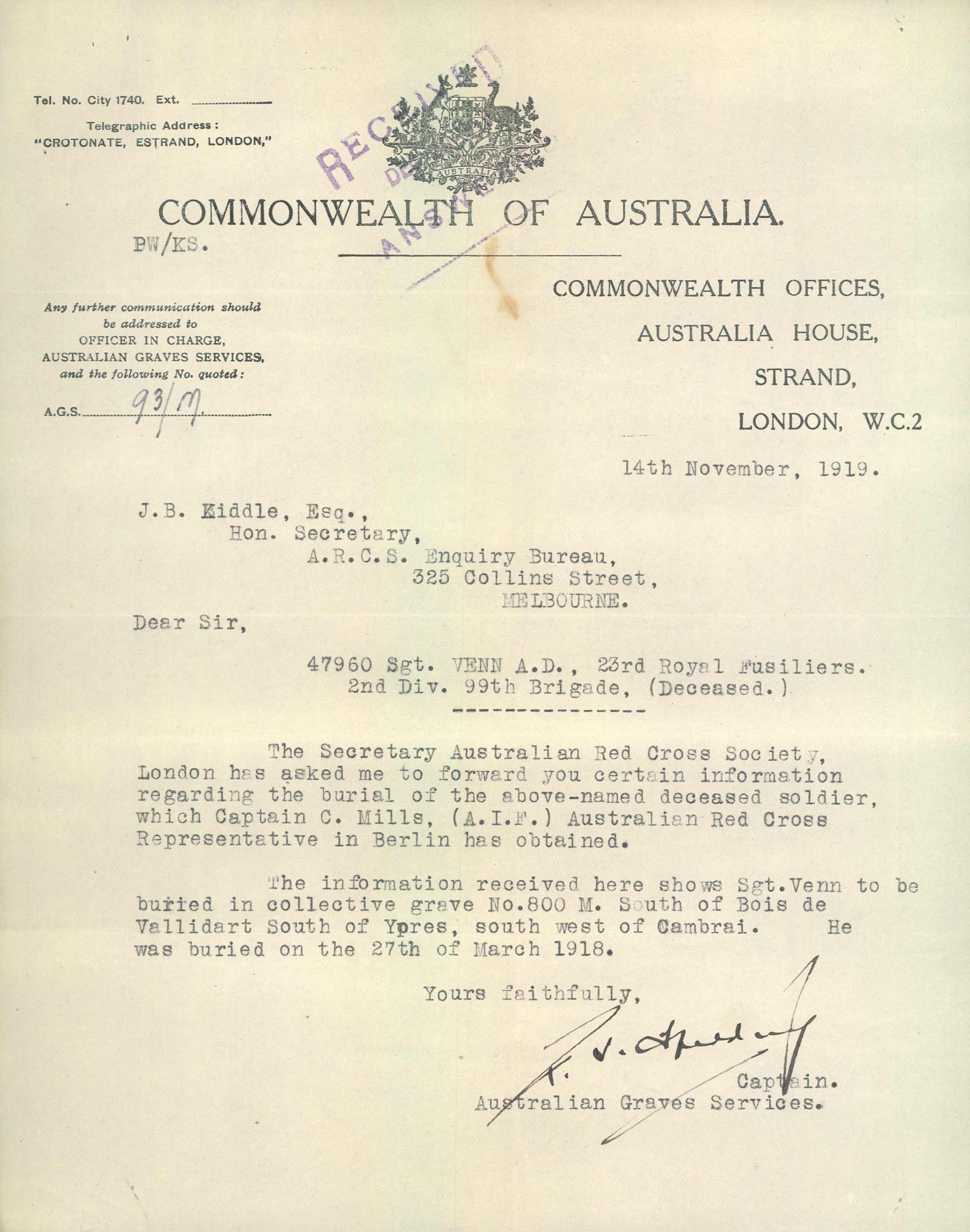
Footnotes
- Colin and Jean’s Story: The Early Years, Self Published, 2014. ↑
- 1 Corinthians 13, 12. ↑
- Malachi 3, 16. ↑
- https://forebears.io/surnames/venn ↑
-
https://gw.geneanet.org/belfast8?lang=en&n=venn&oc=0&p=robert+charles&type=fiche
This geneanet site traces R.C. Venn’s forebears to the early 1700’s – see Appendix 2 below.
Also:
https://www.ancestryresearchservice.com/genealogy/getperson.php?personID=I1889&tree=cameron1This ancestry site has lots of data on the Venn and Harriott families. ↑
- Walter Venn, Of Robert Charles Venn, his many children and other things, Privately Published , Melbourne,1993, p. 11. The marriage was on 9th December 1809 at St. Mary Magdalene church, Bermondsey. Robert’s parents were living at Greenwich prior to their emigration in 1846. ↑
- Walter Venn, p. 11. Elizabeth was baptised on 3rd March, 1793 at Dymock. She was the second child of John and Ann Winter (nee Winterborn), who married at Wantage, Berkshire in November, 1790. Wantage is about 50 miles west of London. Tom Winter, Elizabeth’s nephew, was born in Fownhope, Hertfordshire. This is about 7 miles from Dymock. The Winter family seems, then, to hail from the western counties, particularly Gloustershire and Herefordshire. ↑
- https://www.ancestry.com/search/collections/60528/records/213527714?tid=&pid=&queryId=d357e799-9282-40da-b597-65025e88a119&usePUBJs=true ↑
- Walter Venn, p. 11. Baptisms are recorded as follows:- John James, September 1811; Elizabeth Catherine Hannah, April 1814; Robert Charles 1816 (no record of his baptism can be found); Mary Ann, November 1820 (all at St Mary’s, Rotherhithe); Sarah Ester, September 1832; and Rosetta Matilda, 29 March 1835 (at St Paul’s, Deptford). ↑
- https://victorianlondon.org/population/census1841.htm ↑
- https://www.thehistoryoflondon.co.uk/the-regents-canal/ ↑
- The London & Birmingham Railway was 112 miles long and was opened progressively from July 1837 to September 1838. ↑
- South Shields Museum and Art Gallery. ↑
- Colby College Museum of Art. ↑
- https://herefordshirepast.co.uk/people/tom-spring/ ↑
- https://en.wikipedia.org/wiki/1826%E2%80%931837_cholera_pandemic ↑
- Queen Victoria began her long reign on 20th June 1837. ↑
- Express and Telegraph, 31 December 1867, p. 3. An advertisement by Bob when setting up as a Commission Agent, after ‘30 years’ experience in this colony’. ↑
- Walter Venn, p. iv. Text of a pamphlet advertising his new premises in Hindley Street in July 1870. ↑
- Walter Venn, p. 2. Walter and an earlier researcher, Dal Burton, speculated Bob came aboard the 402 ton sailing ship John Rennick, which was chartered by the South Australian Company to carry immigrants. But it arrived after a 115 day voyage from Gravesend (near London) in February 1837, after the colony was proclaimed. Bob was sailing out of Sydney some years earlier. ↑
-
Colonial Times (Hobart), 18 January 1832, p. 1. Jamieson was master of the ship Mary.
Also:
Sydney Monitor, 15 May 1833, p. 3. Jamieson taking the ship Mary from Sydney to London.
Also:
Tasmanian (Hobart Town), 12 December 1834, p. 3. Jamieson master of the ship Eveline, from Plymouth.
Also:
South Australian Register, 15 August 1868, p. 6. Jamieson’s obituary. Notes he sailed to Adelaide in the ship Trusty and settles there, becoming a Port Adelaide identity. Would most certainly have known Bob. ↑
- State Library of New South Wales, PXB 359/no. 3 by John Carmichael. ↑
- https://en.wikipedia.org/wiki/Demographics_of_Sydney ↑
- https://en.wikipedia.org/wiki/List_of_places_in_Victoria_by_population ↑
- https://www.nma.gov.au/defining-moments/resources/convict-transportation-peaks ↑
- Stuart Piggin and Robert D. Linder. The Fountain of Public Prosperity: Evangelical Christians in Australian History 1740-1914, Monash University Press, 2018, p. 230-231. ↑
- Walter Venn, p. vi. ↑
-
Sydney Monitor, Monday 12 March 1838, p. 2.
Also:
South Australian Gazette and Colonial Register, Saturday 7 April 1838, p. 2. The voyage took 17 days. ↑
- Melbourne Courier, Monday 15 September 1845 p. 2. The Barque Cataraqui was 802 tons. ↑
-
South Australian Gazette and Colonial Register, 18 August 1838, p. 2; 25 August 1838, p. 4.
Also:
Australian, Tuesday 28 August 1838, p. 2. ↑
- Melbourne Daily News, 10 January 1850, p. 4. ↑
- http://familypedia.wikia.com/wiki/Port_Adelaide accessed September 2016. ↑
- The first of the ten ships in the colonising fleet, the Africaine, discharged its settlers on 9th November 1836 at Holdfast Bay (Glenelg). The colony was officially proclaimed on 28th December 1836. ↑
- Walter Venn, p. iv. See Appendix for full text of the pamphlet. ↑
- His store is first mentioned on page two of the ‘South Australian’ of Wednesday 2th April 1839, only nine months after his arrival. A portmanteau belonging to a Mr. Young had been stolen, and a reward was offered for its return to ‘Mr. Venn’ at his store. So he was already well enough known. ↑
- Walter Venn, p.5. ↑
- Walter Venn, p. 15. Four generations later, Katharine (Kate) Venn married Gregor Evans – one of those co-incidences in family history. Holy Trinity Church was built in three main stages. Governor Hindmarsh laid the foundation stone on 28th January 1838 and the church opened in about August that year, the first church building in Adelaide. It quickly became a landmark with its ‘peaked cap’ top tower and the clock, but in 1844 was enlarged and re-roofed, the tower losing its peaked cap. ↑
- Australia Bureau of Statistics, cat. no. 3105.0.65.001 Australian Historical Population Statistics Table 1. ↑
- Robert Evans Venn was born at Port Adelaide, 11th July 1840. ↑
- The South Australian, Tuesday 23 August 1842, p2 The ‘Kate’ was fitted with oyster dredges. ↑
- Letter of Dal Burton. This letter has been mislaid, and the source Dal used is unknown. ↑
-
See http://adb.anu.edu.au/biography/eyre-edward-john-2032
Also: - Early SA History https://www.pioneerssa.org.au/early_sa_history.html ↑
- Holy Trinity Adelaide 1836-2012; The History of a City Church. Brian Dickey. Adelaide 2013. p 37. ↑
- The South Australian, Tuesday 23 August 1842, p 2. ↑
- South Australian Register 17 April 1844, p 4; 1 June 1844, p. 2. ↑
- Southern Australian, Wednesday 31 May 1843, p 2. The Brig Dorset sailed with 9 bags of barilla for Sydney. ↑
- Adelaide Observer, Saturday 3 February 1844, p 5. ↑
- Thirteen tons of salt was shipped from Kangaroo Island to Adelaide in 1843; the following year this had increased to eighty-two tons. http://www.southaustralianhistory.com.au/salt.htm ↑
- South Australian. Friday 28 February 1845, p 2. Reports the ‘Resource’ arriving from Kangaroo Island with 14 tons of salt. Also South Australian. Friday 14 March 1845, p 3; and the ‘Thompson’ with a cargo of salt the same month – South Australian. Friday 28 February 1845, p 2.. ↑
-
South Australian Register. Saturday 16 March 1844, p 2.,
Also:
Walter Venn, p. 9-10. The Resource was built at Encounter Bay in 1842, but no record has been found as to when Bob purchased it – but some time in 1843 is likely. Walter notes Bob purchased the Thompson in 1848, but it was wrecked the following year. ↑
- South Australian Gazette and Mining Journal, Saturday 26 May 1849, p. 3. ↑
- Adelaide Observer, Saturday 3 February 1844, p5; Adelaide Observer, Saturday 6 April 1844, p4; Adelaide Observer, Saturday 13 April 1844, p4. ↑
- South Australian Register, Wednesday 4 April 1849, p. 2. ↑
- Walter Venn, p. 7. The smelter at Yatala closed after 18 months when Burra established its own. ↑
- South Australian Register, 19 October 1844, p. 3. ↑
- The Adelaide Observer, Saturday 27 December 1945, p5. Probably the ‘Resource’. ↑
- Early SA History https://www.pioneerssa.org.au/early_sa_history.html ↑
-
The Adelaide Observer, Saturday 14 August 1847, pp. 2, 5.
Also:
South Australian Register, Saturday 14 August 1847, p. 3. ↑
- Ronald Parsons, “Ships of Australia & New Zealand before 1850″ ↑
- South Australian Register, Wednesday 29 September 1847, p. 3. ↑
- https://en.wikipedia.org/wiki/Venus_Bay,_South_Australia (accessed August 2015) ↑
- South Australian Register, 5 August 1850, p. 2. ↑
- South Australian Register, Wednesday 28 June 1943, p2. Daughter born on June 24th. ↑
- South Australian Register, 30 October 1844, p. 2. ↑
- Adelaide Observer, Saturday 15 November 1845, p. 6. ↑
- List of Ships Transporting Convicts to NSW 1788-1849, http://members.pcug.org.au/~ppmay/ships.htm The Hooghly made numerous voyages to Australia. Those carrying convicts were in 1825, unstated number of Irish men; 1825, five Irish men; 1831, 184 Irish women; and 1834, eight Irish men. ↑
- Adelaide Observer, Saturday 7 November, 1846, p4 ↑
-
South Australian, Tuesday 27 October 1846, p4. Reports Elizabeth’s daughter Mary Ann (as ‘Ann’) arriving on the Hoogley, but this is probably an error. There are no reports of her in Australia, but Rosetta grew up, married and died in Adelaide.
Also:
Walter Venn, p. 13. Notes that Bob’s sister Mary Ann was still living, and died in the Adelaide Lunatic Asylum in 1887, aged 73, and was buried at West Terrace Cemetery. This is incorrect, as the ‘Ann’ buried with Bob is his wife. His sister Mary Ann married Richard Lee in Lancashire. She had five children in the U.K. and died in Lancashire in 1890. See:- https://www.ancestry.com/family-tree/person/tree/27239955/person/2022598201/facts ↑
- https://www.ancestry.com/family-tree/person/tree/27239955/person/2022594596/facts ↑
- This is drawing of the stateroom cabin on the Paddle steamer RMS Britannia, in which Charles Dickens crossed the Atlantic in 1842. The cabins on the Barque Hooghly would likely have been even more spartan. ↑
- Andrew Harriott arrived at Port Adelaide aboard the Ship Pero on 19th September 1838. He had sailed from Sydney with his wife, two children and man-servant, having migrated from Scotland about 1832. It seems Andrew had purchased land in South Australia, as a month after his arrival he was one of 230 colonists who signed a letter of commendation to the outgoing Acting-Governor, George Stephen. He gave his occupation as ‘landowner’. ↑
- Southern Australian, Tuesday 24 October 1843 p 2., Southern Australian, Friday 3 November 1843, p 3. ↑
- This is the correct spelling, but newspaper references also use Harriot, Harriet or Harriett. ↑
-
South Australian Register, 24th September 1867, p. 2. His death notice notes he was from Dalkeith. His farm at Noarlunga was named Dalkeith, as was his grandson Andrew Harriott Venn’s home in Kensington.
Also:
Ancestry.com refers to Andrew’s birthplace as Dalkeith:-
https://www.ancestry.com/search/collections/60528/records/2483963?tid=&pid=&queryId=785a6c08-3d28-4b1e-bb7f-006af1b848e7&usePUBJs=true ↑
- Ancestry.com Leonard Samuel Burton Family Tree. Sources for Andrew Harriott’s parents are dubious. ↑
- O.P.R. Marriages 685/010630 0121 Edinburgh. Edinburgh, September 1822 ‘Andrew Herriot, Flesher and Janet Halliday, both in New North Parish [Edinburgh], daughter of the late Frances Halliday, Labourer, Dalkeith. 3 times pronounced, no objections. Married 11th Instant by Rev’d Robert Crawford. ↑
- https://www.ancestry.com/search/collections/60528/records/213527961 ↑
- Edinburgh Cemetery Register, 1771-1935, page 488. The burial date is 16th September 1832. Their address is given as 2 Simon Square, Edinburgh. ↑
- Ibid. ↑
-
It is possible they first came to Hobart, where an Andrew Herriot held the licence of the Brian Boru Hotel in Harrington-street in 1834. The spelling is different, and it is likely a different person, as a Mr and Mrs Herriot arrived in Hobart in November 1820 aboard the ship ‘Skelton’, which sailed from Plymouth.
Also:
Ian Hawkins Nicholson, Shipping Arrivals and Departures, Tasmania, 1803-1833, Roebuck, 1983, p. 63. The ship Skelton left Portsmouth on 7th July 1820 arriving in the Derwent 27 November 1820. On board were 80 settlers, including Mr & Mrs Herriott. But we know Andrew Harriott was in Edinburgh in 1822, where he married Janet Halliday. Later references to Andrew Herriott in Hobart always spell his name with an ‘e’.
Also:
Hobart Town Gazette, 2nd October 1834. Granting Andrew Herriott the licence for the ‘Brian Boru’ hotel.
Also:
Colonial Times (Hobart) Tuesday 7th July 1835 p. 5. Court case regarding an assault in the ‘Brian Boru’ hotel where Andrew Herriott was a witness. Also Mrs. Buchannan, sister to Mr. Herriot. No other reference to Andrew Harriott having a sister can be found.
Also:
The True Colonist Friday 10 July 1835, p.113. Sale of Brian Boru Hotel and adjoining house as the proprietor was returning to Sydney. The proprietor is not named. References to Andrew Harriott do not appear in Sydney until the following year. ↑
- There is no birth record for Francis, but the unsubstantiated date of 1834 date is given by MyHeritage.com. Ancestry.com has it as 1835. He may have been born in the U.K., on a ship or in Sydney. ↑
- New South Wales Government Gazette, Wednesday 10 February 1836, p. 134. The Ticket of Leave described the convict, and listed the ship that brought them to Australia. Elizabeth Malony came aboard the ‘Numa’. ↑
- This prohibition was eliminated by the Deceased Wife’s Sister’s Marriage Act of 1907. Leviticus 18:18. ↑
-
Pubs and Publicans in the County of Cumberland, NSW to 1850’ lists licence No.254 being granted on 7 July 1836, and renewed 11 July 1837, with the Sign Name ‘Burns Head’ in 1836 and ‘Robert Burns Head’ in 1837. This is the first reference to Andrew Harriott in Australia. ‘
Also:
The Sydney Gazette and New South Wales Advertiser, Thursday 18 May 1837, p 1, also makes a reference Andrew Harriott at this hotel. ↑
- Janet was born 1836 and died in 1837. Andrew was born in 1837 and died in 1838. NSW BDM records. ↑
-
The Sydney Monitor, Monday 30 January 1837, p. 3.
Also:
https://en.wikipedia.org/wiki/1969_New_South_Wales_Sunday_trading_referendum ↑
- The Sydney Gazette and New South Wales Advertiser, Saturday 19 August 1837, p. 2. ↑
-
The Sydney Monitor, Friday 25 August 1837, p. 3.
Also:
The Sydney Gazette and New South Wales Advertiser, Thursday 14 September 1837, p. 4. ↑
- The Sydney Herald, Monday 9 July 1838, p. 3. Eight bags of potatoes. There were likely other consignments. ↑
-
The Sydney Herald, Monday 29 January 1838, p 3.
Also:
The Sydney Gazette and New South Wales Advertiser, Tuesday 30 January 1838, p. 2. ↑
- The Sydney Monitor, Monay 23 April 1838, p. 2. ↑
-
The Sydney Monitor, Wednesday 16 May 1838, p. 2.
Also:
https://monumentaustralia.org.au/themes/people/government—colonial/display/23280-sir-richard-bourke ↑
- The Sydney Gazette and New South Wales Advertiser, Thursday 28 June 1838, p 2. ↑
- South Australian Gazette & Colonial Register, Saturday 22 September 1838, p 4. ↑
- The Sydney Herald, Monday 27 July 1838, p 3. ↑
- South Australian Gazette & Colonial Register, Saturday 22 September 1838, p 3. ↑
- Mary is recorded in the 1841 Census as a two year old, suggesting she was born in 1839, but there is no birth record. A death record has not yet been found. ↑
- The State Library of South Australia holds a ‘Deed of Feoffment’ from John Jacobs to Andrew Harriot, issued on 3rd December 1838. Feoffment is an archaic term for the transfer of property. ↑
- South Australian Gazette & Colonial Register, Saturday 26 January 1839, p 2. Seven years later he was important enough to be on the list of men eligible to serve on a grand Jury. (South Australian, Friday 26 November 1847, p 3). While English in origin, the grand jury now exists only in some States of the USA. The role of the grand jury was to decide whether to ‘indict’ a defendant to face trial or not. If so, the defendant appeared before a “petit” or trial jury of 12 people. ↑
-
South Australian Gazette & Colonial Register, Saturday 30 March 1839, p 2.
Also:
J.C. Hoad ‘Hotels and Publicans in South Australia 1836-1984’ Adelaide 1986. P. E13.
Also:
Southern Australian Register, Saturday 22 December 1840, p. 1. This was given as his address. ↑
-
The Sydney Gazette and New South Wales Advertiser, Tuesday 15 November 1836, p 2.
Also:
The Sydney Monitor, Thursday 31 August 1837, p. 2.
Also:
The Sydney Herald, Friday 7 September 1838, p. 4. Sailor Boy was bred in 1830 at Patrick’s Plains (Singleton) in the NSW Hunter Valley, and lost a race in 1836, after which he was kept as a stud horse. He was 11 years old by the time of his showing at Noarlunga. The horse was still being advertised for stud after the Harriotts left for Adelaide, and it is not known when Andrew purchased him. ↑
- Southern Australian Friday 26 March 1841. p. 3. ↑
-
Southern Australian, Tuesday 14 August 1840, p. 2. Announces that Young purchased the business from Thomas Shepherd. It is not clear if he was in partnership with Andrew Harriott from that time. For the next few years the business is always referred to as Adam Young & Co. It is likely that Andrew invested in the business but was a ‘sleeping partner’.
Also:
South Australian Register, Saturday 2 January 1841, p 1. ↑
-
Southern Australian, 30 April 1840, p. 2.
Also:
Onkaparinga City Council website, page “Moana, European History and Heritage – suburb profile”History of Onkaparinga
↑ - MyHeritage.com Whether at Dalkeith Farm or the Edinburgh Castle is uncertain. ↑
-
Southern Australian Friday 26 March 1841. p. 3.
Also:
http://www.onkaparingacity.com/history/viewsuburb.asp?content=moana. It was later renamed Pedler’s Creek. ↑ - Hoad, E13. It is likely they were living at the Edinburgh Castle in the early 1840’s. Andrew held the license from 6th April 1839 to 26th March 1846. ↑
- South Australian Register Wednesday 5 June 1844, p 3 During a court hearing about a grazing dispute, ‘Kenneth Campbell was called as a witness and said that upwards of two years ago he took possession of Messrs. Young and Harriott’s sheep, which, he believed, were the same which are now on their station in the neighbour hood of the Lake, near the Murray road. The station was situated on Langhorne’s Creek, called …by some the Bremer River; and the sheep at that time were accustomed to depasture on both sides of the road. The distance between that road and the Lake, according to his estimate, was six miles, of which Mr. Harriott claimed three, beginning from the crossing place near the house.’ ↑
-
Southern Australian, Tuesday 14 February 1843, p 3., Wednesday 31 May 1843, p. 2 The second reference records Young as a passenger aboard the Brig Dorset for Sydney, which co-incidentally was carrying nine casks of barilla being exported by Robert Venn. He is recorded returning on the schooner Sans Pareille a few months later – see:-
Adelaide Observer, Saturday 15 July 1843, p. 7.
Also:
The Southern Australian, Tuesday 26 September 1843, p 2, reported a ‘Moorunde Black’ had been accused stealing a pint of oil from ‘Harriot’s in Hindley Street’.
Also:
Southern Australian Register, Saturday 16 December 1843, p. 2., Wednesday 28 February 1844, p. 3., and Southern Australian, Friday 1 March 1844, p. 2. In December Andrew is calling in debts, followed by a notice of a civil action against him and Adam Young, which was withdrawn the next day. This appears to be in connection with the dissolution of the partnership. ↑
- Rosehill was an hamlet west of Sydney near Parramatta. Perhaps Andrew had property or interests there. ↑
- Statistics recorded in the South Australian Directory for 1844. Langhorne Creek is about six miles south-east of Strathalbyn. The Adelaide Times, Monday 24 December 1849, p 1, has an advertisement for the sale of this property, which it says has been ‘occupied by Mr. A. Harriott for the last seven years’, indicating his purchase in late 1842 or early 1843. ↑
- Southern Australian Register, Saturday 22 April 1843, p 3. ↑
- South Australian Gazette and Colonial Register, Saturday 16 May 1846, p. 2. ↑
- South Australian, Tuesday 17 November 1846, p 6. ↑
- Adelaide Observer, Saturday 22nd February 1845, p 1. ↑
- The Adelaide Observer, Saturday 16 October 1847, p. 7. ↑
- South Australian Register, Saturday 16 September 1848, p. 3. ↑
- Jayne Wilson, ‘Bushrangers in the Australian Dictionary of Biography’, Australian Dictionary of Biography, Australian National University, 2015. ↑
- 28 April 1838 https://southaustralianpolicehistoricalsociety.com/learn/ ↑
- The South Australian, Tuesday 21 March, 1848, p. 4. ↑
- The South Australian, 7 April, 1848, p. 1. Leith is dockside Edinburgh. Andrew lived in Edinburgh for a time and married his first wife there. Dalkeith Farm was named for his home town in Scotland. ↑
- South Australian. Friday 27 June 1845, p 3. ↑
- South Australian. Friday 2 January 1846, p 3. ↑
- Two years later his horse ‘Gulliver’ came third in the Galloway Stakes. The Adelaide Observer, Saturday 4 September 1847, p 8., and the year after that ‘Tommy the Nipper’ came second in the Adelaide Races (The Adelaide Observer, Saturday 8 January 1848, p1). At that time he was advertising his stallion ‘Prizefighter’ as a stud at £2. 2s. for each mare serviced.(South Australian, Friday 31 December 1847, p 4)., and again the following year. (South Australian Gazette and Mining Journal, Saturday 25 November 1848, p 1). ↑
- Adelaide Times, Monday 11 June 1849, p. 1. ↑
-
RBA Pre-Decimal Inflation Calculator. Calculated only from 1901, but not much change previous
50 years. https://www.rba.gov.au/calculator/annualPreDecimal.html ↑
-
South Australian Register, Saturday 8 October 1842, p 2 lists 107 men, including Andrew Harriott, who were qualified to vote in elections for the Adelaide Municipal Council.
Also:
Southern Australian, Tuesday 5 September 1843 p. 3. Andrew is listed with others as a reference for a man applying for appointment to the Bench of Magistrates. ↑
- Southern Australian, Tuesday 5 September 1843 p 3, records a W.WILLIAMS applying to the Bench of Magistrates for an Auctioneer’s Licence, and listing Andrew Harriott as one of his ‘influential friends’. ↑
- Southern Australian, Tuesday 23 May 1843, p 2. Cargo for Andrew Harriot is listed as arrived on the Brig Dorset from Sydney included 16 hogsheads, or nearly 4,000 litres of porter (a dark beer), and two bales of slops, or cheap, readymade work clothes. Also, South Australian Register, Friday 8 December 1843, p 2, lists cargo of Andrew Harriott being exported to Hobart aboard the ‘Emma’ comprising 23 casks butter, 1 hogshead of butter (approximately 250 kilograms) and 6 cases pickles. ↑
- Southern Australian Register, Wednesday 22 February 1843, p 3 has an advertisement by Samuel Ewen, an agent of the Colonization Commission, Finsbury Square, London, seeking consignments of wool and other goods from South Australia. Andrew Harriot is one of four contacts listed in South Australia, and significantly no address is given for him or the other three; they were well enough known. ↑
-
Adelaide Chronicle and South Australian Literary Record, 16 March 1842, p. 3. Renewal of licence.
Also:
Southern Australian, Friday 31 March 1843, p 2. Renewal of licence.
Southern Australian, 2nd April 1944, p. 2. Renewal of licence.
Also:
South Australian, 26 November 1847, p 3. List of people required for jury service. Andrew is listed as a victualler. ↑
- South Australian Register, Saturday 16 October 1841, p. 3. ↑
-
Southern Australian Register, Saturday 1 February 1840, p 1 lists many contributors, including Young.
Also:
Adelaide Chronicle and South Australian Literary Record, Wednesday 28 April 1841, p 1 includes Young in the committee arranging a welcome for the first Minister. ↑
- Mary (b.1838) and Young Catherine (b.1841) were baptised at Holy Trinity, North Terrace, and are recorded in the parish register, which still survives and is held along with most other Trinity records in the State Library of South Australia, SRG 94/2. ↑
- South Australian Register Wednesday 3 April 1844, p. 2. Andrew shipped 125 casks of wheat, which was probably about 15 tons. Adam Young sent a similar amount in 192 sacks. A wheat sack = 80kg. ↑
- Southern Australian, Friday 5 January 1944, p. 2. The Port Philip climate was likely more conducive to dairying than South Australia, but Andrew would have needed cellars to keep his butter cool in January. ↑
-
Adelaide Observer, Saturday 2nd November 1844, p. 2.
Also:
South Australian Register, Saturday 12 October 1844, p 2. ↑
- South Australian. Tuesday 17 December 1844, p 2. ↑
- Southern Australian, Friday 28 June 1844, p. 3. Current value calculated from 1901, but not much change over previous 50 years. https://www.rba.gov.au/calculator/annualPreDecimal.html ↑
- Adelaide Observer, Saturday 23nd November 1844, p. 4. Andrew Harriott announces he is ‘giving up business’ at Hindley Street on 15th December 1844. ↑
-
Adelaide Chronicle and South Australian Literary Record, Wednesday 16 March 1842, p. 3.
Also:
Ancestry.com – Margaret’s parents, Francis and Helen Halliday, of Dalkeith, Scotland, had the following children. Janet, b Glasgow, 7 March 1800; Francis, b Dalkeith, 11 January 1803; Margaret, b Dalkeith 15 May 1808; Jean, b Dalkeith 3 December 1810; and Helen, b Dalkeith, 4 September 1814. ↑
- MyHeritage.com ↑
- http://www.stjohnsadelaide.org.au/church_history.html ↑
- Michael Venn, Engineers and Politicians: The Victorian Railways 1854-1904. Chapter Eight. https://railstory.org/chapter-eight/ ↑
-
Adelaide Observer, 14 March 1946, p. 4. Refers to the Golden Fleece.
Also:
South Australian Register, 11 March 1846, p. 2. Refers to the London Tavern.
. The Golden Fleece and the London Tavern were the same establishment.
Also:
Hoad. p. A30. Notes the confusion, and that the Golden Fleece was formerly the London Tavern. ↑
- The South Australian, Tuesday 22 September 1846, p. 7. He would hardly have sunk capital into a property he did not own. ↑
- Hoad, Part 1, p. 4. In 1909 there were 401 barmaids registered in Adelaide, and the wife, mother, daughter or step daughter of the licensee were specifically entitled to serve in the hotel. Furthermore, prior to 1876 children as young as 12 could be served alcohol. ↑
- Hoad. Part 1, p. 1. ↑
- South Australian Gazette and Mining Journal, Thursday 13 September 1849, p. 3. George Doran was the applicant, and he was granted a licence only on condition that Doran’s Family Hotel’ operate as a boarding hose. ↑
-
South Australian Gazette and Colonial Register, Saturday 19 June 1847, p. 2.
Also:
Adelaide Observer, Saturday 17 April 1847, p. 5. ↑
- Adelaide Observer, 14 March 1846, p. 4. ↑
- South Australian, 22 September 1846, p. 5. ↑
- Andrew Harriot ancestry ↑
- Adelaide Observer Saturday 17 October 1846, p 4. ↑
- Adelaide Observer, Saturday 3 January 1846, p 5. ↑
- Southern Australian Register, Saturday 1 February 1840, p 1; Adelaide Chronicle and South Australian Literary Record, Wednesday 28 April 1841, p 1; Adelaide Observer, Saturday 25 July 1846, p 1. ↑
- The South Australian, Tuesday 18 January 1848, p 2. ↑
- Adelaide Times, Monday 25 December 1848, p 2. ↑
-
South Australian Register, Wednesday 29 August 1949, p 1S notes his unplaced entry in the Morphett Vale ploughing match.
Also:
Adelaide Observer, Saturday 18 August 1860 ,p 1 – notes his draft horse ‘Young Lion’ and blood horses ‘Vanguard’ were exhibited at the Parkside Show.
Also:
South Australian Gazette and Mining Journal, Saturday 28 September 1850. P 2. – advertises his stallion draft horse ‘Young farmer’ for stud for £1 10s per mare, plus groomage of 2s 6d. ↑
-
South Australian Register, Friday 15 February 1850, p 3. Only one of the 25 properties in the district was larger (at 708 acres), the average size was 145 acres.
Also:
The Register 9th July 1866. This is a notice by Andrew warning that trespassers on his property, known as Dalkeith Farm, near Noarlunga, Sections Nos.350, 351, 352, 353, 354, 357 and 347, will be prosecuted and stray cattle impounded. ↑
- The Adelaide Observer, Saturday 14 February 1946, p 4. ↑
- The Adelaide Observer, Saturday 21 March 1946, p 4. ↑
- South Australian, Friday 8 January 1847, p 5 ↑
- South Australian Register, Saturday 16 September 1848, p 3 ↑
- A male sheep, especially a castrated one. Also called Wethers. ↑
-
Adelaide Times, Monday 24 December 1949, p 1.
Also:
The Adelaide Observer, Saturday 16th March 1850, p. 3. The farm was still unsold by late February 1850. ↑
- South Australian Gazette and Mining Journal, Thursday 15 March 1849, p 4. Also the South Australian, Friday 16 March 1849, p 2 and The Adelaide Observer, Saturday 17 March 1849, p 1S. Andrew had leased the Edinburgh Castle to a man named Clark, who had sub-let it on an annual basis to Nicholas Browning, under whom the ‘house has been very badly conducted’. ↑
- For a time Andrew was caring for two children called Francis. His own son by Margaret, born in Sydney in 1835, and Bob Venn’s son, by his first wife Kate. When Kate died in 1850, Andrew took care of Francis Venn, who died in 1858. ↑
- South Australian Gazette and Colonial Register, Saturday 28th August 1847, p 1. ↑
- The Tigress was a 218 ton Brig, about the same size as the Pero, which had carried the Harriotts from Sydney to Adelaide. Captain Guthrie was said to be the mate on the emigrant ship Cataraqui when she was wrecked on King Island in 1845. With eight others he managed to swim ashore, but 399 others died. http://oceans1.customer.netspace.net.au/sa-wrecks.html ↑
- None of the accounts of the wreck mention Andrew, although ‘two men in the employ of Mr. Harriott’ are referred to as helping in the rescue efforts. (South Australian Register, Saturday 30 September 1848, p 3). When called as a juryman the previous November, he was described as ‘Andrew Harriott, Currie-street, victualler’. For much of the 1840’s he lived in Adelaide. South Australian, Friday 26 November 1847, p 3. ↑
-
South Australian Register, 15 May 1855, p. 2.
Also:
South Australian Register, 16 May 1855, p. 3.
Also:
Adelaide Times, 17 May 1855, p. 3. ↑
- South Australian Register, Monday 4 June 1855, p1 and 2. ↑
- See Appendix Three regarding the discovery of this photograph. ↑
- Original painted late 1840’s and held by the National Gallery of Australia, Rex Nan Kivell Collection (NK210). ↑
- Leadenhall was London’s main meat, game and poultry market. ↑
- Adelaide Observer, 13 January 1844, p 4. ↑
- South Australian Gazette and Mining Journal, 1 March 1849, p. 3. ↑
- The Colonial Times (Hobart), 9 October 1849, page 2. The Thompson was lost on 10th September, 1849. ↑
- The South Australian Register. 11 March 1851, p 2. ↑
- South Australian Register, 22 January 1850, p. 2. ↑
- South Australian Register, 13 June 1850, p. 3. ↑
- Adelaide Observer, 13 January 1849, p 3. ↑
- South Australian Register, 2 August 1852, p 3. ↑
-
South Australian Register, 20 December 1850, p. 2.
Also:
South Australian Gazette and Mining Journal, 19 December 1850, p 3.
Also:
Adelaide Observer, 21 December 1850. p 4. ↑
- Francis was Bob’s son by his first wife, Kate. ↑
- Adelaide Morning Chronicle, 29 November 1952, p. 3. A similar accident occurred to Paul l Labertouche, the Victorian Secretary of Railways in 1873. He lost an arm. ↑
- South Australian Register. 11 March 1851, p 2. He sold it to a man who went to the Victorian gold diggings before the Bill of Sale was signed, but forgot to notify the authorities of the sale or that the vessel was stranded at Rivolli Bay. ↑
- Sydney Morning Herald, Friday 13 February 1852, p 1. ↑
-
Australian Observer, 2 August 1851, p. 5.
Also:
Adelaide Times, 2 August 1851, p. 5.
Also:
South Australian Gazette and Mining Journal, 9 August 1951, p 2. ↑
- South Australian Register, 14 August 1851, p. 2; 1 January 1853, p. 2; 4 June 1853, p. 1. ↑
- The Colonial Times (Hobart), Tuesday 20 July 1852, p 4. ↑
- South Australian Advertiser, Saturday 10 August 1861, p. 4. ↑
- Walter Venn, p. 20. Lists the dates of birth, marriage and death for Bob’s 16 children. ↑
- South Australian Gazette and Mining Journal, Thursday 27 November 1851, p 4. The Rererve Bank of Australia pre-decimal Inflation calculator £11 would be worth approximately $2,000 in 2022 values. ↑
- The South Australian Register. Tuesday 25 March 1851, p 2; South Australian Gazette and Mining Journal, 24 April 1851, p. 3. Hall’s banners were blue, and Gilles’ red and green. ↑
- The South Australian, 15 April 1851, p 3; The South Australian Register. 25 March 1851, p 2. ↑
- Walter Venn, p. 5. ↑
- 19th January, 1853. ↑
- The surviving Harriot children were Ann, 6th July 1832; Francis 1835, Mary, August 1839; Young Catherine, June 1841; Caroline Wilson; and Agnes Ellen. (Some others died in infancy). All but Ann and Francis were born in South Australia, Mary and Young Catherine being baptised at Holy Trinity, North Terrace. ↑
- The S.S. Chusan was owned by the Peninsular & Oriental Steam Navigation Company, and was one of the early iron hulled steamships. Of 700 tons, she was the first ship to provide a regular, government sponsored mail service to Australia. https://www.pandosnco.co.uk/chusan_to_chusan.html ↑
- South Australian Register, 2 December 1852, pp 2, 3; 20 December 1852, p 3. ↑
- Adelaide Times, Monday 23 July 1855, p 2. ↑
- South Australian Register, Tuesday 25 January 1853, p. 4.; 31 January 1853, p 1-2S.; ↑
- South Australian Register, Monday 14 March 1853, p. 4. ↑
- South Australian Register, Saturday 12th February 1853, p 2; The Adelaide Observer, Saturday 26 February 1853, p 8. ↑
- The Adelaide Observer, Saturday 26 February 1853,p 8. ↑
- Walter Venn, p. 10. ↑
-
Flinders Island is a small island 32km off Elliston, on the Eyre Peninsula, south of Venus Bay. It was farmed, and included ‘Venn’s Bay’. See:-
Adelaide Times, Thursday 8 March 1855, p. 2. ↑
-
Tasmanian Colonist (Hobart Town), Monday 16 May 1853, p 2. The HMS Calliope was commanded by Sir Everard Home, senior officer of the Royal Navy’s Australian Station.
Also:
The Courier (Hobart), Thursday 23 June 1853, p 2. ↑
- The Adelaide Observer, Saturday 11 June 1853, p. 7. ↑
- South Australian Register, Wednesday 27 April 1853, p 2. ↑
- South Australian Gazette and Mining Journal, Thursday 15 February 1849, p 3. About $350 in 2022 values. ↑
- South Australian Register, Saturday 3 January 1852, p 3. A man called Denley, who admitted being rather drunk at the time, threw a stone at Bob’s dog and threatened to throw a brick at his head. Bob set his dog on the man, and had him charged with assault. The magistrate fined Denley 5 shillings. ↑
- This was ‘Rose Cottage’, commonly known as ‘Venn’s Cottage’ and was put up for rental a few years later. South Australian Register, Saturday 6 January 1855, p3. The area is now the suburb of Beverley. ↑
- South Australian Register, Wednesday 16 March 1853, p 3. £50 equates to about $15,000 in 2023. ↑
- South Australian Register, Saturday 4 June 1853, p 3. ↑
- The South Australian Advertiser, Thursday 21 July 1853, p 3. ↑
- South Australian Register, Tuesday 21 February 1854, p 3. Medicine prior to the late 19th Century was not science based. Medical schools at universities were almost unknown. During the Coroner’s inquest, Scammell said ‘he had no diploma under any medical or surgical college, but he had attended the usual lectures on medicine and surgery at one of the principal metropolitan hospitals, and was only prevented from completing his course of study by ill health in England.’ ↑
- Walter Venn, p. 5. ↑
-
South Australian Register, Tuesday 14 June 1853, p. 3. £100 equates to about $30,000 in 2023.
Also:
Adelaide Times, Tuesday 14 June 1853, p 2-3. ↑
- South Australian Gazette and Mining Journal, Thursday 11 March 1852, p. 2. ↑
-
South Australian Register, Saturday 4 June 1853, p. 1.
Also:
South Australian Register, Friday 9 September 1853, p. 1. ↑
-
South Australian Register, Thursday 19 January 1854, p. 2. The birth was on 17th January 1854.
Also:
Walter Venn, p.17. ↑
- South Australian Register, Saturday 2 December 1854, p. 3. The date of his new shop opening has not been found, but he was soon needing help, and advertised for ‘A FIRST – RATE BUTCHER, who must also be a sober and steady man, can find employment from R. Venn, Butcher, Port Adelaide.’ ↑
-
South Australian Register, Monday 15 January 1855, p. 1.
Also:
Adelaide Observer, Saturday 1 November 1856, p. 1. This anchors the location of Bob’s shop.
Also:
South Australian Advertiser, Saturday 6 November 1858, p. 4.Also:
https://cdn.environment.sa.gov.au/environment/docs/portadelaide_shops.pdf (Location of Elders). ↑ - South Australian Register, Monday 15 January 1855, p. 1. ↑
-
South Australian Advertiser, Wednesday 17 November 1858, p. 1.
Also:
South Australian Advertiser, Saturday 6 November 1858, p. 4. His house and blacksmith’s shop adjoined the butcher’s shop in Lipson Street. ↑
- South Australian Register, Saturday 19 October 1844, p. 3. The Half Way Inn (or Half Way House) was the scene of the horse race ten years earlier, where Bob’s horse was beaten two times out of three. ↑
- South Australian Register, Saturday 6 January 1855, p. 3. Rose Cottage continued to be advertised for sale until the following April. It stood near the Half Way Inn, in what is now the suburb of Beverley. ↑
-
South Australian Register, Saturday 13 January 1855, p. 2. Andrew is the author’s great grandfather.
Also:
Walter Venn, p.17. ↑
- South Australian Register, Wednesday 10 January 1855, p. 2. Rosetta (Rose or Rosa) was nineteen years old. She married John Grosse, a merchant. St Paul’s was rebuilt in brick in 1852. ↑
- History of St. Paul’s Church, Port Adelaide. https://www.ohta.org.au/organs/organs/PortAdelaideAng.html ↑
- South Australian Register, Monday 21 April 1856, p. 3. ↑
-
South Australian Register, Saturday 24 February 1855, p. 2.
Also:
Adelaide Times, Saturday 24 February 1855, p. 3. In 2023 values, £3 equates to about $400, and £1 about $135. ↑
- Adelaide Times, Monday 26 February 1855, p. 2. The Empress sailed on Saturday 24th, the same day as Bob and Crapper faced the magistrate. ↑
-
South Australian Register, Thursday 8 March 1855, p. 3. 10s (ten shillings) is worth about $70 in 2023. Marmion was a very popular epic poem published by Sir Walter Scott in 1808.
Also:
Adelaide Times, Thursday 8 March 1855, p. 3. Marmion was a well-known poem by Sir Walter Scott. ↑
- South Australian Register, Thursday 7 April 1853, p. 2. ↑
- South Australian Register, Monday 22 October 1855, p. 2. Discusses the time ships carrying mail took to from England to Australia. The 88 day voyage of the Royal Mail clipper Shalimar was probably about average. ↑
- Adelaide Observer, Saturday 5 July 1856, p. 3. The Armistice was signed in Paris on 30th March, and the announcement was not published in Adelaide until 5th July. ↑
- South Australian Advertiser, Saturday 6 November 1858, p. 4. ↑
- South Australian Advertiser, Wednesday 17 November 1858, p.3. ↑
-
The Admiralty Court judgement is available online at:-
https://vlex.co.uk/vid/the-empress-richard-newman-806324929 ↑
- This index begins at 1901, so the values are approximate. ↑
-
South Australian Advertiser, 17 November 1858, p. 3. A composition in bankruptcy is an informal out-of-court agreement between a debtor and his creditors to settle outstanding debts. It allows the debtor to avoid further legal action and creditor claims, while providing creditors with a partial payment of their claims.
Also:
Bob must have been advised that his case was hopeless before the official verdict, as he arranged the composition a month before. ↑
- Adelaide Observer, 17 March 1855, p. 4. ↑
- South Australian Register, 25 March 1857, p. 3. ↑
- South Australian Register, 24 April 1857, p. 2. ↑
- The South Australian Register, 28 May 1858, p. 2. ↑
- It is not known if Ann was Margaret’s daughter, or her sister Janet’s. ↑
- https://sahistoryhub.history.sa.gov.au/subjects/telegraph/ ↑
- https://www.theshipslist.com/ships/australia/SAassistedindex.shtml#1858 ↑
- South Australian Register, 9 June 1858, p. 1. ↑
- South Australian Advertiser, Wednesday 17 November 1858, p. 3. ↑
- South Australian Advertiser, 24 January 1859, p. 3. It was run by one Octavius Ranford – not Ranford the Butcher. ↑
- South Australian Register, 9 June 1858, p. 1. ↑
- South Australian Advertiser,15 July 1858, p. 3. ↑
- South Australian Advertiser, 17 November 1858, p. 3. ↑
- South Australian Register, 21 June 1858, p. 3. ↑
- The South Australian Advertiser, 13 July 1858, p. 3. ↑
- Lucifer matches were a very popular product, but when ignited the white phosphorous had a bad smell and sparks sometimes flew in all directions. The girls employed in match factories also suffered a serious disease called phossy jaw. Production was eventually banned, in favour of safety matches. ↑
- South Australian Advertiser, 29 July 1858, p. 3. ↑
-
South Australian Advertiser, 13 November 1858, p. 4. The land measured 280ft x 70ft, on Wellington Street.
Also:
South Australian Advertiser, 6 November 1858, p. 4; 17 November 1858, p. 1.
Also:
South Australian Advertiser, 30 October 1859, p. 4. This is a year later, a directed auction of furniture, etc., following a successful action by Bennett against Bob. ↑
- South Australian Advertiser, 29 September 1858, p. 4. ↑
- South Australian Advertiser, 20 November 1858, p. 4. ↑
- South Australian Advertiser, 28 September 1858, p.41. ↑
- South Australian Register, 17 June 1857, p. 3. Mentioned in the case of William Nunn, another Port Adelaide butcher, who was before the Insolvency Court. ↑
- https://en.wikipedia.org/wiki/United_Kingdom_insolvency_law ↑
- South Australian Advertiser, 15 March 1859, p. 1. A few months later, Bob’s restaurant was reopened by E. Whittaker, who advertised a less ambitious menu and hours of trade.. ↑
-
J.L, Hoad, Hotels and Publicans in South Australia, Adelaide 1986, p. A-30. Andrew held the licence thee times – 2nd April 1846 – 29 March 1848, then 24th March 1855 – 22nd June 1858, then 5th April 1860 – 27th June 1860.
Also:
South Australian Register, 18 June 1857, p. 3. He was a witness in a court case, referred to as ‘innkeeper, Currie-street’. This was the Golden Fleece. His son (Francis) is noted as living at Dalkeith Farm. By then he was 22 years old. ↑
- South Australian Register, 23 June 1859, p. 1. ↑
-
South Australian, 6 March 1946, p. 3.
Also:
South Australian Register, 23 March 1858, p. 2. Andrew Harriot is in the list of licences granted. But this was most likely a renewal, as three months later James Schmidt was granted the licence – see:-
J.L, Hoad, p. A-30.
Also:
South Australian Advertiser, 21 May 1859, p. 1. Bob advertises ‘that he has taken the…well known house’ ie, the Golden Fleece. However, Schmidt remained the licensee until April the following year.
Also:
South Australian Register, 13 September 1859, p. 3. ↑
-
South Australian Register, 21 September 1850, p. 2.
Also:
Adelaide Observer, 8 March 1856, p. 8. ↑
- South Australian Advertiser, 25 November 1858, p. 3. ↑
- Alex C. Castles. ‘Benjamin Boothby 1803-1868’, Australian Dictionary of Biography, Vol. 3, MUP, Melbourne, 1969. https://adb.anu.edu.au/biography/boothby-benjamin-3025 ↑
- South Australian Advertiser, 17 August 1859, p. 4. ↑
- South Australian Advertiser, 23 July 1859, p. 3. ↑
- South Australian Advertiser, 17 July 1858, p. 3. But the charge could not be proved. ↑
- South Australian Advertiser, 1 August 1859, p. 3. (10/- is approximately $90 in 2023 values). ↑
- South Australian Advertiser, 19 August 1859, p. 3. ↑
- South Australian Advertiser, 23 June 1859, p. 3. This was one instance recorded. ↑
- South Australian Advertiser, 10 August 1859, p. 1. ↑
- South Australian Advertiser, 2 August 1859, p. 1; 3 August 1859, p. 1. ↑
-
South Australian Advertiser, 25 August 1859, p. 3.
Also:
South Australian Register, 25 August 1859, p. 3. ↑
- South Australian Advertiser, 30 August 1859, p. 1; 8 September 1859, p. 1. ↑
- South Australian Advertiser, 5 October 1859, p. 4. ↑
- South Australian Advertiser, 17 October 1859, p. 1. ↑
- South Australian Advertiser, 22 October 1859, p. 1. ↑
- South Australian Advertiser, 20 September 1859, p. 4. ↑
- South Australian Advertiser, 6 October 1859, p. 3. ↑
- Walter Venn, p. 17. ↑
- South Australian Advertiser, 9 November 1859, p. 3. ↑
-
South Australian Advertiser, 8 October 1859, p. 3. In 2023 values, Bob had to pay Elizabeth about $1000 plus Court cost of about $680.
Also:
Walter Venn, p. 17. ↑
- South Australian Advertiser, 18 October 1859, p. 2. ↑
- South Australian Advertiser, 3 November 1859, p. 3. ↑
- South Australian Advertiser, 3 November 1859, p. 3. ↑
- South Australian Advertiser, 30 October 1859, p. 4. ↑
- South Australian Advertiser, 9 November 1859, p. 3. ↑
- South Australian Advertiser, 14 July 1860, p. 2. ↑
- South Australian Advertiser, 15 November 1859, p. 1. ↑
- South Australian Advertiser, 25 November 1859, p. 3. ↑
- South Australian Advertiser, 3 December 1859, p. 3; 17 December 1859, p. 3. ↑
- South Australian Advertiser, 16 August 1860, p 2. Rudolf’s full name from myheritage.com ↑
- Adelaide Observer, 18 August 1860, p 1. ↑
- Hoad, p. 17. R.C. Venn held the licence from 8th September 1850 to 4th April 1860. ↑
- Walter Venn, p. 17. 16th February 1861. ↑
-
Hoad, p. E13. R.C. Venn held the licence until his death in 1870, whereupon his wife Ann held the licence until she died in 1880. It then transferred to Rudoph Henning, husband of Andrew Harriot’s daughter, Young Catherine, and Ann’s brother-in-law. He held it until 11th September 1881, probably allowing the remaining Venn children to stay on.
Also:
South Australian Advertiser, 12 March 1861, p. 3. ↑
- South Australian Advertiser, 23 July 1861, p. 1. ↑
- South Australian Advertiser, 18 October 1861, p. 3. In Greek mythology Mount Parnassus was the home of the Muses and became known as the home of poetry, music, and learning. ↑
- South Australian Advertiser, 2 August 1861, p. 1. ↑
- South Australian Advertiser, 10 August 1861, p. 4. ↑
- South Australian Register, Wednesday 21 January 1857, p. 4. ↑
- South Australian Register, 26 October 1861, p. 1. Same advertisement two days later. ↑
-
South Australian Advertiser, 8 November 1861, p. 4.
Also:
Walter Venn, pp.17 & 20 for ages of children. ↑
- Beddomes in Australia. Samuel Beddome (1818-1899) emigrated from Manchester to Adelaide in 1843. He became a Stipendiary and Police Magistrate, also possibly a Sergeant-Major in the Adelaide militia. The Beddome Ranges south of Alice Springs just over the Northern Territory border are named after him. He married Mary Ann Keswick. https://www.theedkins.co.uk/jo/genealogy/beddome/australia.htm ↑
- His cousin was England’s first ‘scientific’ boxer. ↑
- South Australian Advertiser, 8 August 1861, p. 3. ↑
- Henry Rudolf Wrigley (1797-1872) was a Stipendiary Magistrate. ↑
- South Australian Advertiser, 14 September 1861, p. 3. ↑
- South Australian Advertiser, 7 September 1861, p. 3. The customer was a Mr. Solomon. ↑
- State Library of South Australia B23981. He was SA.’s first Police Magistrate. ↑
- South Australian Advertiser, 5 October 1861, p. 3. ↑
- The South Australian Advertiser, 9 September 1861, p. 1. ↑
- South Australian Advertiser, 21 November 1861, p. 3. ↑
- South Australian Advertiser, 22 November 1861, p. 3. ↑
- South Australian Advertiser, 17 December 1861, p. 3. A case brought against Bob by a man named McLeod was deferred until early January 1862, but no report of a hearing occurred, so it was probably dropped. ↑
-
South Australian Advertiser, 29 November 1861, p. 3.
Also:
Sally O’Neill, ‘John Hart’ Australian Dictionary of Biography, Vol. 4, MUP, Melbourne, 1972.
https://adb.anu.edu.au/biography/hart-john-3729
Also:P.L. Edgar, ‘Sir James Penn Boucaut’, Australian Dictionary of Biography, Vol. 3, MUP, Melbourne, 1969. https://adb.anu.edu.au/biography/boucaut-sir-james-penn-3028 ↑
-
South Australian Register, 1 August 1851, p. 2. Captain Hart and Bob Venn were both at a celebratory banquet after Captain Hall won the seat of Port Adelaide.
Also:
South Australian Advertiser, 6 December 1861, p. 3. John Hart, not to be confused with Goodman Hart, who was a creditor of Bob’s, and took over the Golden Fleece Hotel. ↑
- The Advertiser, 30 April 1902, p 6. A historical summary of early elections in South Australia. ↑
- South Australian Advertiser, 30 November 1861, p. 1. ↑
- South Australian Advertiser, 2 December 1861, p. 3. ↑
- South Australian Advertiser, 14 December 1861, p. 2. Reserves about universal suffrage were expressed in an article published in the conservative newspaper, The Register, and were rebutted in this article. ↑
- South Australian Advertiser, 3 December 1861, p. 3. ↑
- South Australian Advertiser, 4 December 1861, p. 3. ↑
- South Australian Advertiser, 10 December 1861, p. 3. There were also 156 informal votes. ↑
- South Australian Advertiser, 15 January 1861, p. 3. ↑
- South Australian Advertiser, 6 September 1861, p. 2; 10 September 1861, p. 1. ↑
-
Walter Venn, p.21. In 1865 he married a daughter of Captain Alexander Jamieson, and old friend of Bob Venn’s.
Also:
https://www.robe.sa.gov.au/explore/history
Also:https://www.flickr.com/photos/82134796@N03/24423991435/in/album-72157634925465714 ↑
-
G.C. Boulton, ‘Henry Whittal Venn 1844-1908’, Australian Dictionary of Biography, Vol. 12, MUP, Melbourne, 1990. https://adb.anu.edu.au/biography/venn-henry-whittall-8911
Also:Walter Venn, pp. 25-26. ↑
- South Australian Register, 26 August 1867, p. 4. Notes he was one of Noarlunga’s first landholders, and where ‘he has lately resided.’ ↑
- South Australian Advertiser, 8 March 1861, p. 2. Eight miles per hour was a good average speed for mail coaches, including the change of horses. ↑
-
South Australian Advertiser, 14 July 1860, p. 3. Referred to as W.W. Harriot – initials are likely a misprint.
Also:
Hoad, p. A-30. The Golden Fleece licence was granted to Goodman Hart on 27 June 1860. ↑
-
South Australian Register, 24 January 1861, p. 1.
Also:
Adelaide Observer, 16 February 1861, p. 4. ↑
- Adelaide Observer, 24 August 1861, p. 8. ↑
- Adelaide Observer, 26 October 1861, p. 8. ↑
- South Australian Register, 9 October 1861, p. 4. ↑
-
South Australian Register, 30th January 1862, p. 3.
Also:
Adelaide Observer, 1 March 1862, p. 4.
Also:
South Australian Weekly Chronicle, 15 March 1862, p. 7.
Also:
South Australian Register, 31 March 1862, p. 3. ↑
-
South Australian Register, 8 August 1862, p. 3.
Also:
South Australian Advertiser, 12 August 1862, p. 4. ↑
-
South Australian Register, 17 October 1862, p. 3.
Also:
South Australian Advertiser, 12 August 1862, p. 4. ↑ - South Australian Register, 7 February 1863, p. 3. ↑
- South Australian Register, 16 October 1863, p. 3. ‘Emperor’s new owner was C.W. Bennett. ↑
- South Australian Register, 6 January 1864, p. 3. ↑
- Adelaide Observer, 30 April 1864, p. 2. ↑
- From myherritage.com. Very scrappy details, no reference in newspapers. ↑
- South Australian Advertiser, 16 February 1865, p. 4; 28 February 1865, p. 4. ↑
- South Australian Register, 9th July 1866, p. 1. The warning applied to all his property, none of which appears to have been sold. ↑
- Adelaide Observer, 3 January 1863, p. 4. ↑
-
South Australian Register, 29 April 1863, p. 2.
Also:
South Australian Advertiser, 26 September 1864, p. 2. A Depository held the Society’s funds. ↑
- https://www.ancestry.com/family-tree/person/tree/27239955/person/2022594620/facts. This site lists two daughters:- Rosetta May Groose 1855, and Rose Mary Groose 1857. They are no newspaper notices. ↑
-
Walter Venn, p. 17.
Also:
South Australian Register 1 November 1864, p. 2. ↑
- Adelaide Observer, 27 January 1866, p. 1. ↑
- Adelaide Express, 27 January 1866, p. 2. ↑
- South Australian Register, 31 January 1866, p. 2. ↑
- South Australian Advertiser, 3 March 1866, p. 2. She died on 2nd March 1866. ↑
-
South Australian Register, 18 May 1866, p. 2.
Also:
Walter Venn, p. 17. ↑
-
Adelaide Observer, 20 September 1862, p. 8.
Also:
https://en.m.wikipedia.org/wiki/Lancashire_Cotton_Famine ↑
- South Australian Advertiser, 14 September 1864, p. 3. Case listed for the Local Court. ↑
-
Adelaide Observer, 11 April 1863, p. 5.
Also:
Walter Venn, p. 17. ↑
- South Australian Register, 17 March 1864, p. 3. ↑
- South Australian Register, 15 December 1864, p. 3. ↑
- South Australian Register, 19 April 1864, p. 3. ↑
- South Australian Register, 20 December 1864, p. 3. ↑
-
Adelaide Observer, 16 August 1862, p. 8. He is advertising for the return of lost livestock.
Also:
South Australian Register, 25 October 1864, p. 2. Refers to a miscreant ‘who was formerly stockkeeping for Mr. F. Harriot on the Coorong’. ↑ - South Australian Register, 13 March 1866, p. 2. ↑
- Adelaide Observer, 17 March 1866, p. 3. The hearing was on 13th March 1866. This certificate was given to a person who had contributed to his insolvency due to incorrect supervision or incorrect accounting, but who had tendered a full disclosure to the court. ↑
- Express and Telegraph, 20 April 1867, p. 1. The Surveyor General directing tenderers for wells to be dug in the McGrath’s Flat area to examine plans at Mr. Francis Harriott’s house. ↑
- South Australian Register, 27 July 1866, p. 3. ↑
- South Australian Weekly Chronicle, 28 July 1866, p. 7. ↑
- South Australian Register, 20 November 1866, p. 2. ↑
- South Australian Weekly Chronicle, 17 March 1866, p. 3. ↑
- South Australian Register, 29 September 1866, p. 8; 5 October 1866, p. 1. ↑
-
Express and Telegraph. 19 March 1867, p. 2.
Also:
South Australian Weekly Chronicle, 30 March 1867, p. 6. ↑
- South Australian Weekly Chronicle, 30th March 1867, p. 2. ↑
-
South Australian Register, 20 August 1867, p. 3. Case heard in the Insolvency Court on 19 August 1867. Seventeen days later Poole sold furniture to pay his debts, and then left Adelaide.
Also:
J.C. Hoad, A30. Shows Poole as licensee 18/4/67 to 8/4//68, but this is at odds with evidence given to the Insolvency Court. ↑
- South Australian Register, 15 April 1867, p. 4. ↑
-
Express and Telegraph, 20 April 1867, p. 1. Evidence Francis was at McGrath’s Flat.
Also:
South Australian Register, 26 July 1867, p. 1. Evidence Francis had taken over Dalkeith Farm. ↑
- South Australian Register, 20 August 1867, p. 3. ↑
-
The South Australian Advertiser, 26th August 1867, p. 1; p. 2.
Also:
South Australian Register, 24th September 1867, p. 2; p. 4. ↑
- South Australian Register, 26 December 1867, p. 2. He was born that day. ↑
- South Australian Weekly Chronicle, 2 November 1867, p. 1. ↑
- Express and Telegraph, 31 December 1867, p. 3; 2 January 1868, p. 4. ↑
- Express and Telegraph, 22 January 1868, p. 2. ↑
- South Australian Register, 7 March 1868, p. 2. ↑
- Adelaide Observer, 16 May 1868, p. 9. ↑
- South Australian Register, 31 July 1869, p. 2. ↑
- South Australian Register, 9 March 1869, p. 3. ↑
- Evening Journal, 13 July 1870, p. 1; 30 July 1870, p. 2. ↑
- South Australian Advertiser, 27 September 1870, p. 2. ↑
- South Australian Register, 2 September 1870, p. 4. Dropsy is no longer a medical diagnosis, but in the 19th Century was used to describe a broad range of conditions that led to fluid retention. ↑
- South Australian Advertiser, 2 September 1870, p. 1. ↑
- State Library South Australia B-1934 ↑
- Walter Venn, p. 18. His grave in the West Terrace Cemetery is in Road 3, Path 12, Lots 28 & 29. ↑
- South Australian Register, 8 February 1871, p. 4. ↑
- South Australian Register, 26 November 1878, p. 4. Gives St. Andrews as Adelaide, but it is Walkerville. ↑
- South Australian Advertiser, 25 June 1878, p. 2. ↑
- South Australian Register, 28 June 1881, p. 4. Ann’s book of prayers has not been located. ↑
-
Kent Archaeology Society – Monumental Inscriptions in the Churchyard at Kemsing, Kent. http://www.kentarchaeology.org.uk/Research/Libr/MIs/MIsKemsing/MIsKemsing.htm
Also:
https://www.ancestry.com.au/family-tree/person/tree/202267743/person/192652374994/facts.William’s father was also William (born 1807), his mother Sarah Elloner Gunner (born 1804). ↑
- Adelaide Times, 27 December 1849, p. 2. His name is mis-spelled ‘Wigrell’. ↑
- England, Select Births and Christenings, 1538-1975, Yrs 1813-1834, p. 221, No.1473692. ↑
- The South Australian Advertiser, 24 April 1860 p. 2. Alfred G. Wigzell, William, Sarah, and Fanny Wigzell were included in the 360 passengers on the Barque Grand Trianon, of 1,050 tons. ↑
-
New South Wales Government Gazette, 31 December 1847 (No.114), p. 1444. A Richard Wigzell migrated to NSW in 1838 from Ightham, three miles from Kemsing.
Also:
Adelaide Observer, 24 November 1849, p. 3. George and Elizabeth Wigzell and four children arrived on the 562 ton barque Ascendant.family arrived on 21 November 1949.
Also
South Australian, 25 April 1851, p. 1. George and Elizabeth settled at Mount Barker. ↑
-
SLSA GRG 35/48/1 Official assisted passenger lists.
Also:
Shipping Gazette and Sydney General Trade List (NSW), 22 March 1851, p. 89.
Also:
South Australian Register, 6 March 1851, p. 2. ↑
- South Australian Marriage Registrations Book 4, Page 287. ↑
- South Australian Register, 4 October 1854, p. 1; 5 September 1856, p. 1; and 13 January 1857, p. 1. ↑
- https://www.ancestry.com.au/family-tree/person/tree/202267743/person/192646281702/facts ↑
- South Australian Register, 24 June 1857, p. 1; 19 October 1857, p. 2. ↑
- South Australian Register, 13 January 1857, p. 1. ↑
- South Australian Register, 19 November 1858, p. 3; 3 October 1859, p. 3. ↑
- South Australian Register, 9 January 1861, p. 3. Ten shillings equated to about $100 in 2023. ↑
- South Australian Register, 3 March 1863, p. 2; 3 September 1863, p. 2. ↑
- South Australian Advertiser, 26 June 1867, p. 1. ↑
- Near the current Adelaide University footbridge. ↑
- South Australian Register, 25 April, 1868, p. 7. ↑
- South Australian Register, 20 April, 1868, p. 4. ↑
- South Australian Register, 27 August, 1868, p. 2. A.G. (Alfred Gunner) Wigzell was William’s brother. ↑
- https://www.coppercoast.sa.gov.au/your-community/cemeteries/search-cemetery-records?action=grave&id=825155 ↑
- South Australian Register, 8 February 1869, p. 3. ↑
- South Australian Register, 9 December, 1869, p. 2. ↑
- South Australian Register, 10 July, 1871, p. 4 ↑
- Baptisms solemnized in the Parish of Saint Bride for that of Saint Dunstan in the West, City of London, 1832, Page 149. This boy was born 1st February 1832 at 27 Chancery Lane, London. It could be William Richardson, but the occupation of his father (also named William) is given as a Boot Closer (making the upper parts of leather boots). Other references have him as a Builder or Carpenter, and living west of Birmingham. Also, the boy’s mother Mary Ann Manders is recorded in Ancestry.com as born on 31 March 1816 in Dudley, Worcestershire (with no supporting documentation) which would make her just 15 years old – probably too young. ↑
- Worcestershire Church of England Marriages and Banns, 1754-1947, p. 217. Mary Ann and her bridesmaid Ellen Ennis signed with an ‘X’ (they were illiterate). The witness was Joseph Manders, her father. His occupation was given as Miner. Dudley was then a coal mining district. http://www.historywebsite.co.uk/articles/Dudley/mining.htm. ↑
- 1841 England Census for Sedgley, Wolverhampton, page 24, Schedule 16. Living in Broad Lane, he is recorded as a 35 year old carpenter. Hence birth date of 1806. The ages of everyone in the family are given, indicating Mary Ann was about 19 when their son William was born, then three years later Sarah. ↑
-
They married at St. Phillips Church, Birmingham on 9th March 1853. But no date for their migration found. See:-
https://www.ancestry.com.au/family-tree/person/tree/202267743/person/192649805659/facts ↑
- 1841 England Census for Sedgley, Wolverhampton, page 24, Schedule 16 ↑
-
South Australian Register, 16 August 1853, p. 2. William not listed.
Also:
Adelaide Observer, 5 July 1902, p. 21. William noted as arriving on the Ann Holzberg. ↑
- https://www.sl.nsw.gov.au/stories/shipboard-19th-century-emigrant-experience/class-distinctions ↑
- Adelaide Times, 20 August 1853, p. 2. ↑
- South Australian Register, 17 August 1853, p. 2. No others of her family mentioned. ↑
- The 1851 Census has 15-year-old Sarah’s family living 121 Portway Road, Wednesbury. Her father James is a 50 year old Brickmaker, born in Darleston, only a mile or so from Wednesbury, both in Staffordshire. Her mother Elizabeth is 52, born in Worcestershire. Further information about Elizabeth has not been found. ↑
-
https://teara.govt.nz/en/the-voyage-out/page-3
Also:https://www.sl.nsw.gov.au/stories/shipboard-19th-century-emigrant-experience/life-board ↑
- South Australian Marriage Register for 1855, No. 265. The building was demolished in 1975. ↑
- South Australian Register, 23 May 1878, p. 4. By 1878 they were living in Charles Street. ↑
- South Australian Register, 23 May 1878, p. 4. She was born at Charles Street Norwood. ↑
- https://www.ancestry.com.au/family-tree/person/tree/202267743/person/192649805659/facts ↑
- South Australian Register, 2 January 1863, p4 ↑
- South Australian Register, 2 January 1866, p. 3. ↑
- South Australian Register, 17 April 1866, p. 2. ↑
- The Register, 26 June 1920, p. 6. ↑
- South Australian Register, 26 November 1878, p. 4. ↑
- South Australian Birth Registrations Book 5, Page 30. Sarah was born in Adelaide on 8th September 1854. ↑
- Advertiser (Adelaide), 10 June 1903, p. 4. Joseph died in Marrickville, Sydney in June 1903, aged 46. ↑
-
https://www.ancestryresearchservice.com/genealogy/getperson.php?personID=I1889&tree=cameron1 This site provides some brief biographical information on Ann’s children – clicking the underlined names opens a page for each one. Joseph married Annie Coles, aged 19 years, at the Church of St Matthew, Kensington, SA on 18th February 1882. He was aged 24 years. In 1883 he is listed as an engineer of Currie Street and had moved to Glanville by 1885, then Semaphore by 1887.
Also:
Advertiser (Adelaide), 14 August 1890, p. 4. ↑
- https://www.ancestryresearchservice.com/genealogy/getperson.php?personID=I2126&tree=cameron1 At the time Andrew’s occupation was noted as a Draper of the Arcade, Adelaide. ↑
- Geoffrey Blainey Stuart. A History of Victoria, (2nd Edition), Cambridge University Press, 2006, pp. 71, 142. Blainey makes the point that Melbourne owned banks were powerful in South Australia. Colin Venn mentioned the family legend to Michael. ↑
- South Australian Almanac. ↑
- https://en.wikipedia.org/wiki/Horse_trams_in_Adelaide Adelaide’s first Horse tram was opened on 10th June 1878 from Kensington Road to the City. ↑
- South Australian Register, 6 December 1881, p. 4. ↑
-
South Australian Register, 6 December 1881, p. 4.
Also:
South Australian Almanac & Directory 1881. Andrew is shown as a ‘Dealer’ and house Queen Street. ↑
- Bob related this to his son Colin. ↑
- In Victoria he worked as far east as Stawell and Ararat, Hamilton in the South West, Nhill, Horsham, and Warracknabeal in the Wimmera, Ouyen and Mildura in the Mallee. In South Australia he covered everywhere from Mount Gambier in the South East to the Riverlands, the Burra, Peterborough, Broken Hill, Quorn, and Port Augusta in the North. ↑
-
Advertiser (Adelaide), 3 May 1905, p. 7.
Also:
The Church of England office of Lay Reader was for lay people (i.e., not formally trained and ordained Priests), who were given some theologically training and were licensed to preach, teach, lead worship and assist in pastoral work. Their work was voluntary and usually restricted to a specific parish. They would lead the services Morning and Evening Prayer, Holy Communion, and preach as required, usually in parishes where the number of services and preaching places was more than the ordained priest could manage by himself. ↑
- Advertiser (Adelaide), 1 October 1903, p. 4. ↑
- Mail (Adelaide), 21 February 1914, p. 6. Social notes by ‘Cousin Kate’. ↑
- Advertiser (Adelaide), 10 June 1903, p. 4. He died in Sydney, living his wife Annie a widow. ↑
- News (Adelaide), 13 December 1924, p. 1. ↑
- Register (Adelaide), 24 March 1928, p. 8. ↑
- John the Baptist was a cousin of Jesus of Nazareth, and was announcing the imminent revealing of the Messiah, of whom he said he was not worthy to unfasten the strap of Jesus’ sandals. ↑
- 1920 is the last entry in the South Australian Almanac. ↑
- Advertiser (Adelaide), 5 April 1905, p. 6. ↑
- Mail (Adelaide), 18 September 1915, p. 10. ↑
- The medal is in Michael Venn’s possession. ↑
- Colin Venn and recounted this. ↑
- Advertiser (Adelaide), 1 May 1928, p. 12. ↑
- Advertiser (Adelaide), 1 October 1903, p. 4. ↑
- Adelaide Observer, 10 September 1904, p. 31. ↑
- Register (Adelaide), 3 January 1910, p. 6. She was buried at West Terrace Cemetery. ↑
- Advertiser (Adelaide), 7 February 1913, p. 2. ↑
-
Muirden College was established in 1900 for students in their final years of secondary school. Located in King William Street, Adelaide, it had small classes, allowing teachers to work with students on an individual basis, prepping them for university. It is still functioning (2025).
Advertiser (Adelaide), 18 October 1902, p. 8. ↑
- Advertiser (Adelaide), 20 July 1904, p. 6. ↑
- Advertiser (Adelaide), 16 December 1904, p. 7. ↑
- Advertiser (Adelaide), 12 December 1904, p. 9. ↑
- Advertiser (Adelaide), 10 June 1905, p. 11. The Author is probably the second of Robert Charles Venn’s descendants to attend University, and was fined for Jaywalking outside Flinders Street Station in 1965. ↑
- Advertiser (Adelaide), 18 December 1905, p. 8. ↑
- Advertiser (Adelaide), 7 August 1905, p. 8; 22 August 1905, p. 8. ↑
-
Advertiser (Adelaide), 16 December 1905, p. 7.
Also:
Register (Adelaide), 11 January 1908, p. 4. Passed with honours in scripture, catechism, church history, and Prayer Book. ↑
- Port Augusta Dispatch, Newcastle and Flinders Chronicle, 11 January 1907, p. 2. ↑
- Advertiser (Adelaide), 17 March 1908, p. 10; 1 August 1908, p. 8; 13 August 1908, p. 9; 23 February 1909, p. 11. He spent Christmas in London and Bath. ↑
- Advertiser (Adelaide), 19 December 1904, p. 8; 13 September 1906, p. 10. ↑
- Advertiser (Adelaide), 23 March 1907, p. 12; 23 March 1907, p. 12; 26 September 1907, p. 5. ↑
- Advertiser (Adelaide), 5 October 1901, p. 8. ↑
- Advertiser (Adelaide), 2 September 1915, p. 6. ↑
-
Evening Journal (Adelaide), 28 May 1909, p. 1. An example of a baseball report mentioning Fred.
Also:
Express and Telegraph (Adelaide), 8 October 1909, p. 1. An example of a cricket report mentioning Fred. ↑
- Renmark Pioneer, 24 January 1913, p. 7. ↑
- Advertiser (Adelaide), 27 March 1913, p. 13; 23 Jul 1913, p. 5; 13 August 1913, p. 13. ↑
- Advertiser (Adelaide), 6 November 1917, p. 8. ↑
- Renmark Pioneer, 21 February 1913, p. 5. ↑
- National Archives of Australia, MT1486/1 VENN/FRED WIGZELL ↑
- They lived in St Kilda and had two children, Rebecca and Sidney. ↑
- Advertiser (Adelaide), 9 July 1901, p. 5. ↑
- Advertiser (Adelaide), 30 July 1901, p. 8; 9 October 1902 p. 6; 23 April 1903, p. 7; 4 August 1904, p. 7. There are other references too. Some of these references are to the Hillside Cricket Club. ↑
- The Advertiser (Adelaide), 15 June 1903, p. 7; 4 August 1904, p. 7. ↑
- Advertiser, 17 July 1906, p. 5. ↑
- Advertiser (Adelaide), 9 December 1905, p. 8. They were married by the Rev. Joseph Robertson, M.A. ↑
- South Australian Register, 23 May 1878, p. 4. ↑
- Renmark Pioneer, 15 January 1909, p. 7. ↑
-
Renmark Pioneer, 9 July 1909, p. 8.
Also:
The Advertiser (Adelaide), 26 August 1909, p. 5. ↑
- Observer (Adelaide), 29 October 1910, p. 48. ↑
- Renmark Pioneer, 20 October 1911, p. 11. ↑
- Renmark Pioneer), 18 November 1910, p. 6. ↑
- Daily Herald (Adelaide), 24 November 1910, p. 3. ↑
- Renmark Pioneer, 17 February 1911, p. 5. ↑
- Renmark Pioneer, 2 December 1910, p. 6. ↑
-
Kapunda Herald, 1 December 1911, p. 3.
Also:
Register (Adelaide), 1 April 1912, p. 10. Another game reported in Renmark. ↑
- Register (Adelaide). 16 February 1911, p. 6. ↑
- Remembered by their son Colin. ↑
- Register (Adelaide), 11 December 1915, p. 8. ↑
- Register (Adelaide), 2 February 1918, p. 6. ↑
- Amy later married Cliff Bailey in Melbourne, during November 1940. ↑
- Amy Thelma Boehm was born at Brighton (SA) on 10 July 1903, to John Gottlob Boehm and Hilda Morris, nee Bath. South Australian Birth, Deaths & Marriage Register 1842 – 1906, Book 715. Page 12. There were other Boehm children, and it appears her father may have been a widower, and later remarried. ↑
- Register (Adelaide), 6 September 1923, p. 8. She died at the residence of her niece, Mrs. H. C. Burnet, in Percival street, Norwood. Prior to that she was living at Osmond terrace. She was in her 88th year. ↑
- In Victoria he worked as far east as Stawell and Ararat, Hamilton in the South West, Nhill, Horsham, and Warracknabeal in the Wimmera, Ouyen and Mildura in the Mallee. In South Australia he covered everywhere from Mount Gambier in the South East to the Riverlands, the Burra, Peterborough, Broken Hill, Quorn, and Port Augusta in the North. ↑
- He would have been pleased to know that his grandson Michael won a CTA scholarship to Melbourne University in 1964. ↑
- Advertiser (Adelaide), Monday 13 October 1919, p. 11. ↑
- Keith Venn remembers trips in rural South Australia a few years later in his father’s 1926 Dodge, with several tins of fuel strapped to the running board. ↑
- Harold Pitman, son of Norman and Nell Pitman (nee Richardson) became Managing Director of the Weymouth Motor Company, which later began assembling cars in South Australia. ↑
- South Australia retained its wine industry after those in the Eastern states had been ruined by phylloxera epidemic and good table wine forgotten. ↑
- Remembered by Alan Richardson and Colin Venn. ↑
- http://www.radio.adelaide.edu.au/intro/history_OZ-radio.pdf ↑
- Colin was posted to New Guinea. Lance was based at Laverton, near Melbourne. ↑
- His funeral was conducted with Masonic rites, which his son Colin found difficult. ↑
- Article by ‘Eula’ in the Mail (Adelaide, SA), Saturday 8 May 1926, p 11. ↑
- Mr. A.T. Saunders, Letter published in the Mail (Adelaide) Saturday 15 May 1926, p 25. ↑
- The Advertiser, Saturday 20 December 1947, p13. Article by Geoffrey Shepherd entitled ‘…how a Smuggler’s Home Claimed A Wreck’. ↑
- City of Onkaparinga website, accessed July 2016. http://onkaparingacity.com/onka/home.jsp (History of Onkaparinga/ Suburb profile/ Moana). ↑
- Adele Pridmore ‘The Rich Valley’ Adelaide, 1949. p101. ↑
- Ibid. p102. ↑
- Noarlunga Heritage Study 19th April 1979. Document held by the Noarlunga Library. ↑
- Maps courtesy of the Noarlunga Library. ↑
- South Australian Register, Saturday 28th September 1867, p8. ↑
- Noarlunga Heritage Study. Op. Cit. The Heritage Study also found both stone and brick, the bricks ‘said to have been hand made at the site’. If the house was made with bricks, these may have been recycled before World War II. In all references to Dalkeith Farm after the War the house was gone. ↑
- The Adelaide Times, Thursday 31 May 1855, p3 ↑
- South Australian Register, 18 July 1855, p. 4; 27 July 1855, p. 2. ↑
- David J. Towler ‘A Fortunate Locality’ Peacock Publications, S.A., 1986, p 136. ↑
- Mr. A.T. Saunders, ibid. He recalls a fine of £900 for one ship owner who had brought in liquor without the proper papers. ↑
- David J. Towler, Op Cit. p 37-38. ↑
- Adelaide Observer, 12 May 1860, p. 3. ↑
- Janet Callen ‘What Really Happened to the Nashwauk?’ Butterfly Press, S.A. 2004, p4 & 9. ↑
-
City of Onkaparinga website accessed September 2016. Under ‘Suburb Profiles’ for Moana, it states:-
Andrew Harriott had arrived in the Moana area by 1841 and had established Dalkeith farm, south west of Old Noarlunga, and erected an imposing two storey mansion which was to be the centre of smuggling activities. Lights were said to be kept burning in an upper room to signal to the ships carrying contraband goods. It is rumoured that Harriott used a team of horses to cart the goods to store at his property and then transport them to the Horseshoe Inn at Noarlunga and the Golden Pheasant Inn at Hackham. Harriott’s enterprises were so successful that he was able to purchase several land sections in the area. ↑
- The South Australian Advertiser, Monday 26th August 1867, p 2. ↑